
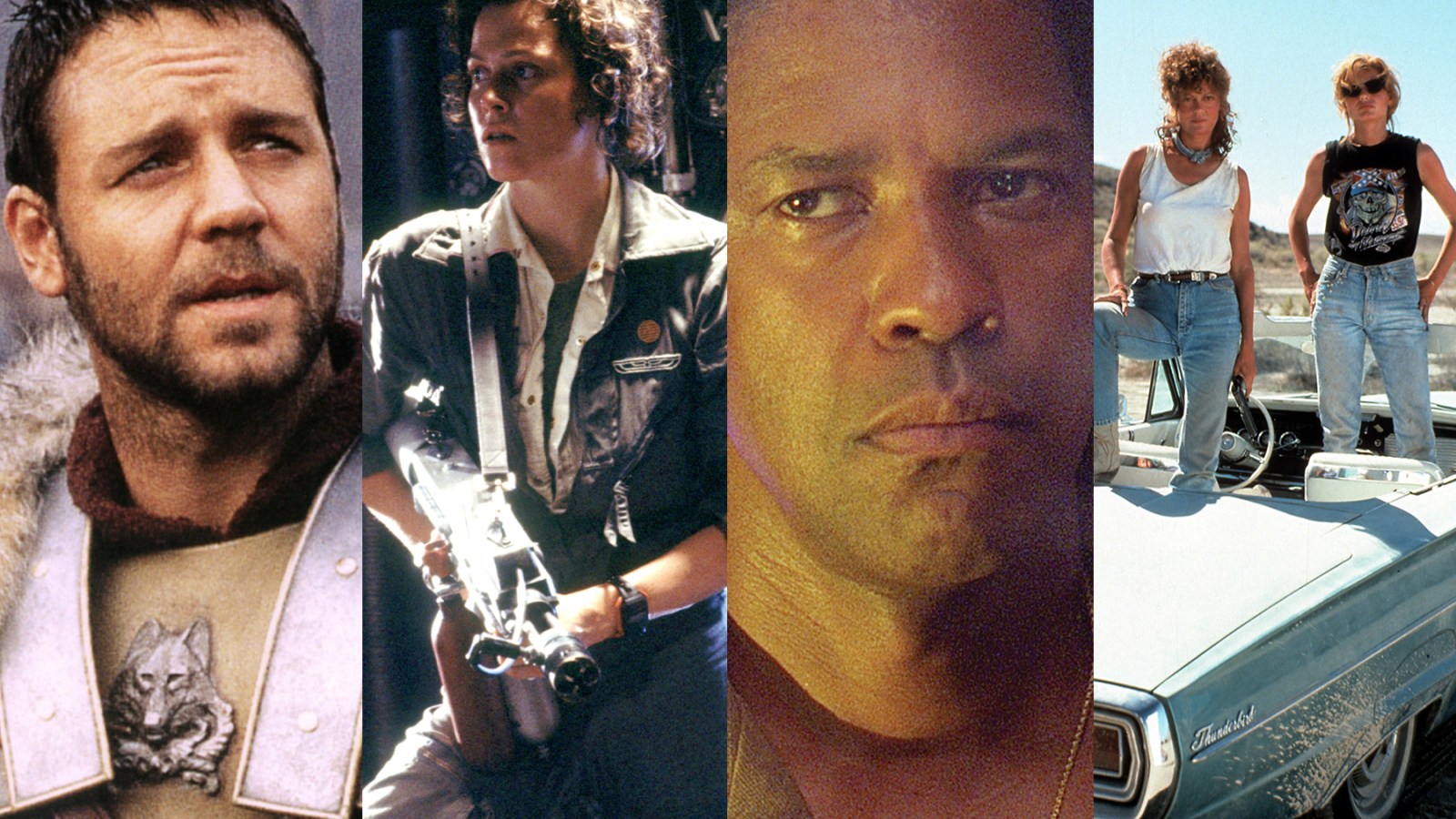
From biblical epics to Lady Gaga dramas, Black Hawk Down to Blade Runner — our complete rundown of Sir Ridley's greatest hits (and misses) Science-fiction landmarks, sword-and-sandal epics, slick neo-noirs, gritty crime thrillers, gory horror flicks, female-bonding road movies, war films, romantic comedies, lavish costume dramas, coming-of-age parables — Sir Ridley Scott has made virtually every type of movie you could imagine, short of musicals and Westerns. (And there’s a strong argument to be made that his latest, an adaptation of the dystopian novel The Dog Stars, is actually a Western in disguise.) He’s dealt with stories that take place 1300 B.C. and the 22nd century, giving respective screen time to Roman gladiator and paranoid androids, and has the ability to go from staging massive battle sequences to intimate conversations between two women on the open highway. Over a professional career that’s spanned five decades — six if you count his early days as a set designer for the BBC in the early 1960s and his prolific commercial work in the early 1970s — Scott has done it all. And the seemingly indefatigable 88-year-old filmmaker shows no sign of slowing down or stopping any time soon. The sheer diversity in Sir Ridley’s resumé doesn’t just apply to genres, however. It also extends to the subject of quality. Look back at his filmography, and you’ll find masterpieces, cinematic car wrecks, and everything in between. In the spirit of admiration, we present our ranked list of the best and worst of Ridley Scott’s features — the good, the great, and the not-so-great. All that’s left to say is that we stand by our placement of his vastly underrated gem The Counselor and we will not be taking questions at this time. ‘Exodus: Gods and Kings’ (2014) Image Credit: Twentieth Century Studios Look, people, it’s hard to make a biblical epic. It was hard in the 1920s and the 1950s, when movie audiences were likely more forgiving. And it was definitely hard in 2014, even if you can conjure up a cast of thousands with the click or a mouse. Scott may be one of the few modern filmmakers who can pull off period spectacle, as numerous entries on this list prove. But good lord — pun intended — this retelling of Moses leading his people out of slavery is atrocious enough to make audiences leave theaters in droves. You can’t say that Christian Bale isn’t 100-percent committed per usual to playing the prophet who goes from boyhood chum of Ramses II to B.C. revolutionary, though it’s a mystery as to why, given the cinematic chariot wreck of a movie all around him. The cast includes an A-list’s worth of stars — Joel Edgerton, Sigourney Weaver, Ben Kingsley, Aaron Paul, John Turturro, Ben Mendelsohn in high camp mode — and whether or not you think most of them should have been cast as Egyptians is a matter between you and your God(s). But the fact that they all have to say some truly cringeworthy dialogue in between crocodile attacks and avoiding giant CGI waves suggests there’s no divine providence present or accounted for here. —David Fear ‘Robin Hood’ (2010) Image Credit: David Appleby/Universal/Everett Collection Gritty reboots were all the rage in the late 2000s, which still doesn’t quite explain why anyone thought it would be a good idea to make a grimy historical epic about what Robin of Loxley was up to before he started robbing from the rich to give to the poor. Basically Gladiator without the crowdpleasing grandeur, Scott’s dubiously “realistic” origin story drains all the color out of the legend in favor of plodding political intrigue and generically muddy battle scenes. Firing more stony stares than arrows, Russell Crowe offers an exceptionally unplayful take on the folk hero; his lumbering archer makes Kevin Costner look like Errol Flynn. In the end, the only thing this Robin Hood steals is your precious time — 140 very long minutes of it. —A.A. Dowd ‘1492: Conquest of Paradise’ (1992) You can totally understand why Scott would have wanted to mount a massive production centered around Christopher Columbus, even if it hadn’t been the 500th anniversary of his inaugural journey to “the New World” — he’s a perfect subject for the lavish-costume-drama treatment. But the end result of Sir Ridley’s exploration of Columbus’s rise and eventual fall is as disastrous as the navigator’s attempt to establish colonial rule on the island he dubs San Salvador, if not quite as violent. The interactions among the indigenous tribes don’t seem to mesh with the palace intrigue happening back in Spain or the action sequences on land and sea; both Armand Assante and Michael Wincott’s respective villains constantly seem to be one mustache-twirl away from tying a damsel to railroad tracks; and though you’d have assumed that Gerard Depardieu would be the perfect choice to play the venerable captain, he seems oddly lost throughout. While we agree with Scott that American audiences should be more tolerant of European accents, the sheer indecipherability of much of his dialogue does not help matters. “What [Columbus] found was an earthly paradise,” the filmmaker said, “which became his hell.” His hell and, via this misbegotten project, moviegoers’. —DF ‘Legend’ (1985) Image Credit: Universal/Everett Collection Scott endured a few critical and commercial bombs in the early and mid-1980s. But whereas, say, Blade Runner has since been hailed as visionary, the director’s follow-up film has not — and for good reasons. There are commendable things about Legend, including its impressive practical effects and wizardly production design. But this stilted fantasy — full of elves, fairies, and a babyfaced Tom Cruise decked out in long hair as Jack O’ the Green — remains a confused jumble of different comic-book and fantasy influences. True to form, Scott would eventually release a longer director’s cut, but even that couldn’t save this honorable misfire. Just don’t tell Scott: “Legend still plays today,” he insisted in a 2015 interview. “Somebody said to me, ‘Why don’t you come to your senses and do something normal?’” Scott laughed. “I said, ‘I thought that was normal!’” —Tim Grierson ‘Someone to Watch Over Me’ (1987) Image Credit: ©Columbia Pictures/Everett Collection Police detective Mike Keegan (Tom Berenger) is tasked with protecting wealthy socialite Claire Gregory (Mimi Rogers) after she witnesses a mob boss murder. Despite his happy home life with his wife (played winningly by Lorraine Bracco) and a boisterous son, Mike falls for Claire, entangling himself in a nonsensical, morally ambiguous affair concocted by Scott and screenwriter Howard Franklin. It’s a generic neo-noir, with the kind of aesthetic that embodies late Eighties thrillers — from steam billowing from the grates as Mike strolls the late-night NYC streets to a soundtrack of nonstop jazz sax. No one seems to have been watching over this whatsoever. —Emily Zemler ‘Body of Lies’ (2008) Image Credit: Francois Duhamel/Warner Bros. This adaptation of David Ignatius’s 2007 novel was Scott’s attempt to offer a more nuanced portrait of the Middle East in the midst of post-9/11 tensions, while also interrogating the morally murky higher-ups who run the CIA. “These people play golf at the weekend,” the filmmaker said at the time. “They don’t walk around wearing suits of armor.” Casting frequent collaborator Russell Crowe as the untrustworthy handler of Leonardo DiCaprio’s virtuous field agent trying to catch a dangerous terrorist, Body of Lies epitomized Scott’s knack for riveting, efficient thrillers. But despite a welcome attempt to avoid demonizing the region, the plot ends up being too much of a jumble. As a result, Scott strands several fine actors — including Mark Strong as a savvy Jordanian agent and Golshifteh Farahani as DiCaprio’s romantic interest — in a well-meaning, disposable political potboiler. —TG ‘White Squall’ (1996) Part coming-of-age movie, part disaster flick, and part super-intense J. Crew commercial, Scott’s take on a real-life tragedy — in which a sailboat carrying a number of students was hit by a white squall in 1961 and suffered numerous fatalities — benefits from some serious leading-man star power and one of the more appealing baby-faced ensembles of the Clinton era. You know that Scott Wolf, Ryan Phillippe, Jeremy Sisto, and the rest of the under-21 ragtag gang will learn a few rough life lessons onboard the good ship Albatross before being chucked headfirst into adulthood. And, given the way that Scott gives Jeff Bridges a true hero’s entrance, that his Mr. Chips of the sea is the embodiment of a tough but empathetic father figure, which only makes the third act’s catastrophe all the more gutting. The squall itself allows Scott to flex his directorial muscles in a way that makes it a stand-out set piece. Everything else will feel very familiar. Very, very familiar. —DF ‘Kingdom of Heaven’ (2005) Image Credit: ©20thCentFox/Everett Collection Perhaps none of Scott’s films was helped more by an extended director’s cut than this flawed but fascinating widescreen epic set during the Crusades. Orlando Bloom plays Balian, a common French blacksmith who travels to Jerusalem, becoming a hero of the people in the process. The original version, released in theaters in May 2005, has the scope of a towering historical drama, but it shortchanges the character dynamics that would have given this would-be blockbuster an emotional underpinning. Later that year, Scott unveiled a longer version that stretched across more than three hours, allowing a massive ensemble — which included Eva Green and Edward Norton — more room to breathe. It’s the superior investment, although the director’s cut doesn’t entirely erase the original’s pacing problems or Bloom’s sturdy but uninspired lead performance. —TG ‘A Good Year’ (2006) Image Credit: ©20thCentFox/Everett Collection Were Scott’s unlikely romantic comedy — which reunited the director with Gladiator star Russell Crowe — released today, it would almost certainly top the streaming-content charts. The Oscar-winner plays a fast-talking, high-wealth London banker whose life is upended when his uncle dies, leaving him a run-down chateau and vineyard in Provence. The movie has everything you’d expect: a local love interest (Marion Cotillard), a surprise cousin who might upset the inheritance (Abbie Cornish), a secret wine vintage being sold on the black market, requisite scenes of the chateau’s makeover. There’s a genuine sweetness here that you rarely see from a filmmaker better known for his spectacles. It’s arguably the best Netflix film not made by Netflix. —EZ ‘Hannibal’ (2001) Jodie Foster might have moved on, declining to reprise her Silence of the Lambs role and taking all the emotional complexity of that Oscar-winner with her. But thankfully, Scott’s baroque sequel has a decadent flavor all its own. Racing through the lurid twists of its Thomas Harris source material, this globetrotting thriller presents a whole world gone as mad as on-the-lam Lecter (played, once more, by Anthony Hopkins, hammier than his literally porcine costars) once again plays cat-and-mouse games with FBI agent Clarice Starling, now played by Julianne Moore. Scott wheels out one excess after another: disfigured pedophiles, opulent Italian scenery, a Grand Guignol climax so hilariously gross it threatened to turn every popcorn bucket into a makeshift barf bag. If Lambs was Hollywood haute cuisine, Hannibal is like greasy fast food served on the good china. Sickos, at least, ate good. —AAD ‘Black Rain’ (1989) Image Credit: Paramount Pictures Pop quiz: What was Ridley Scott’s only legitimate box-office hit of the 1980s? It was this super-stylish, ultra-cool, fairly superficial crime-thriller, which starred Michael Douglas as Nick, a hardened New York detective, who travels to Osaka with his partner (Andy Garcia) to deliver a Yakuza hit man to local authorities. The hand-off goes badly, however, leading to a kinetic fish-out-of-water action film in which Nick must acquaint himself with how law and order works in Japan. Scott wasn’t trying to beat the allegations that he was all flash and no substance, but despite its obvious shortcomings, the neon-flecked Black Rain has its B-movie kicks while confidently putting butts in seats. —TG ‘House of Gucci’ (2021) Image Credit: Fabio Lovino/Metro-Goldwyn-Mayer Pictures Inc. Part biopic and part crime drama, House of Gucci finally saw Scott documenting the Gucci dynasty after acquiring the rights to Sara Gay Forden’s 2001 book The House of Gucci: A Sensational Story of Murder, Madness, Glamour, and Greed years prior. And boy, did he go big, casting Lady Gaga as Patrizia Reggiani, the eventual wife of the fashion label’s heir Maurizio Gucci (Adam Driver, doing his absolute best with an unwieldy accent). The costumes, hair and makeup and sets are as ornately-wrought as the acting, and there is no question that Scott brought the absolute maximalist sense of dramatic camp to the production. It’s sensationalist filmmaking in the best possible way, even if it does feature one of Jared Leto’s most annoying performances to date. —EZ ‘All the Money in the World’ (2017) Image Credit: Giles Keyte/TriStar Pictures/Everett Collection Scott film about the infamous kidnapping of John Paul Getty III — and his grandfather J. Paul Getty’s refusal to pay the ransom — is probably better known for the drama that happened behind the scenes than what’s onscreen. He’d originally cast Kevin Spacey as the elder Getty; sexual misconduct allegations were then made against the actor shortly after production wrapped. Scott was forced to recast the role with Christopher Plummer and reshoot all of the character’s scenes in only eight days. Yet the result is uncannily seamless, and serves as evidence of Scott’s dexterity as a filmmaker. Plummer is powerfully captivating in the role, for which he was nominated for an Oscar, BAFTA, and Golden Globe. But it’s Michelle Williams, as the kidnapped Getty’s mother Gail Harris, who steals the show. —EZ ‘Napoleon’ (2023) Image Credit: Aidan Monaghan/Apple In his later films, Scott has expressed profound misgivings about the Great Man Theory, turning works like All the Money in the World and House of Gucci into sly critiques of ambitious, morally blinkered men. There’s a sharp sense of satire coursing through this biopic as well, which views Napoleon Bonaparte as a tyrant ruled by his grievances and insecurities. Joaquin Phoenix is perfect casting: The Oscar-winning star resists playing Napoleon as any kind of stirring leader, instead seizing on the man’s miserly, petty demeanor. Not that Scott has lost any of his formidable skill at staging epic battle scenes, but even here Napoleon seeks to undercut the myth of the brilliant military tactician. If anything, the movie works best as a tart dark comedy, with Vanessa Kirby venomous as Napoleon’s faithless beloved Joséphine, who proves to be the more coldblooded strategist of the two. —TG ‘Matchstick Men’ (2003) Image Credit: Warner Bros Fizzy entertainments aren’t exactly a Ridley Scott specialty — which makes this funny, twisty Nicolas Cage vehicle a welcome exception. Not that it’s a perfectly natural pivot: The freeze frames and jittery transitions come across like a labored impersonation of Ocean’s-era Steven Soderbergh, even if they’re just meant to evoke the OCD of Cage’s character, a con man whose big score is complicated by the appearance of a daughter (Alison Lohman) he didn’t know he had. But even a little overdirection can’t spoil the pleasures of a caper that pulls the rug out from under the audience without making us feel like suckers for investing in its relationships. For all his indulgent twitchiness and typically outsized line readings (“Have you ever been dragged to the sidewalk and beaten till you… PISSED BLOOD?”), Cage provides an aching humanity that Scott’s genre exercises sometimes lack. —AAD ‘Alien: Covenant’ (2017) Image Credit: Mark Rogers/Twentieth Century Studios Yes, it’s more of an Alien movie, in the traditionally gnashing sense, than Prometheus was. In fashioning a second prequel to his seminal cosmic nightmare, Scott delivers the obligatory multi-mouthed mayhem the franchise-branded title promises. But he also reaches back much further than 1979, tracing the roots of the series he launched to the origins of science fiction itself: By the time another doomed crew stumbles upon a downed ship with the ambience of a gothic manor, it’s clear that the director is putting a modern spin on The Modern Prometheus. He even finds a Frankenstein figure in David, one of two synthetics — identical in appearance but not motivation — played by Michael Fassbender. Much more than the uptick in Xenomorph fan service, it’s the star’s kinky double turn that doubles the fun here. —AAD ‘The Last Duel’ (2021) Image Credit: Patrick Redmond/20th Century Studios Four decades after his celebrated debut, Scott circled back to French duellists — this time, by dramatizing the legendary conflict between a knight (Matt Damon) and a squire (Adam Driver) who fight to the death over the allegations leveled by the former’s wife (Jodie Comer). The screenplay by Damon, costar Ben Affleck, and indie filmmaker Nicole Holofcener retells this true story from, well, dueling perspectives, offering three versions of events and essentially allowing the actors to essentially deliver three distinct performances. Though the structure superficially recalls Rashomon, the film is less a riff than a rebuttal, dismissing the notion that truth is inherently subjective — because who does that really serve but those hoping to obscure it? The trial-by-combat climax is brutal (a vintage Scott knock-down, drag-out set piece), but no more so than the spectacle of a woman dragged through the court of he-said, she-said skepticism. —AAD ‘Prometheus’ (2012) Image Credit: 20th Century Fox After watching a few too many directors try their hand at Alien sequels, the man behind the unimpeachable original returned to the franchise he birthed — and delivered a grand, somber prequel. Set roughly 30 years before Scott’s 1979’s sci-fi landmark, Prometheus takes its time unveiling the frightening xenomorphs we’ve come to love and dread. But that elegant delay just permits Scott the space to build tension as we meet a wholly new crew, highlighted by the haughty, strangely soulful android David, played by a Peter O’Toole-channeling Michael Fassbender. Then comes the terror, which is as steely and visceral as in the first Alien. Rarely has a filmmaker so comfortably revisited a past triumph, bringing an older, warier perspective on humanity’s eternal hubris and endless capacity for self-destruction. —TG ‘G.I. Jane’ (1997) Image Credit: ©Buena Vista Pictures/Everett Collection Lieutenant Jordan O’Neill never asked to be a pawn in a political power struggle — this intelligence analyst is simply trying to get through the American military’s toughest, most brutal training course and become a member of an elite unit that bears a striking resemblance to the Navy SEALs. If she happens to break glass ceilings in a notoriously misogynist environment (embodied by Viggo Mortensen’s gung-ho Master Sergeant), so be it. Scott’s torn-from-the-headlines drama about female integration in the armed services is best remembered as the film in which Demi Moore shaves her head onscreen. But it’s really a testament to the star’s overall commitment to give 100-percent to matching the character’s physical endurance; watching Moore do one-armed push-ups and rapid pull-ups, you can see the lines blur between the onscreen groundbreaker and the woman playing her. You wouldn’t call Sir Ridley’s take on the then-controversial subject of gender equality in the military subtle, but it is effective. And the last 20 minutes, in which O’Neill and her team must save trapped soldiers in Libya, plays like a dry run for what Scott would do a few years later in Black Hawk Down. —D.F. ‘Gladiator II’ (2024) Image Credit: Aidan Monaghan/Paramount Pictures Both Scott and Russell Crowe had been toying with the idea of a sequel to their 2000 Oscar-winner epic for years; the latter had even commissioned a script from Nick Cave, which ended up being not quite right (but quite a trip). But Sir Ridley was determined to continue the story in some way, given how popular the film remained. When he finally hit upon a story involving Maximus’s now-grown son fighting in the pits, however, the filmmaker was ready to return to the arena — and thank the gods he did. This continuation of the sword-and-sandal saga gives Paul Mescal a choice role as Lucius Aurelius, a commoner sold into slavery to the Romans who turns out to be a first-rate gladiator. There’s thrills, chills, a few jaw-dropping sequences (that faux-naval battle!), and Fred Hechinger getting to go full Caligula as a mad emperor. But let’s not kid ourselves: This is Denzel Washington’s movie, and from the moment he enters the picture, the veteran star owns Gladiator II. His heel turn here as a power-broker with his eyes on the political prize is one of his best performances, full stop. That alone earns the movie this high ranking. —DF ‘Black Hawk Down’ (2001) A military procedural shot like a disaster film (or maybe vice versa), Scott’s harrowing adaption of Mark Bowden’s book on the Battle of Mogadishu — in which a 1993 military raid to capture Somali militia leaders turned into a two-day standoff and resulted in the loss of American lives — still makes you feel like you’ve dropped into an active combat zone. The you-are-there-feeling of the film’s FUBAR-operation second half is nothing if not designed for maximum nerve jangling. Scott is clearly chasing the adrenalized experience of being under fire as much as he’s retelling a narrative. And the fact that he’s stocked the cast with a who’s who of recognizable faces — Ewan McGregor, Josh Hartnett, Orlando Bloom, Sam Shephard, Eric Bana, Jeremy Piven, Tom Sizemore, Jason Isaacs — helps alleviate some of the criticism that you don’t get enough time with the individual troops before the shit hits the fan. —D.F. ‘American Gangster’ (2007) Image Credit: David Lee Sir Ridley gave Denzel Washington one of his best roles in this based-on-a-true-story drama about Frank Lucas, the notorious Harlem kingpin who quietly built an empire in the 1970s by smuggling heroin into America from Vietnam. That rise-and-fall-of-a-gangster saga would have been enough for Scott to mount a throwback epic on its own, but the director also devotes screen time to Richie Robert (Russell Crowe), the Newark detective who formed the task force that’d eventually take Frank down. Scott flips between these parallel storylines so much that you wonder if he’s trying to do his own versions of The Godfather and The French Connection simultaneously; by the time the two strands converge, the filmmaker has already given us a woozy look at crime and the city that doubles down on the grit. The sequence in which Washington guns down a rival in the street while barely batting an eye is enough to earn this one a spot in the Top 10. —D.F. ‘The Counselor’ (2013) Image Credit: Kerry Brown/20thCentFox/Everett Collection Say what you will about Cormac McCarthy’s only original screenplay, a twisty crime thriller involving a lawyer (Michael Fassbender), Mexican cartels, and the consequences of chasing the American dream via the south-of-the-border drug trade: Ridley Scott knows exactly how to translate the author’s singular voice to the screen. (The fact that he was never able to get his adaptation of Blood Meridian off the ground is a stone-cold tragedy.) One of the more divisive entries in Scott’s extensive filmography — which is saying something — this sleek neo-noir about a deal gone wrong that literally causes heads to role looks couldn’t feel chillier or more brutal, which only makes its pitiless take on late-capitalism run amuck feel that much more in line with McCarthy’s stark, end-of-days worldview. The movie also looks like a million bucks, has a helluva cast (Brad Pitt, Javier Bardem, Penelope Cruz), and wears its 21st century nihilism on its custom-tailored sleeve. And should you think Sir Ridley is afraid to get weird, he also takes a time out so a Cameron Diaz can make love to a car’s windshield. It’s even stranger and more unseltting than it sounds. A vastly underrated gem. —D.F. ‘The Duellists’ (1977) Image Credit: ©Paramount/Everett Collection How else but with the clang of steel could Sir. Ridley have kicked off his career? Scott chronicles a grudge match of mounting absurdity — the increasingly farcical tale of a French soldier (Keith Carradine) hounded by a fellow officer (Harvey Keitel) who keeps challenging him, for literal decades and for reasons he never articulates, to a fight to the death. This perverse and characteristically gorgeous historical drama paints a senseless rivalry — reignited every few years without fail — as a cautionary tale about adhering to pointless codes of honor no matter the risk. Scott would soon permanently pivot to Hollywood concerns, but his Cannes-feted debut echoes throughout his filmography. —A.A.D. ‘The Martian’ (2015) Image Credit: Twentieth Century Fox Even star Matt Damon had to laugh when the Golden Globes marooned his epic, galaxy-crossing survival thriller in the comedy category. Still, there are jokes aplenty in this adaptation of the first hard-science bestseller from author Andy Weir, in which Damon’s botanist gets stranded alone on Mars and has to figure out a way to “science the shit out of” his dilemma. Crosscutting between his stubbornly persevering hero and an ensemble of movie stars (Jessica Chastain, Chiwetel Ejiofor, Kristen Wiig, Sebastian Stan, Donald Glover, Jeff Daniels) scrambling on the other side of the solar system, Scott emerges with a stirring ode to collaboration, science, and “working the problem.” It’s like Apollo 13 on an even grander scale. ‘Gladiator’ (2000) Image Credit: ©DreamWorks/Everett Collection It was a throwback to a long-retired 20th century movie staple — the sword-and-sandal epic — and damned if Ridley Scott didn’t temporarily restore our faith in a genre left for dead. Russell Crowe was at the peak of his Movie Star phase when he played Maximus Meridius, a Roman general who’s betrayed by self-proclaimed new-emperor-in-town Commodus (Joaquin Phoenix, in what feels like an early warm-up for his nutty Napoleon) and ends up fighting in the gladiatorial arena. There are bloody showdowns involving spears, battle-axes, chariots and angry tigers, and to answer the rhetorical question Maximus asks: Yes, we were entertained! What’s surprising is how moved we also were by warrior-turned-widower’s quest for vengeance, which has a lot to do with Crowe’s moody matinee-idol performance and Scott’s balance of big spectacle and human-sized drama. —D.F. ‘Thelma and Louise’ (1991) It’s the ending everyone talks about — a literal photo finish of outlaws putting pedal to metal, frozen in fatalistic triumph like Butch and Sundance for a new generation. But that iconic parting snapshot is just the final note of the honky-tonk symphony Scott plays with this slick, emotionally vibrant crowdpleaser about two friends pushed over the line and forced to go on the lam by the compounding cruelties of a sexist world. Geena Davis and Susan Sarandon scored equally deserving Best Actress nominations as the title characters, always three-dimensional even as Thelma and Louise become more mythically righteous in the home stretch. (For all the men who ogle our heroines throughout, the movie’s own leering gaze lands only on a young heartthrob named Brad Pitt, whose small role as a hunky hitchhiker rocketed the 27-year-old to stardom overnight.) Coming from a director who often looks to the past or future, it was a welcome gearshift into modern concerns. —ADD ‘Blade Runner’ (1982) Image Credit: Sunset Boulevard/Corbis/Getty Images Flesh and blood or just good circuitry? Decades later, fans keep turning that origami over in their hands, searching for clues to the true nature of Rick Deckard, the hero of Scott’s genre-redefining dystopian noir. (To this day, even the director and star can’t agree on what’s ticking behind the detective’s shifting eyes.) One thing’s for sure: Deckard feels less deeply than his quarry, an escaped chain gang of misfit toys, more human than human in their neurotic fear of “retirement.” When Rutger Hauer’s simultaneously terrifying and tragic replicant leader bares his soul in the rain, he becomes an emblem of the whole seductive enterprise: sleekly cold-blooded on the surface, but with a heartbeat of warm synth underneath. Every bit as influential in its grungy vision of the future as the deep-space classic Scott made right before it (see No. 1 below), Blade Runner burns very, very brightly still. You don’t need a Voight-Kampff machine to see its wounded humanity. —A.A.D ‘Alien’ (1979) Image Credit: Twentieth Century Fox “In space, no one can hear you scream.” Scott’s second movie set the bar not just for the rest of his career, but for every movie that’s ever attempted to mix horror and hard sci-fi — it’s the ultimate haunted-house-in-space story, featuring a revolutionary female hero in Sigourney Weaver’s Ripley, a peerless ensemble cast (Tom Skerritt! Yaphet Kotto! Veronica Cartwright! Harry Freakin’ Dean Stanton!!!) and introducing a creature that would prove to be both culturally durable and iconic. Like the monster itself, Alien takes its time and toys with its prey before going in for the kill, slowly introducing the crew and giving audiences a chance to take in its “dirty space” aesthetic. Once John Hurt gives birth to a bouncing baby Xenomorph though his chest, however? Oh, it’s on. When Ian Holm’s paranoid android describes the ship’s apex-predator stowaway as “a perfect organism,” he could be talking about Scott’s film itself. —D.F.
Ridley Scott’s Movies, Ranked Worst to Best
Full Article
Original Source
Read the full article at Rollingstone →KhanList aggregates and links to publicly available news content. We do not host full articles from third-party sources. Always verify important information with original sources.