
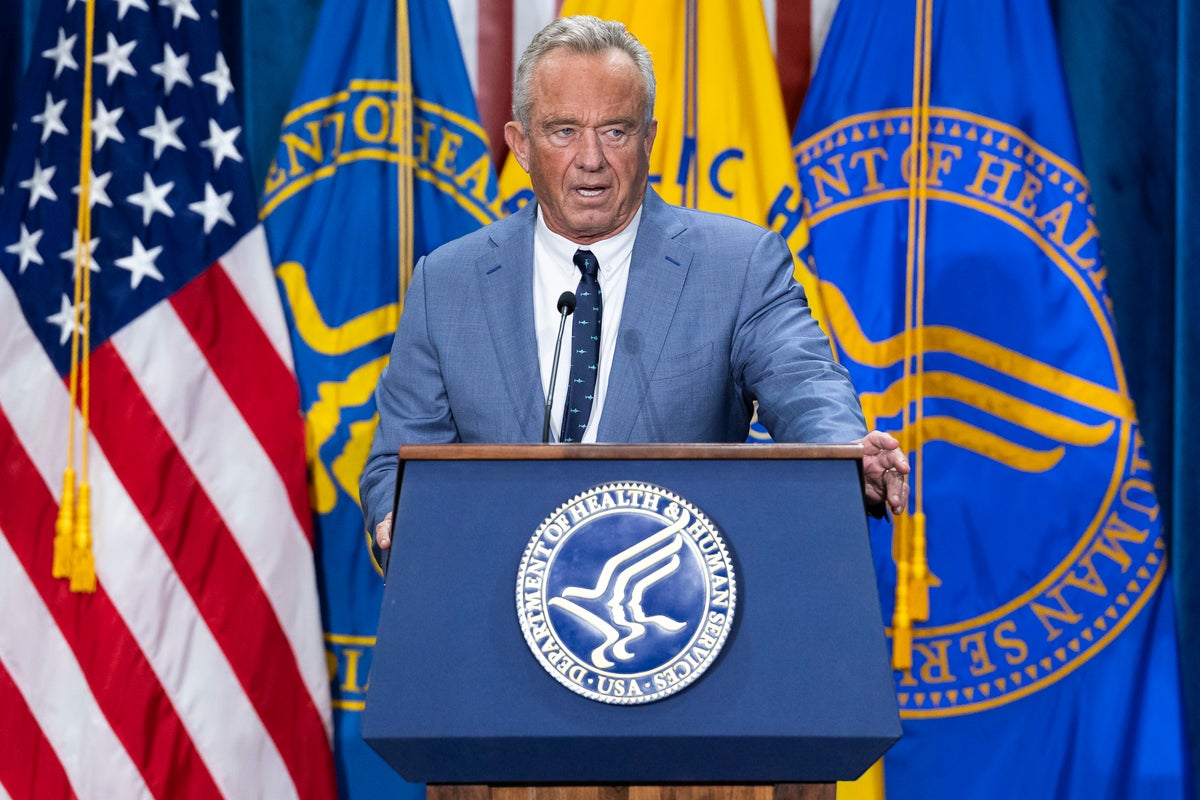
Health Secretary Robert F. Kennedy Jr’s vaccine skeptical views influenced the decision to shelve the U.S. bird flu response plan, insiders have said.The H5N1 virus infected 70 people and killed one person as it spread aggressively among cattle herds and poultry flocks last year. The disease has killed some 200 million birds since 2022 and contributed to the record high egg prices seen in early 2025.The Agriculture Department unveiled a $1bn strategy to curb the disease last February, including $500m set aside for biosecurity measures, $400m in relief for farmers and $100m for vaccine research, reducing regulation and exploring import options.But five people with knowledge of the matter told Politico that agriculture secretary Brooke Rollins was concerned that an internal strategy for vaccinating poultry and egg-laying hens would clash with RFK’s anti-vaccine views.U.S. Secretary of Health and Human Services Robert F. Kennedy Jr pictured in Washington DC on 5 October (Getty)The department had hoped to share the strategy widely with foreign countries and foreign leaders in a bid to curb the spread of the highly pathogenic disease, the outlet reported on Tuesday.Kennedy publicly disavowed the idea of vaccinating chickens and last March proposed letting the disease “run through the flock” to identify birds with natural immunity, even as the USDA gave conditional approval for a vaccine.Rollins at the time told CBS News they could pilot the natural immunity idea with a number of willing farmers, despite backlash from veterinary experts.Dr. Gail Hansen, a former state veterinarian for Kansas, told the New York Times that the plan was a “really terrible idea, for any one of a number of reasons”.If H5N1 could run through a flock of five million birds, it would represent five millions chances for that virus to replicate or to mutate, increasing the likelihood of the virus spreading and affecting farm workers or other animals, she explained.Eggs for sale at $0.66 per egg from a supermarket on February 10, 2025 in Monterey Park, California (AFP/Getty)“So now you’re setting yourself up for bad things to happen. It’s a recipe for disaster,” she said.Insiders said that Rollins had nonetheless urged the importance of a comprehensive vaccination strategy, and asked her veterinary services staff to have an internal plan completed by June of last year.One person with knowledge of the situation told Politico that the strategy already had the technical and communication aspects in place by summer of last year, but the final document ended up only being circulated with fewer “than a dozen people”.In the U.S., as many as 107 outbreaks had been reported by November of last year, nearly four times the number a year prior. In Europe, the situation was also more severe than the year prior, with Germany recording the highest number of outbreaks in three years.Between early September and mid-November, 1,443 cases of bird flu were detected in wild birds in 26 European countries - a fourfold increase compared with the same period in 2024 and the highest since 2016, the European food safety agency EFSA said.Kennedy publicly disavowed the idea of vaccinating chickens and last March proposed letting the disease “run through the flock” to identify birds with natural immunity, even as the USDA gave conditional approval for a vaccine. (AFP/Getty)Earlier this year, officials told Reuters that the Health Secretary had tried to divert $5bn from the National Institutes of Health to investigate the long-debunked theory that vaccines cause autism - a plan that would have consumed over a tenth of the agency’s annual budget.The idea was ultimately shelved after NIH Director Jay Bhattacharya persuaded Kennedy that the agency was already investing heavily in autism research, including a $50 million initiative launched last September to study the condition's causes.According to eight current and former officials, Kennedy has continued searching for evidence to support his long-held belief that many vaccines are inadequately tested and can cause serious side effects, even after publicly agreeing to avoid discussing vaccines following concerns from senior White House aides that his views could become a political liability for Republicans.
RFK Jr’s anti-vaccine views influenced decision to shelve U.S. bird flu response plan, sources say
Full Article
Original Source
Read the full article at Independent →KhanList aggregates and links to publicly available news content. We do not host full articles from third-party sources. Always verify important information with original sources.