
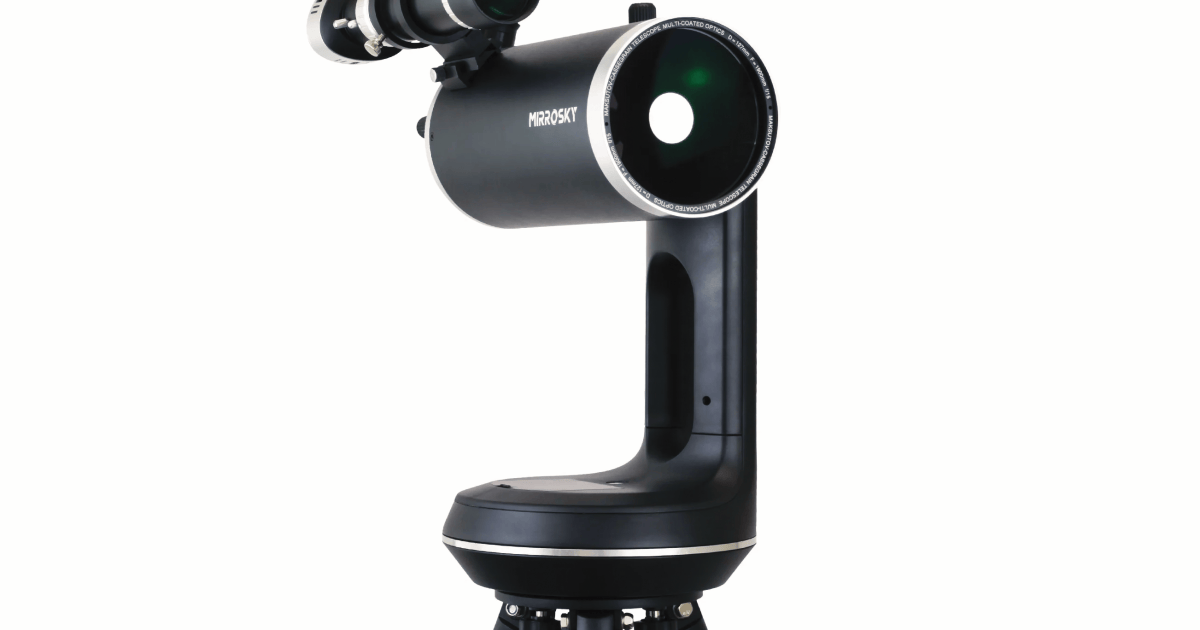
Credit: Spectrum Optics The smart telescope revolution has grown rapidly over the past few years. Most of these scopes focus primarily on electronic imaging, though, and while amateur astronomers may marvel at the images, they also still enjoy the simple pleasure of looking directly through a telescope. That’s where the SkyPilot 127 from Spectrum Optics ($999) takes a different approach. Rather than replacing direct observing with a screen-based experience, the SP127 combines a traditional 5-inch (127 millimeters) f/15 Maksutov-Cassegrain telescope with a smart guidance and imaging system. Dual purpose At first glance, the SP127 looks like a conventional catadioptric with a standard finder on a motorized alt-azimuth mount. But looks can be deceiving. The secret lies in that “finder.” On closer inspection, it is not a finder at all, but a 2.1-inch (53 mm) f/4 ED refractor outfitted with a digital camera. This second optical tube is the heart of the SP127’s electronically assisted system, serving as both guide scope and imager. The guide scope determines the telescope’s position through plate solving, slews to selected targets, maintains tracking, and captures images. Spectrum Optics also includes the same intelligent camera and 53 mm refractor in its separately sold SPi53 Smart Telescope system. The camera is built around a Sony IMX662 CMOS color sensor with 2.9-micrometer pixels and a resolution of 1920×1080 pixels. It includes 64 gigabytes of onboard storage. The MirroSky app, available for iOS and Android, is central to the SP127’s operation. It controls target selection, image capture, live stacking, and display, while the guide scope and camera work together to find objects and produce live-stacked images. Meanwhile, the Maksutov is dedicated primarily to visual observing. The optical tube weighs approximately 6.5 pounds (2.95 kilograms) and measures 14.6 inches (370 mm) long. A Vixen-style dovetail makes it easy to remove the optical tube from the mount. Total weight for the assembled SP127 is about 26 pounds (11.8 kg). In addition to the guide scope/imager, the SP127 comes with a 25 mm Plössl eyepiece, a 90° 1¼” star diagonal, a screw-on visual back, an adjustable tripod with steel legs 1.5 inches (3.8 centimeters) in diameter, cables, an AC adapter, and a Bahtinov focusing mask for the guide scope. The camera’s nosepiece is also internally threaded to accept standard 1¼” filters. In its standard configuration, the included camera photographs through the 53 mm refractor rather than the Maksutov. Although the camera is removable, Spectrum Optics recommends a separate camera for imaging through the Maksutov because its long focal length and narrow field are not well-suited to the included camera’s plate-solving system. That doesn’t mean you have to invest in more equipment, though; I took some very nice shots of the Moon simply by holding my iPhone to the Mak’s 25 mm eyepiece. The SP127’s hybrid arrangement works well in practice. After the user selects a target in the app, the guide scope directs the mount to the correct location, then tracks the sky. The observer can view the target visually through the Maksutov while the guide scope stacks and displays images via the app. A word of caution, however: Be careful not to shake the instrument when looking through the eyepiece. Even a slight motion will blur the image being photographed. Like most Maksutov-Cassegrain systems, the SP127 excels at medium and high magnifications. Its 1,900 mm focal length is especially well-suited for observing the Moon, planets, planetary nebulae, and double stars. Product Information Spectrum Optics MirroSky SkyPilot SP127 Primary Optical Tube: 5-inch 127mm Maksutov-Cassegrain Focal Length: 1900mm Length: 14.6 inches (370 mm) Focal Ratio: f/15 Guide Scope Optical Tube: 53mm ED refractor with Sony IMX662 CMOS camera Focal Length: 200mm Focal Ratio: f/4 Assembled Weight: 26 lbs. (11.8 kg) Mount Payload: 9 lbs. (4 kg) Connectivity: built-in Wi-Fi, 2.4 and 5 GHz Camera Storage: 64GB onboard storage Tripod: Full-size adjustable steel-leg tripod Eyepiece: 25mm Plössl Price: $999.99 Contact: Spectrum Optics 2175 S Grand Ave Santa Ana, CA 92705 1-888-879-5143 spectrumoi.com Trial run For this review, I arranged to receive a sample SP127 directly from Spectrum Optics. It arrived securely packed and in perfect condition. Setup was easy, thanks to the well-illustrated paper manual that came with the scope. After I aligned the guide scope with the Maksutov during the day, as the instructions suggested, the scope was ready to go. I had everything together in under half an hour. Control is handled entirely through the MirroSky app. To initialize the scope to the sky, the system uses onboard sensors combined with date, time, and location information supplied by the connected smart device. The camera includes dual-band Wi‑Fi capability supporting both 2.4 and 5 gigahertz connections. During use, the app’s interface was straightforward and easy to navigate. Target acquisition was quick and accurate. Chosen objects were always centered in the field of view. The app also provides guided tours and a database containing more than 100,000 stars, solar system members, and deep-sky sights. Tracking performance was accurate for visual observations and short-exposure imaging. Since the SP127 uses an alt-azimuth mount, field rotation may become evident around the edges with longer exposures. The SP127 can be powered by eight user-supplied AA batteries in the mount, a suitable external 12-volt power source, or the included AC adapter. A separate camera is recommended for imaging through the SP127’s Maksutov-Cassegrain scope, but the author was able to capture images of the Moon by simply holding his phone to the eyepiece. Credit: Phil Harrington I found that the Maksutov performed very well. Lunar views were well-defined, with crater walls, rilles, and other surface features standing out crisply. I was especially impressed when, in moments of steady seeing, the SP127 detected a few of the craterlets on the floor of Plato. It passed another tough test by resolving Schröter’s Valley, a sinuous rille near craters Aristarchus and Herodotus. Planetary performance also proved impressive. Multiple cloud bands as well as the Great Red Spot were clearly visible on Jupiter, and shadows cast by Galilean moons could also be seen on the planet’s cloud tops. Double stars were another strong point, thanks to the long focal length. The Trapezium in the Orion Nebula, for instance, was striking. The included eyepiece did well, but the view really sparkled when I swapped in my own eyepieces with shorter focal lengths. Despite light-polluted skies, the SP127 produced a vivid image of the Orion Nebula (M42) with only a few minutes’ exposure. Credit: Phil Harrington Throughout it all, I was very impressed with the crispness of the images, showing the high quality of the Maksutov’s optics. Like most catadioptric telescopes, the SP127 focuses by moving the primary mirror. This takes tight manufacturing tolerances to maintain a precise focus without tilting the mirror. I found that alignment stayed spot-on after swapping eyepieces and refocusing the view. I was equally impressed with the imaging results using the 53 mm guide scope. The app allows you to customize settings, including gain, exposure length, number of frames to capture, and dark frames. After I experimented with the settings, the Orion Nebula appeared in vivid color after only two minutes of exposure, even as it was setting in my light-polluted sky. The Pleiades also recorded beautifully, although not all members squeezed into the guide scope’s approximately 1.6° by 0.9° field. The Horsehead Nebula, the Whirlpool Galaxy, the Great Globular Cluster in Hercules, and more displayed details exceeding what you might expect from such a small aperture, especially after post-processing using apps like PixInsight, GIMP, and Photoshop. Final thoughts The SkyPilot 127 is one of the most original entries in today’s smart telescope market. For observers who still enjoy looking through an eyepiece but appreciate the convenience of app-driven targeting and imaging, the SP127 offers something genuinely special. In a small but growing group of smart telescopes that combine traditional eyepiece observing with integrated electronic imaging, the SP127’s hybrid design makes it an appealing bridge between conventional astronomy and the smart telescope revolution. Contributing Editor Phil Harrington received the Walter Scott Houston Award in 2018 for his lifelong work in astronomy.
REVIEW: Spectrum Optics SkyPilot 127
Full Article
Original Source
Read the full article at Astronomy →KhanList aggregates and links to publicly available news content. We do not host full articles from third-party sources. Always verify important information with original sources.