
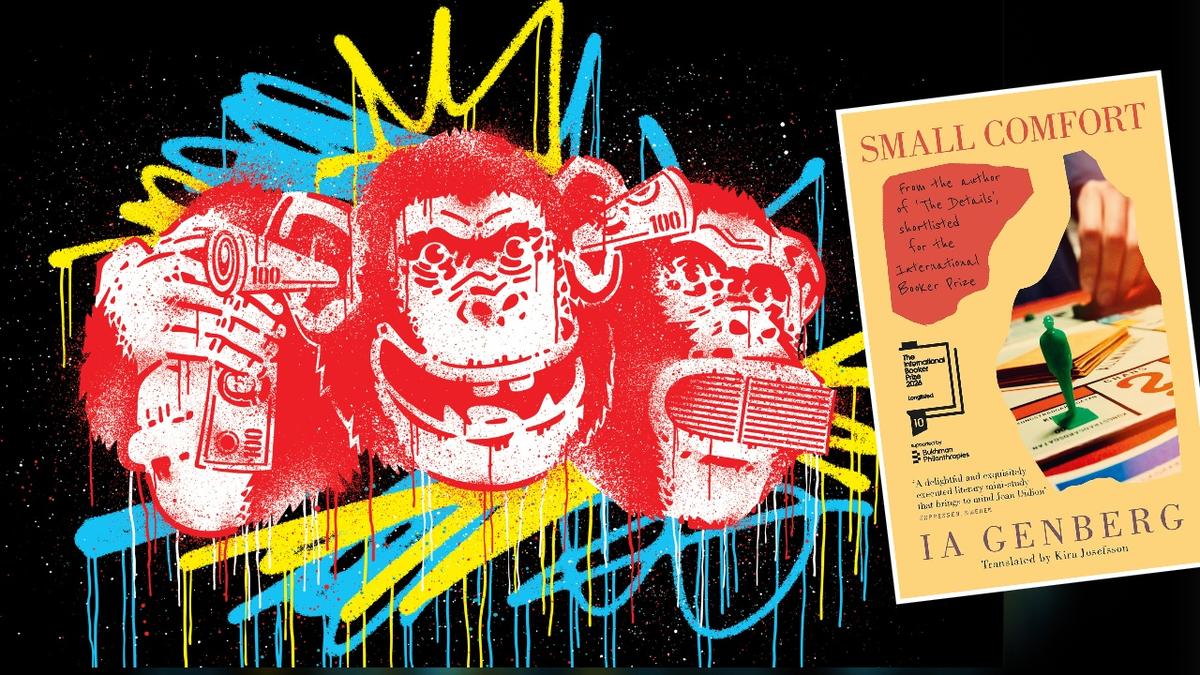
Two people are asked to play Monopoly. Before the game begins, one player is given more money, resources and opportunities to move around the board. The other is left to make do with less. In the end, the richer player is ruder, more callous and less empathetic.This was what a famous experiment by psychologist Paul Piff at the University of California, Berkeley, found in the 2010s. Swedish novelist Ia Genberg examines this revelation by making it the central argument in her anthology, Small Comfort, longlisted for this year’s International Booker Prize. Translated by Kira Josefsson, the book is a strange, exhilarating and sharply funny set of five interconnected stories about what money does to our moral, emotional and social lives.The book is quite an ambitious experiment. Genberg stitches five stories together to sift the idea from radically different perspectives. There is a hunchbacked man who was once a famous child actor, a pharmaceutical employee involved in bribery, a possible assassin hired by the mother of a drug addict, a fictional scientist studying people playing rigged Monopoly and a writer-cum-cab driver who stays married in the hope of inheriting some of his wife’s bequest.But Genberg’s question soon grows beyond whether money makes us worse people. What happens when the economically powerful get to define success, respectability and worth? And what happens when the people at the margins refuse to accept those definitions thrust upon them? Translator Kira Josefsson and author Ia Genberg with their shortlisted book ‘The Details’ at the 2024 International Booker Prize ceremony in London. | Photo Credit: Getty Images The anticipation of violenceWhat I specifically liked was Genberg’s use of language, almost like a surgeon’s scalpel, cutting through layer after layer of deceit, self-delusion or moral compromise. Take ‘Success Greger’, the first story, for instance. Greger Johnson, once a child actor, then a car thief and junk dealer who has also dug for gold in Australia, is a slippery character who code-switches every few pages. He also anticipates and challenges the assumptions being made about him while being interviewed by a journalist, also named Ia Genberg, making it a thrilling piece of metafiction.Knowing that his words will be taken apart and rearranged, Greger objects to the journalist’s impulse to impose coherence on his life. At one point, he says, “That’s because you’re a journalist. You guys arrange stories that way, as if everything is finished with a bow tied on top. But the real world isn’t whole like that. It’s totally f***ing half. Unfinished, like your name.”It is a revealing moment because Greger rejects the hierarchies that people comfortably use to judge him. As someone at the fringes, constantly moving between identities, he turns the interview into a power struggle over who gets to decide what his life means. The journalist wants a cogent story; Greger insists on contradiction. And behind that struggle, Genberg raises a pertinent question: if money gives some people power, does it also give them the power to decide what counts as a successful, respectable or worthwhile life?Another reason I really enjoyed the book is that each story takes a different form — a letter, a speech, a transcript, research notes — which are used to interrogate the machinery of meaning we implicitly rely on to understand people and their lives. Who gets to speak? Who gets believed? Who gets to arrange the facts into a story and call it the truth?What keeps the book ticking, at least in the interview with Greger, and in subsequent stories that include an assassin’s speech and a letter announcing a pharmaceutical employee’s death, is the anticipation of violence. There is always a looming threat. In two of the stories, a character narrates an act of violence that happened to somebody else. But their irreverence, evasions and refusal to behave as expected create a delicious sense of danger. Form over matterIt is also to the translator’s credit that the English version is taut, as I assume the original would be. Josefsson, who also translated Genberg’s 2024 International Booker-shortlisted novel, The Details, preserves the distinct tones and registers of each story, allowing every character to sound like a commanding performer—sometimes for the reader, sometimes for another character and often for themselves.Genberg herself admits in an interview to the International Booker committee that she couldn’t quite manage to make one story flow naturally into the next. That showed. The research notes documenting the Monopoly experiment, and the eponymous final story, fail to reach the pitch at which Genberg begins the book. Also, the formal experimentation did occasionally feel more interesting than the material it contains.Still, Small Comfort is an absolutely worthy read for the hypercapitalist times we live in. It starts with the idea of empathy, but by the end, it leaves you wondering whether any of us is truly incorruptible in the face of our need for money — without offering any answers. Small Comfort Ia Genberg, trs Kira JosefssonWildfire Books₹699The reviewer is a freelance journalist with bylines in leading international and Indian publications.
Review | ‘Small Comfort’ by Ia Genberg is all about the corrupting influence of money
Full Article
Original Source
Read the full article at Thehindu →KhanList aggregates and links to publicly available news content. We do not host full articles from third-party sources. Always verify important information with original sources.