
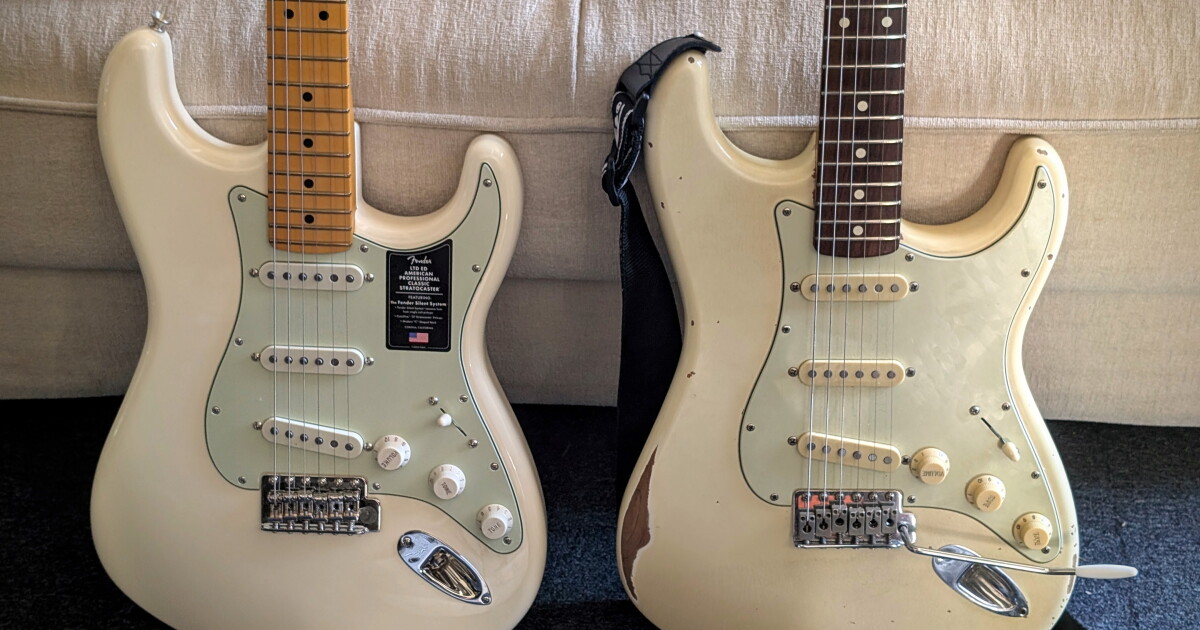
It's only taken 72 years, but Fender has finally, comprehensively solved the biggest problem with its most iconic electric guitar: the amount of unwanted noise it makes.Well, specifically the noise that's unwanted by the guitar player. There's no such solution here for noise unwanted by the player's partner, family or neighbors. But they're not the customer here, and ear plug technology is fairly mature at this point. 60-cycle hum: The problemFor the uninitiated, here's the problem: electric guitar pickups are designed to sense changes in the magnetic field caused by the vibrating movements of metal strings, and send them to an amplifier, which magnifies these vibrations into wonderfully exuberant speaker cone movements that can be enjoyed by entire grateful neighborhoods at once. But these subtle magnetic flux changes are not the only ones the pickups... Pick up.The main bugbear is mains power. Electricity and magnetism being two heads of the one snake, any nearby electromagnetic activity gets adopted into the guitar's output signal. So if you're in the USA, where alternating current (AC) from wall sockets alternates at 60 cycles per second, a single-coil pickup will add a buzz around 60 Hz to whatever you're doing with the strings. In Europe and down under, it's 50 Hz.It's not a big deal when you're playing nice civilised clean guitar sounds – or indeed even most of the time when you're playing high-gain, distorted metal tones. But if you've set your amp up for the latter, it can be super loud and annoying in between notes and when you stop. Aftermarket companies like Seymour Duncan make a ton of different pickup types designed around different tones and noise suppression characteristics (Some of) the solutions: Humbuckers and Fender's Noiseless seriesThere have been plenty of solutions over the years. One of the most enduring was patented just one year after Fender launched the magnificent Stratocaster in 1954, when rival company Gibson came up with the "humbucker" - a pickup with twin coils, on which the magnetic polarity and coil winding direction is reversed. This effectively reinforces the signal from the strings, while cancelling out the unwanted interference that causes 60-cycle hum.And humbuckers are great. They're the big fat fellers that look like two band-aids next to each other instead of just one band-aid on the guitar. They rock! But they don't sound like Fender's single-coil pickups – they tend to emphasize midrange frequencies that... Well, to grossly oversimplify, humbuckers generally sound shouty, honky, warm, round, grunty or throaty in comparison to the crispy, sparkly, glassy, hollow, bottly, spanky, snarly, crystalline tones you can get out of nice single coils. And yes, when you're talking about geeters, these kinds of terms can be deemed sensical. Fender has taken several stabs at the problem with its own 'Noiseless' series of... Well, they look like single-coils, but they're actually more like stacked humbuckers. Which again, are fine and good and a perfectly valid set of colors to paint with, unless you're in love with the tone of true single-coils... Which many of us are, tragically enough to get out soldering irons and spend hundreds of dollars on new pickups we believe will take us closer to the promised land... To hell with lessons and practice, it's gear that'll get us there, damnit. I've got a MIJ Modern Strat sitting in the rack looking at me, whose Noiseless v4 pickups felt like blunt instruments to me. They lacked top end, definition, chime and what I'd consider overall Strattiness to the point where I spent $350 and lightly burned a finger replacing them with a set of Fat 50s. Fender's 2026 Silent SystemSo yes, I'm not a fan of the Noiseless series personally. Which brings us to 2026, and Fender's new Silent System, which it has sent to me embodied in the new Limited Edition American Professional Classic Stratocaster. Fender Director of Product, Allen Abbassi tells me over email that "we wanted to take a fresh approach to reducing hum without modifying the pickups themselves, keeping that single-coil tone intact."What is the system? It's an extra coil in a plastic housing with no magnets in it. A dummy coil, about twice the width of a single coil, that sits in a new cavity routed into the body of a Strat or Tele. Without its own magnet, it can barely perceive what the strings are doing, so it delivers a pretty pristine copy of the room-noise signal into the tone circuit, where it's used to neatly subtract this unwanted noise from the signal. The dummy coil sits in a pretty chunky new hole in the wood under the pickguard; don't expect we'll be seeing this as a kit, thenFender Weirdly, Fender used to run a similar dummy coil system on its Elite Series Strats back in the 80s. But it seems it's taken a long time to work the kinks out this time around. "Senior Design Engineer Steven Casado began experimenting back in 2021," says Abbassi, "and after several years of development he presented us with what is now the Fender Silent System."I'm delighted to say that as far as my ear will take me, the Silent System does exactly what it says on the tin. Indeed, in terms of power cycle hum, it's notably quieter than two humbucker-loaded axes I plugged in next to it... Albeit likely because they're both higher-output guitars. It's actually quite eerie, the silence when you mute the guitar, and it takes a bit of getting used to – but the added definition it gives your playing at higher gain levels is absolutely wonderful. In terms of tone... I really can't separate it from my favorite single-coil daily driver, an equally Olympic White/Mint Green Stratocaster, but a noisy, lightly factory-beaten one from the Road Worn series back in 2009. The sound is immaculate single-coil Fender to me in all pickup positions, including the in-betweenies. When asked how the Fender system differs from similar dummy coil systems that have been sold by Suhr and Ilitch for some years now, Abbassi takes a deft sidestep. "The coil in the Fender Silent System is wider than any pickup we make," he writes. "It’s also deeper; the extra width and depth allow for the use of a much larger gauge magnet wire, which is key to preserving high end response. Protecting the natural frequency response of Fender pickups was at the heart of this project and the Fender Silent System really encompasses that." The dummy coil itself: huge, and uses nice fat wire, Fender tells usFender So yes, if you're looking for single-coil tone with the noise removed, that's what yer getting here, for a very reasonable US$100 (or AU$200) on top of the price of the same model without the system. If you're shopping around that American Professional end of the market, and you turn your guitar up loud, or use high gain amps, or you like distortion or overdrive pedals, this upgrade is an absolute no-brainer for me. Abbassi confirms there's no plans to make this an aftermarket upgrade kit – probably because you'd need to chisel a hole for it. As to whether we'll start seeing more of Fender's high-end Strats shipping with the Silent System... The company's not announcing anything yet, but Abbassi says "we love the results... And see exciting potential for the technology." Boy, does media training take the fun out of things.He's clear on one point though: there will be no ceremonial burning of the Noiseless series. "Absolutely not! Noiseless pickups are an awesome alternative to combat hum," he tells me. "We have been evolving our design for a very long time and they are fantastic pickups in their own right. Lots of players swear by them and they are still a valid and elegant solution to the noise issue." Valid? OK. Elegant? Ehhhhh.... As a quick note on the rest of the guitar, it's mostly superb; Fender's getting into a great groove delivering the 'classic' bits most players want (the look, the shape, the sound, those wonderful castle-style vintage tuners) with the right kinds of modern touches, like the 9.5" radius fretboard with medium jumbo frets, the headstock-based truss rod access, the 5-way switch, and the "Greasebucket" tone circuit. That Greasebucket tone circuit is a great example of how Fender can look backward but still consider the modern playerLoz Blain / New Atlas The latter is a wiring design that routes the second tone knob to the bridge pickup and puts a treble bleed on the volume knob, giving you terrific control over how hard you're hitting the amp, as well as a very useful ability to tame that bridge pickup from its full-on snarling, trebly country rock roots down to a much more midrange-focused impersonation of a humbucker tone that plays nicely with big distortion. It makes this beast arguably even more versatile than an HSS (humbucker/single/single) setup with a coil tap.Do I still have complaints? Why, sure I do! I find it very odd that guitars are coming out of factories in 2026 that don't have slippery nuts and saddles. I get that these bent steel saddles are important to the look... But the strings stick on them, so they go out of tune when you use the whammy bar or have the temerity to bend notes too much. Just about every guitar I've got now has at least 20 bucks' worth of Graph Tech self-lubricating nut on it, if not also a set of slippery saddles, which solve the problem immediately and pretty much permanently.And these old-school screw-in tremolo bars are a real drag when you know Fender's got the push-pop type sitting right there on the shelf... As well as the (dare I say it) functionally superior 2-screw tremolo system. But I get it, that's not vintage.At US$1,599 in the USA (AU$2,799 in Australia), they're a bit pricier than the standard American Professional Classic models these limited editions are built on. But as I say, I wouldn't hesitate – it's absolutely brilliant having a single-coil guitar that's happy to go all the way to the red channel on my Marshall DSL100, but that still sounds truly like a Stratocaster. They should all be this way! Exploring the American Professional Classic Fender Silent System | Fender Source: Fender
Review: Fender's new Silent Strats are an absolute no-brainer
Full Article
Original Source
Read the full article at Newatlas →KhanList aggregates and links to publicly available news content. We do not host full articles from third-party sources. Always verify important information with original sources.