
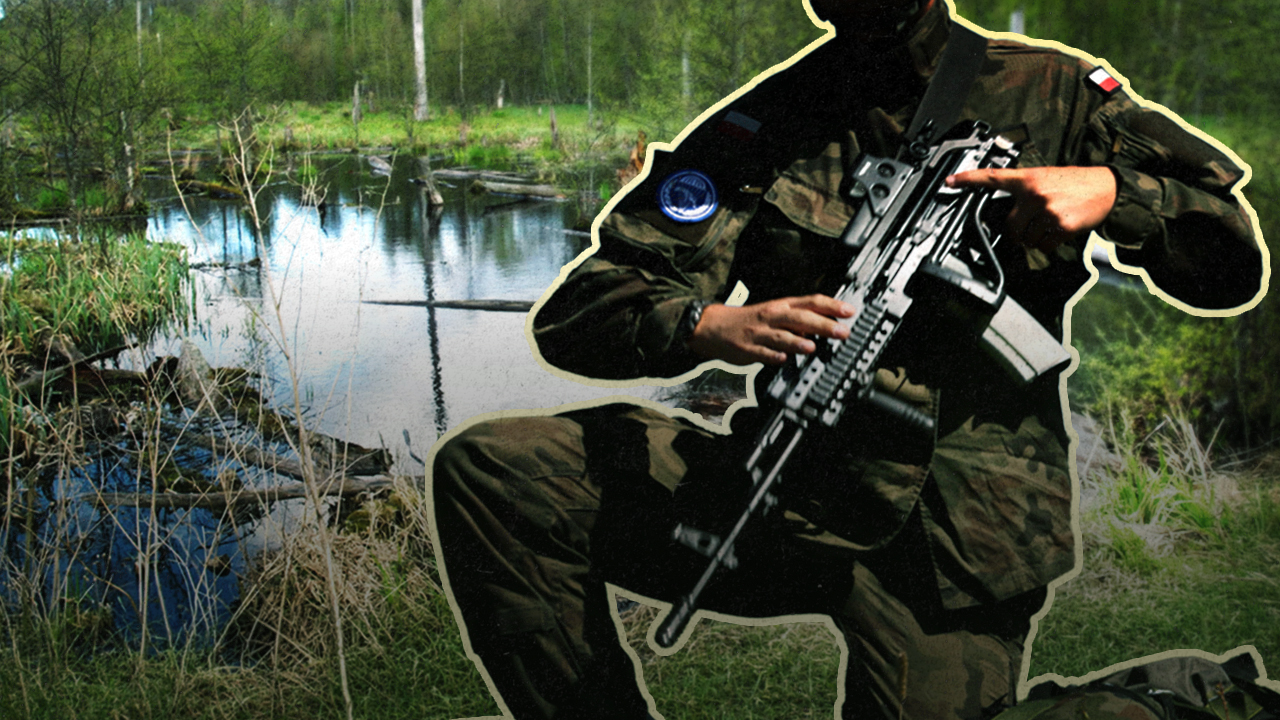
POLAND — Białowieża Forest. Białowieża Forest, one of Europe’s last remaining primeval forests, straddles the border between Poland and Belarus. Its wetlands and ancient trees support a dazzling array of life, but decades of drainage, drought and fragmentation have left the ecosystem under pressure.Now, it faces a new challenge. As the threat from Russia and its ally Belarus grows, Poland is strengthening its eastern border through a project called the East Shield. New military fortifications and infrastructure are planned in the region to bolster existing border security. Scientists warn that further development in and around the forest could be devastating for the ecosystem. They have, however, suggested an alternative: restore the forest, its wetlands and rivers to their natural state. The resulting landscape, dense with trees and boggy with water, not only provides important habitat but can also be practically impenetrable to heavy vehicles and ground forces. Some have dubbed this strategy “warwilding”, using restored natural landscapes as part of military strategy.The idea has found traction within the Polish military, which recognises the strategic value of natural barriers and supports efforts to restore parts of the forest. But recognizing nature’s defensive value is easier than restoring it. Hundreds of kilometers of drainage ditches still carry water away from the forest, while roads provide easy routes through terrain that could otherwise form a natural barrier. Conservationists say large-scale restoration will require coordination, funding and political will, but believe it could also be the forest’s best chance of long-term survival.Mongabay’s Video Team wants to cover questions and topics that matter to you. Are there any inspiring people, urgent issues, or local stories that you’d like us to cover? We want to hear from you. Be a part of our reporting process—get in touch with us here!Banner image: A collage featuring a Polish soldier and Białowieża Forest. TranscriptNotice: Transcripts are machine and human generated and lightly edited for accuracy. They may contain errors.Maybe don’t film? We don’t need a permit. What do you mean? The soldiers often don’t know what’s allowed and what isn’t. Years of rising tensions with Belarus, Russia’s closest ally, have transformed Poland’s eastern border into a heavily militarised frontier. But that border cuts through Białowieża forest, one of Europe’s last ancient woodlands, Where decades of drainage, drought and fragmentation have already pushed the ecosystem to its limits. We will always defend every centimeter of Poland. Since Russia invaded Ukraine, Poland has further accelerated it’s defensive plans, launching the East Shield in 2024, a vast network of fortifications and surveillance systems along its eastern border. Implementing such a scheme in places like the Białowieża Forest would mean absolute destruction. We’d have to deforest this area, build bunkers, minefields, anti-tank ditches and that would be a disaster for all the nature here. We decided to propose a different approach. Places like this are very important, because a tank can’t get through. So, if we expect an attack from that side Then we should preserve this type of environment here. Michal and other Polish scientists suggested a green shield using forests, rivers and wetlands as a defence barrier, wherever possible. This floodwater covers a large area, with a forest beyond, so it’s an ideal barrier. This is crucial, because 1,500 meters away, we have the Polish-Belarusian border. To the scientists surprise, the Ministry of Defence embraced the idea and incorporated ecological recovery into its defence strategy. Our position, as the military, is that the construction of the “East Shield” and environmental protection can go hand in hand. Ukraine has taken action to flood an area to prevent Russian troops from accessing it. The landscape can put up a fight. And we would be idiots not to take advantage of it. We’re standing in front of a map, and we’re indicating to the Ministry of Climate and Environment we want bogs here. This is known as as warwilding, using nature as a form of defence. In a surprising alliance, generals and conservationists believe that restoring wetlands and forests could help defend Poland’s borders and give the ancient forest a fighting chance. Two years after the scientist’s proposal the authorities made an announcement. Together with the Ministry of Environment, we managed to divert over $120 million from EU funds. So far, things are happening very slowly. We’re mostly hearing declarations, and not much is happening on the ground. We tried to involve other ministries from the start. Rewilding is time consuming. However, there’s goodwill from everyone involved. The Army, the Ministry of Climate and Environment and NGOs. For now, most of the rewilding efforts have come from conservation groups and volunteers. Above all, the outflow of water through drainage ditches must be stopped immediately. This dense network of ditches was built over decades to use this area for economic purposes. Some rivers in the forest were also artificially straightened, and all of this means that water flows out of the area faster. All of these factors have transformed bogs that were inaccessible, even 30, 40, or 50 years ago, today can be walked through. But the wetlands that could slow an advancing army are also essential to the forest’s survival. If groundwater levels continue falling, those swamp forest ecosystems, alder carrs, spruce forests or bog forests, they will cease to exist. Some species will simply start to disappear. There’s no sign of mud. Though far from the border, this water retention project offers a glimpse of what warwilding could mean for Białowieża’s future. The water is 28 cm below the threshold. That’s disastrous for springtime. We want to retain as much water as possible in the forest. We want to rewild rivers. Namely, slow down the rivers’ course by reconnecting old meanders to the riverbed. We already completed river rewilding in the Białowieża Clearing. We recreated 10 meanders of the old river by building dams on this channel and excavating oxbow lakes. Our water rention projects help our country’s defense. We know that nature doesn’t always come first, but we have such a valuable UNESCO site so we should take care of it. Scientists and the military may agree that a wet, dense forest can be a powerful natural barrier, but Białowieża has another problem. For these two effects to work, we can’t have a dense network of roads. There are around 2000km of roads cutting through the forest and regional authorities are now widening an old one. This is astonishing. If we’re thinking about national security, securing its borders, using nature to improve national security, then the construction of this road is something incredible. This road takes you to the border. For Michal, the question is no longer whether nature can defend Poland’s border, but whether there is enough time, and will, to let it do so. I’m hoping it’s a matter of the state moving a little slower, because it is constrained by legislative procedures. We need drastic action, in terms of scale and pace. It’s not like we can ponder another five years. Because the geopolitical situation is very uncertain, very unstable.
Restoring a 12,000-year-old forest to help defend Poland’s border
Full Article
Original Source
Read the full article at News →KhanList aggregates and links to publicly available news content. We do not host full articles from third-party sources. Always verify important information with original sources.