
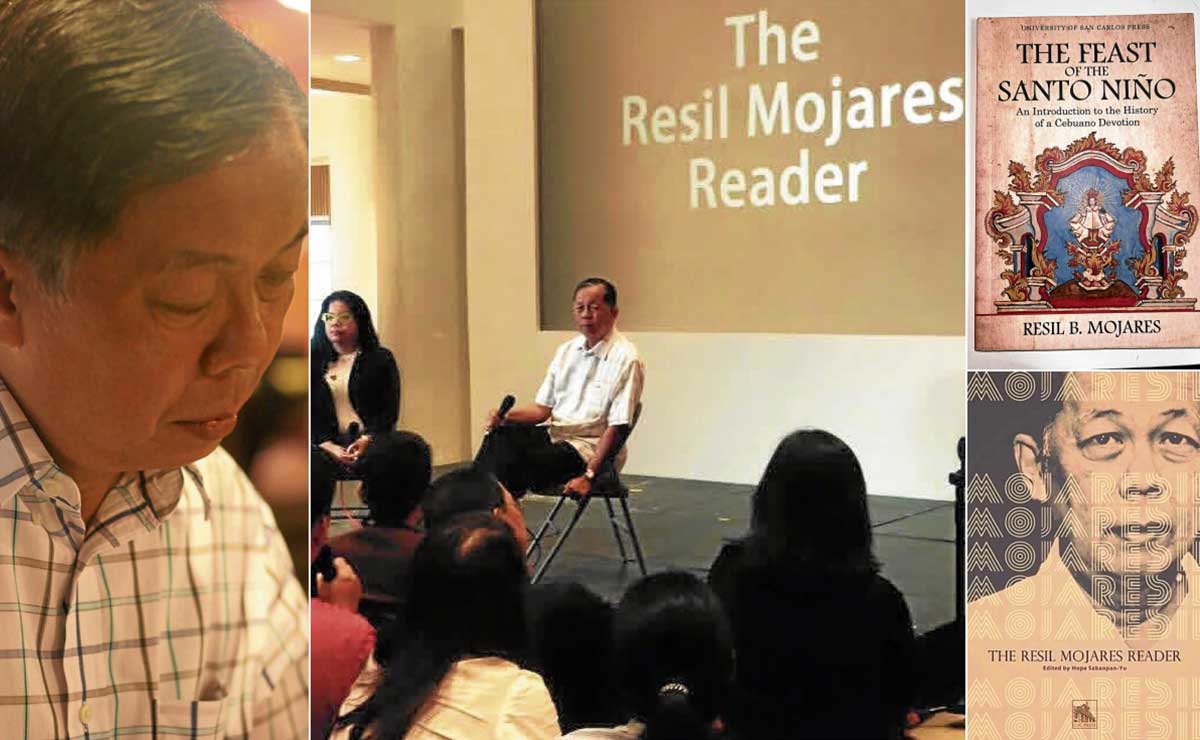
LASTING LEGACY National Artist for Literature Resil Mojares is remembered through his books, writings, and the Cebuano Studies Center at the University of San Carlos, where he built a lasting legacy of scholarship and cultural preservation. Photos show Mojares signing books during the launch of “Isabelo’s Archive,” a copy of “The Feast of the Santo Niño,” a portrait of Mojares, and the center’s interior. —Photos courtesy of Cebuano Studies Center, Morexette Marie B. Erram, University of San Carlos, and Resil B. Mojares Facebook page CEBU CITY, Philippines — Before Resil Mojares became one of the country’s most respected historians and Cebu’s foremost keeper of memory, he was a fictionist. He was also a journalist, writing about Cebu’s history and culture while increasingly engaging with the political landscape of the early 1970s. These were not successive chapters in his life. For a brief but consequential period, they existed side by side. Article continues after this advertisement Then Martial Law came. Mojares’ detention in 1972, the restrictions imposed on him after his release, and the changing literary and political environment effectively brought that early writing life to an end and set him on a different path, which would eventually lead to decades of scholarship, the founding of the Cebuano Studies Center and, in 2018, recognition as a National Artist for Literature. But the fictionist never entirely disappeared. Born in 1943 in Polanco, Zamboanga del Norte, to public school teachers, Mojares grew up in northern Mindanao and dreamed of becoming a writer. He spent two years at Silliman University, where he was in a class co-taught by celebrated writers Edith and Edilberto Tiempo. He later moved to the University of San Carlos (USC), where he earned his degree in English. Article continues after this advertisement In 1965, Mojares began teaching at the Societas Verbi Divini (SVD)-led university. Between 1966 and 1971, Mojares published at least 13 short stories in English, several of which earned recognition. Article continues after this advertisement In 1971, his story “Beast in the Fields” won second prize for the English short story in the Carlos Palanca Memorial Awards for Literature, behind Cirilo Bautista’s “The Ritual.” But fiction was only one part of the young writer’s life. Around the same period, Mojares was also building a career in journalism. By the early 1970s, he was writing “Sticks and Stones,” a column for The Freeman, one of Cebu’s English dailies.His subjects included local history and culture, but his writing increasingly intersected with the political tensions of the period, particularly student activism, anti-imperialism and the growing authoritarianism of Ferdinand Marcos Sr. Habit The overlap matters because it shows that Mojares was not simply a budding fictionist who later became a scholar. He was already moving between storytelling, journalism and cultural inquiry. That habit of looking closely at society would eventually become central to his scholarship. Then came 1972. Mojares had written what would become his final short story, “In the Beginning of the War.” He was preparing to submit it for publication when Martial Law was declared in September that year. The story would not appear in print until 1987, when it was published in Ani, the literary journal of the Cultural Center of the Philippines. His journalism ended even more abruptly. On Sept. 23, 1972, his final “Sticks and Stones” column appeared in The Freeman. That same day, he was arrested as Marcos imposed Martial Law. He was detained for about two and a half months at Camp Sergio Osmeña in Cebu City. His interrogators, he later recalled, were largely interested in his writings and his associations with activist organizations. After his release, Mojares was placed under “provincial arrest.” He could not publish, give press interviews or leave the province without permission from military authorities. The restrictions were only part of the story. Mojares said he was also increasingly consumed by academic work and had “lost the appetite for fiction.” During the early years of Martial Law, there were few outlets for literary writing outside the Marcos-controlled publication Focus, which many writers chose to boycott. In other words, his fiction career did not end because he suddenly stopped being a writer. The circumstances around him changed, and so did he. Redirection After his release from detention, two figures at the USC helped redirect Mojares toward scholarship. Fr. Rudolf Rahmann, then the university president and an anthropologist, offered him a series of informal doctoral courses in anthropology. Fr. Joseph Goertz, the university’s director of research, supported Mojares’ project to collect Cebuano periodicals, books and manuscripts, materials that libraries had largely overlooked at the time. That project eventually led to the establishment of the Cebuano Studies Center in 1975, with Mojares as its founding director. As Mojares himself put it, the experience “irrevocably” launched him into a career in research and scholarship. He continued to approach history through stories, personalities, places and details often overlooked by conventional national narratives. He would later say that growing up in Mindanao and living in Cebu gave him an advantage as a writer. The distance from Manila allowed him to see the country from a different vantage point. Mojares went on to produce a body of scholarship spanning literature, history, politics, anthropology and cultural studies. His books included Origins and Rise of the Filipino Novel, The War Against the Americans, House of Memory, Waiting for Mariang Makiling, Brains of the Nation and Isabelo’s Archive. He received numerous national and international honors for his work. Yet his prose remained distinctly literary. Chinese Filipino scholar Caroline Hau, who interviewed Mojares for the journal Philippine Studies: Historical and Ethnographic Viewpoints, described him as a “master of the essay form” and praised the lyricism and precision of his writing. His later works gave his imagination and curiosity room to operate even within scholarship. Mojares himself acknowledged that he sometimes wondered about the fiction he had left behind. In 2019, he said he regretted leaving fiction and had at times considered returning to it. He had sketched novel plots and accumulated notes, but never quite found his way back to the form. “Creative writing is not quite like academic writing, or writing research, or journalism. It requires a different kind of concentration, of emotional and mental conditioning,” Mojares said for the Philippine Studies: Historical and Ethnographic Viewpoints interview with Hau. Still, the drive for storytelling remained. He wrote about people whose lives had been forgotten, about places that had been pushed to the margins of national history, and about communities whose experiences could challenge Manila-centered versions of the Philippines. He also spent years writing the stories of others, serving as a trustee of the Ramon Magsaysay Award Foundation and later as a biographer, editor and writer of citations for its award recipients. Perhaps that was where the fictionist ultimately went. Not away from stories, but deeper into them. Mojares once wrote that writers must learn to recognize the possibilities contained in their own experiences, places and memories. A place, he argued, is not truly possessed simply by living in it, but through “the work of knowledge, imagination, and craft”—and love. Your subscription could not be saved. Please try again. Your subscription has been successful. It is a fitting description of the life he built after 1972. /cb
Resil Mojares: The storyteller behind Cebu’s historian
Full Article
Original Source
Read the full article at Newsinfo →KhanList aggregates and links to publicly available news content. We do not host full articles from third-party sources. Always verify important information with original sources.