
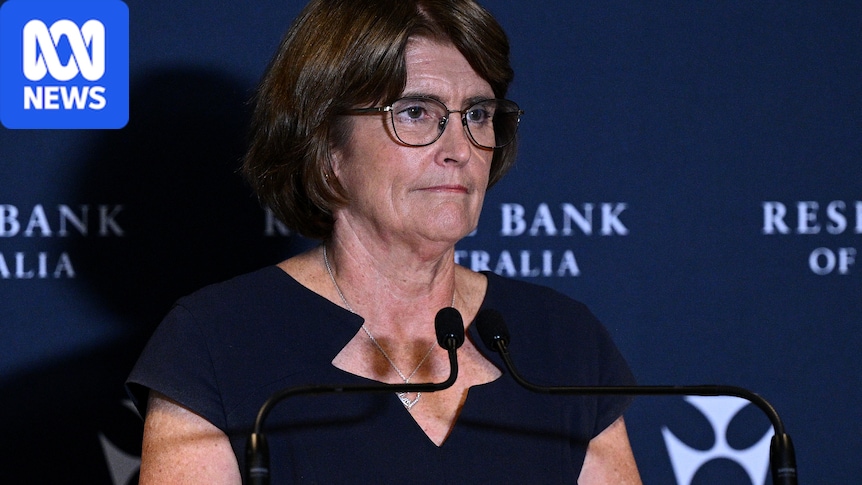
The Reserve Bank's senior officials are among the highest paid people in Australia.RBA governor Michele Bullock received total remuneration of $1.22 million in 2025-26, with a base salary of $1.01 million.Deputy governor Andrew Hauser received total remuneration of $955,033, with a base salary of $903,217.The RBA's four assistant governors received total remuneration between $743,000 and $868,000 each, and its chief operating officer received total remuneration of $905,543.The figures can be found in the RBA's 2026 annual report, which was released on Thursday afternoon.The median annual earnings for all employees in Australia is $74,672. In March this year, Ms Bullock received unwanted media attention when she and her husband bought a $2 million home in Yamba, in northern NSW, on the same day that the RBA lifted interest rates on February 3.It was her third investment property. Her property purchase was recorded in her declaration of material personal interests on the RBA's website. Michele Bullock says she sympathises with the plight of Australian workers. (ABC News: John Gunn)The RBA governor's pay is slightly above most federal departmental or agency heads, which are mostly clustered around $900,000-$1,000,000. However, the chief executives of some publicly owned corporations are paid far more.Ellie Sweeney, the NBN Co chief executive, received $3.4 million in total remuneration in 2025-26, up from $1.9 million a year earlier, making her Australia's highest-paid public servant.Paul Graham, the chief executive of Australia Post, received $3.3 million in 2024-25. Dennis Barns, the chief executive of Snowy Hydro Limited, received $2.1 million in 2024-25.RBA workers don't want a real wage cutThe RBA is currently arguing with junior RBA staff about pay and conditions.Lower-ranked RBA staff have been asking for a pay increase of 11 per cent over three years and an inflation-protection mechanism that triggers additional pay rises if inflation outpaces wages, to avoid real wage cuts in coming years.But last month, hours after the RBA lifted rates for the fourth time this year, Ms Bullock emailed RBA staff and asked them to vote for a pay offer of 9.5 per cent over three years. A majority of RBA staff had rejected a similar proposal in July.The Finance Sector Union says enterprise agreement negotiations have been dragging on since late last year and the RBA has refused to move on its original pay offer.The latest round of voting for the RBA's proposed enterprise agreement will close on Monday at 5pm.After lifting interest rates last month, Ms Bullock said she sympathised with the plight of Australian workers.But she said the only way workers could keep receiving sustainable increases in real wages was from productivity growth, and Australia's economy was struggling to deliver it."People are feeling, quite rightly, very annoyed and very upset about the fact that the costs of everything are rising, that their wages are not keeping pace with that, they’re seeing real wage cuts," she said."If we don't get productivity growth, there's not going to be real wage rises coming down the pipeline."According to the RBA's annual report, the bank has 2,201 employees, equating to 2,082 full-time equivalent employees.It has 76 senior executives, and another 222 highly paid staff.The RBA's workforce has increased by 8 per cent over the past 12 months. The RBA says that reflects the additional resources it needs to implement its transformation and change agendas.The additional staff are concentrated in technology and corporate support functions.RBA staff numbers increased by 8 per cent in the past year. (Source: RBA annual report 2026)Higher unemployment will help to control inflationAustralia's unemployment rate is 4.7 per cent, in seasonally adjusted terms.It is higher than the RBA forecast for this point in its rate-hiking cycle.At a fireside chat last month, Ms Bullock said Australia may need an unemployment rate of 5 per cent to get inflation completely under control."[W]hat level of unemployment eases the pressure on the supply side of the economy?" she asked."I think between 4.5 and 5 will probably take enough heat out of the labour market that it'll ease pressure on inflation," she said.On Thursday, Bureau of Statistics data showed that Australia's unemployment rate has risen 0.6 percentage points (from 4.1 per cent to 4.7 per cent) since the RBA started lifting interest rates in February this year.Tom Kennedy from JP Morgan said outside of the COVID-19-related volatility, it was the largest nine-month increase in unemployment in more than a decade. "The deterioration is also more pronounced than the RBA had forecast back in August," he said."Importantly, it's too early to see any effect from the RBA's September rate hike, which we think will weigh on both GDP growth and labour demand in coming quarters."RBA records $11.3 billion negative equity positionThe RBA's annual report shows the bank had a "negative equity" position of $11.3 billion at the end of June (compared with a negative equity position of $5.3 billion in June 2025).The deterioration in its net equity position reflected a large "accounting loss" in 2025/26, which was partially offset by valuation gains on its gold holdings.As at 30 June 2026, the RBA had a negative equity position of $11.3 billion. (Source: RBA annual report 2026)The RBA's Governance Board says negative equity does not affect the RBA's ability to operate effectively or perform its functions, but it is important that the equity position is restored over time."This can be achieved by retaining future year profits," the RBA says in its annual report."Based on market expectations for the cash rate as at 30 June 2026 and market prices and exchange rates at this time, negative equity is expected to diminish over the next few years. "However, a return to target for the Reserve Bank Reserve Fund probably remains more than a decade away."
Reserve Bank governor paid $1.2 million as RBA workers fight real wage cuts
Full Article
Original Source
Read the full article at Abc →KhanList aggregates and links to publicly available news content. We do not host full articles from third-party sources. Always verify important information with original sources.