
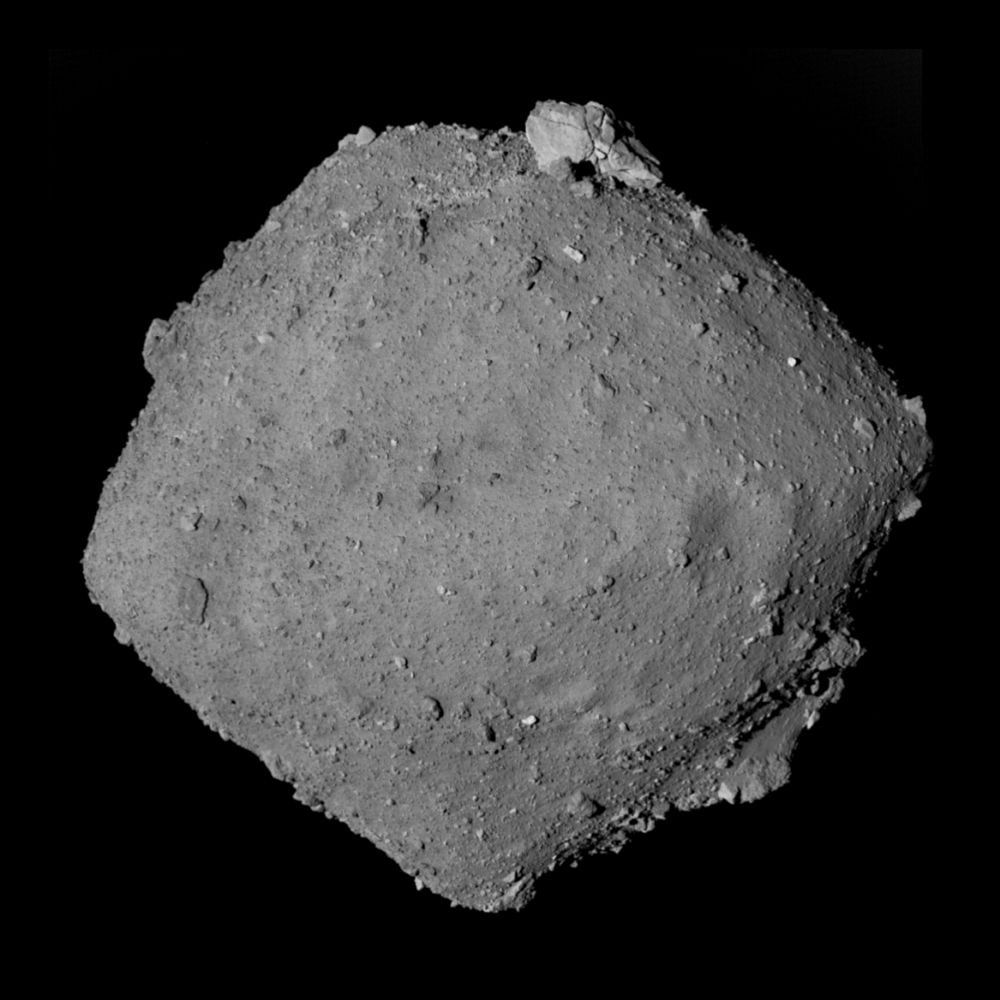
The Solar System's asteroids are sometimes referred to as fossils because they preserve evidence of the conditions when the Solar System formed. Asteroids are critically different than their planetary counterparts. On the rocky planets, the rock itself has been subjected to billions of years of change. On Earth, tectonic plates have melted rocks, exposure to water has altered its mineral content, and pressure deep inside the Earth has transformed its crystalline structure. Cosmic and solar radiation has also driven fundamental changes on some worlds, and across Mercury, Venus, Earth, and Mars, a mixture of these factors have altered the rock. But asteroids and the parent bodies they came from haven't been subjected to all of these forces. In many ways, they remain unchanged from the early days of the Solar System, 4.5 billion years ago. They haven't remained completely unchanged; that would be next to impossible. But their ancient state and what it can teach us about the Solar System's history is why we've sent missions to collect samples and return them to Earth. In 2020, the Japan Aerospace Exploration Agency's (JAXA)Hayabusa 2 successfully completed its sampling mission to asteroid Ryugu and returned its precious sample to Earth. Almost six years after its arrival on Earth, the Ryugu sample is still generating valuable scientific results, as researchers examine its mineralogical and chemical composition. The newest results are in research titled "Pervasive poorly crystalline Mg-rich hydrous silicate material in C-type asteroid matrices." It's published in Nature Communications Earth and Environment, and the lead author is Reon Okumura from the Division of Geosciences and Civil Engineering at Kanazawa University, Japan. Ryugu and other carbonaceous chondrites present an apparent contradiction. It involves aqueous alteration, where contact with water creates mineralogical and chemical changes in rocks and minerals. Aqueous alteration isn't a rare action that happens only in space environments; it's common on Earth. The best-known example is how clay forms from common silicate rocks in Earth's crust, from exposure to water. It's basically how soil is created. A JAXA official successfully retrieving the 16 kg capsule that it contained a sample from the asteroid Ryugu. (Courtesy: JAXA) There's obviously no soil on Ryugu, but there is aqueous alteration. "C-type asteroid-derived samples, including Ryugu and carbonaceous chondrites, consist primarily of fine-grained matrices of magnesium-rich hydrous silicates formed by aqueous alteration," the paper states. The contradiction stems from the matrix of minerals in the asteroid. There seems to be two components, each altered under a different set of aqueous conditions. That implies that Ryugu's interior matrix is patchy, which is highly improbable. An asteroid can be clumpy on a macroscale, but how can it have two components in the same mineral matrix? That's been a nagging question in cosmochemistry: how can aqueous alteration happen to some of the matrix while leaving some of it more intact? The authors write that Ryugu's matrix is "commonly interpreted as mixtures of serpentine- and saponite-like phyllosilicates..." Serpentine and saponite are both found on Earth, where they're created when rock is aqueously altered. But despite the fact that they're generally interpreted to be these substances, "their mineralogical characteristics do not fully correspond to these well-crystalline terrestrial layered silicates." To dig into this apparent contradiction, the researchers used the SPring-8 synchrotron radiation facility and the Photon Factory High Energy Accelerator, both in Japan. Both of these research facilities use powerful x-rays to look deeply into the Ryugu sample. They found the expected serpentine and saponite, but they also identified something else: poorly crystalline magnesium silicate hydrate (M-S-H). “What makes M-S-H particularly interesting is that it can accommodate a wide range of magnesium-to-silicon ratios,” said study corresponding author Keisuke Fukushi of Kanazawa University. “This flexibility may be key to understanding how water-rock interactions proceeded without erasing pre-existing chemical differences within their parent asteroids.” The composition of most materials remains stable when subjected to the same aqueous conditions. But previous research and lab work shows that M-S-H is a bit of an oddball: it can exist in the same aqueous conditions and have different magnesium to silicon ratios. So this work suggests that M-S-H is the initial starting point, and that if it formed into serpentine and saponite phases, the presence of M-S-H can explain the two different outcomes without necessarily requiring a different aqueous alteration for each one. This illustration helps explain the findings. The previous interpretation on the left shows tighly packed grains of serpentine and saponite, with the parallel lines representing their orderly crystal structure. The alternating blue and green lines in some grains represent interleaves of serpentine and saponite layers in the same crystal. There's almost no empty space between grains. The image on the right shows the new model, with a background of poorly crystalline M-S-H, making up the bulk of the matrix. In this model, serpentine and saponite are a minor part of the matrix, and are poorly-formed intrusions. Image Credit: Keisuke FUKUSHI, Kanazawa University (2026) The study says something not only about Ryugu, but about carbonaceous chondrites. Much of their matrices could be poorly crystalline M-S-H. If this material precipitated first and then was transformed later, the different compositions of clay-like minerals found in the matrix could have arisen without a separate, distinct water environment for different regions of the parent asteroid. "Assuming its initial precipitation and subsequent mineralogical transformations, a wide range of compositional variation can be produced without requiring separate aqueous conditions for each local composition," the authors write. "This framework provides a physicochemical basis for explaining the compositional variability and associated phyllosilicate diversity of C-type chondritic matrices within a parent-body alteration scenario." The Japan Aerospace Exploration Agency (JAXA) is developing a reputation for successful sampling missions, one of the most difficult type of missions to complete. The original Hayabusa mission, though plagued with difficulties, still managed to return a small sample from asteroid Itokawa in 2010. Hayabusa 2 was a complete success, as this research shows. And at this moment, JAXA's Martian Moons eXplorer mission is on its way to collect a sample from Phobos, the largest of Mars' two moons. That sample should be on Earth five years from now. What questions will it answer?
Researchers May Have Solved a Puzzling Contradiction in the Ryugu Sample
Full Article
Original Source
Read the full article at Universetoday →KhanList aggregates and links to publicly available news content. We do not host full articles from third-party sources. Always verify important information with original sources.