
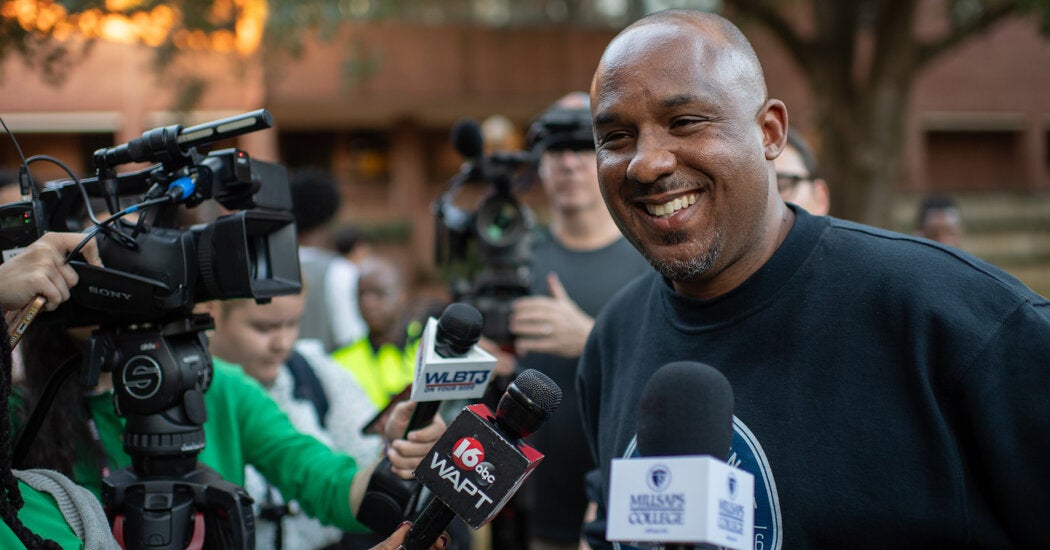
AdvertisementSKIP ADVERTISEMENTThe Democrat Scott Colom’s stunning Senate upset punctuated a dismal midterm showing for the G.O.P. in a region they had dominated for years.Scott Colom, the Democratic Senate candidate in Mississippi, secured a major upset over Senator Cindy Hyde-Smith, a Republican. Credit...Rory Doyle for The New York TimesNov. 12, 2026, 5:55 p.m. ETRepublicans were routed in Georgia and stunned in South Carolina. In Louisiana, a Republican Senate candidate won by less than two percentage points against a little-known Democrat who ran just two TV commercials.Then came Wednesday in Mississippi, where Scott Colom became the first Democrat to win a Senate race in 44 years, defeating Senator Cindy Hyde-Smith and further shaking Republicans’ once-unquestioned hold on the South.Now, after the series of midterm shocks, Southern Republicans have been left to confront a new reality: A region they dominated for years is no longer a lock for their party.“Republicans fell asleep at the wheel,” said Bill Armistead, a former chair of the Alabama Republican Party, adding, “If we stay asleep at the wheel, we could see some losses in the future.”ImageMs. Hyde-Smith’s loss cast doubts on Republicans’ once-unquestioned power on the South.Credit...Michael A. McCoy for The New York TimesRepublicans also lost their grip on the Georgia governor’s mansion, suffered a staggering loss by nearly 20 points in North Carolina’s Senate race and surrendered seats in state houses in Tennessee, Alabama and Arkansas. In South Carolina, 10 state legislative seats flipped into Democratic hands.Some Southern Republicans said their party’s midterm performance was a historical outlier in a year when Democrats made sweeping gains across the country with campaigns that capitalized on anger with inflation and President Trump. Democrats, who continue to face brand and image problems, could face difficulties keeping their gains in the South in future elections held in less favorable political climates.At the same time, other Republicans begrudgingly believe that the South’s political trajectory is shifting under their feet. And Democrats have signaled that they plan to keep their focus on the South, with their 2028 presidential nominating process starting in South Carolina.The unsettling midterm performance for Southern Republicans comes at a moment of uncertainty for their party, as Mr. Trump enters the lame-duck stage of his second term, the coalitions he has built fracture, and college-educated voters appear to be flocking to Democrats. Republicans are also reckoning with lost ground among Black voters, who make up a significant share of the electorate in the South and were angered by G.O.P. efforts to redraw congressional districts in ways that diluted their influence.“I hope this is a wake-up call for all of my Republican colleagues,” said Mike Hurst, the chairman of the Mississippi Republican Party. He added that Republicans could not take the state’s governor’s race next year for granted. “I think it will be competitive, and I think we as Republicans will have to work to earn the trust of the voters.”ImageTen state legislative seats flipped into Democratic hands at South Carolina’s state capitol.Credit...Sean Rayford for The New York TimesMr. Colom’s defeat of Ms. Hyde-Smith, who had held her seat since 2018, sent particular reverberations across the South, given how widely Mississippi had been viewed as a hub of loyal conservatives. Mr. Colom made history with his win, becoming the first Black senator in the state since the 1800s.Black voters, who make up about 40 percent of Mississippi’s population, the largest share of any state, largely back Democrats and have repeatedly elected the state’s lone House Democrat, Representative Bennie Thompson. White voters in the state have long voted for Republicans in huge numbers.The Senate result in Mississippi suggested that the racial polarization that has helped propel Republican candidates in the South for decades is weakening, said Brian Robinson, a Republican strategist in Georgia. Mr. Colom was lifted by his remarkable strength in the Memphis suburbs in northwestern Mississippi. In DeSoto County, a majority-white county made up of Memphis suburbs that Mr. Trump won by 24 points in 2024, Mr. Colom beat Ms. Hyde-Smith by about eight points.White voters with college degrees, who decades ago were safely Republican, have been gravitating toward Democrats, Mr. Robinson said.“That’s changed forever,” Mr. Robinson said, expressing uneasiness about Republicans’ standing in his home state of Georgia. “I do think for an extended period of time North Carolina and Mississippi are going to be competitive. I hope Georgia can be competitive.”In Georgia, the Republican Senate nominee, Representative Mike Collins, lost to the Democratic incumbent, Senator Jon Ossoff, by about 18 percentage points. The Democratic candidate for governor, former Mayor Keisha Lance Bottoms of Atlanta, also won comfortably to become the first Black person elected the state’s governor and the first Black woman elected governor anywhere in the United States.In Mississippi, Mr. Hurst, the Republican Party chairman, acknowledged the “incredible milestone” of Mr. Colom becoming that state’s first Black senator in nearly 150 years.Mr. Colom was lifted by his remarkable strength in the Memphis suburbs in northwestern Mississippi. In DeSoto County, a majority-white county made up of Memphis suburbs that Mr. Trump won by 24 points in 2024, Mr. Colom beat Ms. Hyde-Smith by about eight points.Republicans will face another test in Mississippi next year when they try to defend the seat of Gov. Tate Reeves, who is term-limited.ImageGov. Tate Reeves of Mississippi will reach the end of his second term next year, presenting another test for the state’s Republican Party. Credit...Brandon Bell/Getty ImagesThey must now confront a triumphant base of Democratic voters, as well as questions about whether the coalition of Black voters, white liberals and disaffected conservatives that Mr. Colom harnessed this year will remain cohesive.Part of that likely depends on how Mr. Colom carves his path as part of the new generation of Southern Democrats arriving to power in Washington and state capitols.“I’m going to treat your future the way I want my future to be,” Mr. Colom said in his victory speech on Wednesday. “My commitment is to be someone that continues to stay in prayer, continues to have faith and continues to work to make every Mississippian’s life better.”There is also an open question about whether Mississippi Republicans will move to redraw district lines in the coming weeks after the Supreme Court this year weakened the Voting Rights Act of 1965. Lawmakers held a series of public hearings before the November elections, but they have not said whether they will make changes or how if they do.The Supreme Court decision, as well as the ensuing scramble to undercut majority-Black districts across the South, helped galvanize Black voters in Mississippi to support Mr. Colom. It also helped pushed voters across the region to turn out for Democrats in the midterms.Some Mississippi Republicans said the outcome in the state’s Senate race was still more a reflection of a broader frustration with high prices, the Trump administration’s tariffs and the economic toll of the Iran war.“Let’s put it in perspective: This is one statewide race,” said State Senator Scott DeLano, a Republican, noting that all three of Mississippi’s Republican congressmen comfortably won re-election. “I don’t think that this is a foretelling of things to come in Mississippi.”Hs said it was clear that Republicans in Mississippi were making a statement against the war and high food and gasoline prices, and that Mr. Colom’s campaign had taken advantage.State Senator Michael McLendon, a Republican, agreed that Ms. Hyde-Smith had been “absolutely” outworked by Mr. Colom, and that Mr. Colom’s message carried greater potency at a time when voters were exasperated with high prices.“It was a perfect storm,” Mr. McLendon said.But he also said the election offered a lesson to Mississippi Republicans.“You better not take any races for granted,” he said. “It’s a different climate.”Emily Cochrane is a national reporter for The Times covering the American South, based in Nashville.Related ContentAdvertisementSKIP ADVERTISEMENT
Republican Setbacks Swell in the South With Stinging Loss in Mississippi
Full Article
Original Source
Read the full article at Nytimes →KhanList aggregates and links to publicly available news content. We do not host full articles from third-party sources. Always verify important information with original sources.