
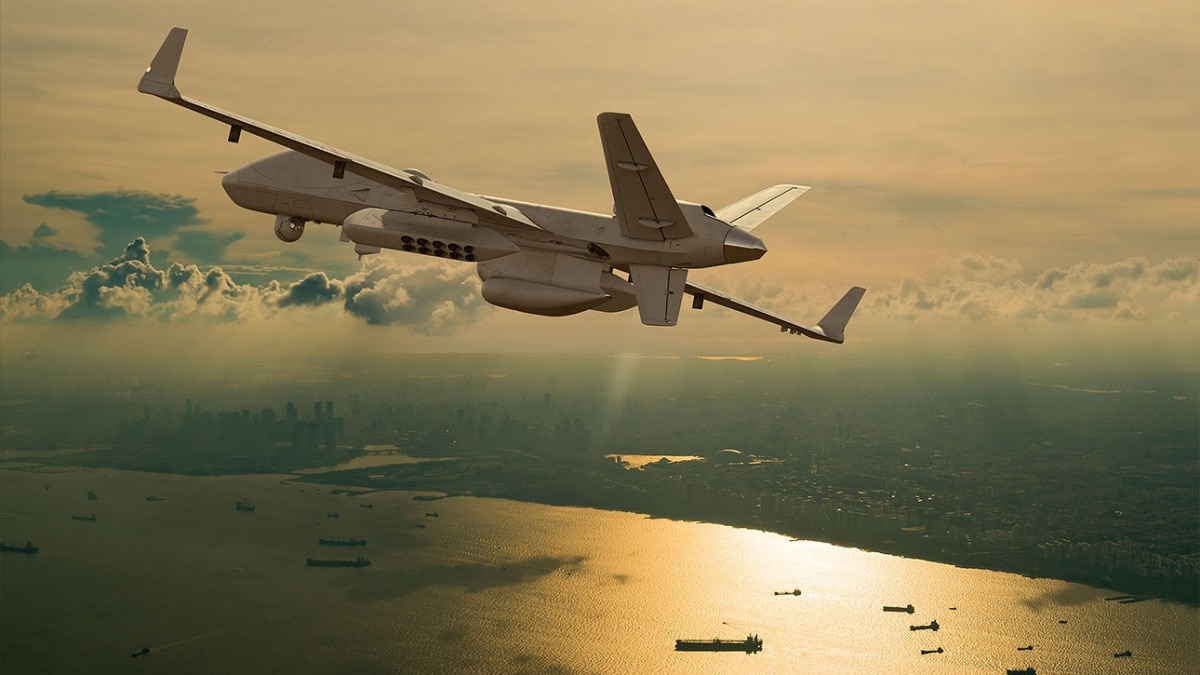
The Ministry of Defence has signed a Rs 1,943-crore contract with General Atomics to lease two MQ-9B Sea Guardian drones for the Indian Navy for 30 months. The move helps the Navy sustain and enhance long-range surveillance across the Indian Ocean until its planned MQ-9B acquisitions begin arriving.The Sea Guardian can fly for around 30 hours non-stop while monitoring large swathes of the ocean (Photo: General Atomics)The Ministry of Defence on Monday signed a Rs 1,943-crore contract with the US defence company General Atomics to lease two MQ-9B Sea Guardian drones for the Indian Navy for 30 months. Arguably the best long-range surveillance drone in the world, the Sea Guardian is expected to provide the Navy with sustained intelligence, surveillance and reconnaissance, or ISR, coverage across the Indian Ocean Region.Leases might seem relatively uncommon when it comes to military equipment, but this is actually a familiar arrangement. The Navy has operated two General Atomics aircraft on lease since November 2020, initially brought in when military tensions with China peaked following the deadly Galwan Valley clash. The new lease will boost the Navy's ability to keep a hawk's eye on the Indian Ocean at a time when global geopolitical temperatures remain high amid the continuing uncertainty surrounding the US-Iran war.BUT THEN, WHY A LEASE?This is simply a faster way to get your hands on equipment that India has already decided to buy. In October 2024, India signed a deal to acquire 31 MQ-9Bs -- 15 Sea Guardians for the Navy and 16 Sky Guardians for the Army and Air Force. But the first deliveries are scheduled only from early 2029.An acquisition under India's complex and highly bureaucratic defence procurement system has to pass through a long chain of approvals, evaluations, bidding and negotiations. Leasing, introduced more formally into India's military acquisition framework in recent years, allows for the immediate fulfilment of a pressing requirement. It is a bit like the military equivalent of renting a house while saving up for that big purchase. So in 2020, when China unexpectedly built up its forces along the Line of Actual Control, resulting in a violent brawl that left 20 Indian soldiers dead, leasing two Sea Guardians was the fastest way for the Indian Navy to bolster its ability to monitor Chinese activity in the Indian Ocean.Another factor that favours leasing over outright purchases is the ability to transfer substantial maintenance and support obligations to the supplier. For example, in September 2024, when one of the two leased Sea Guardians suffered a technical failure and had to be ditched at sea, General Atomics supplied the Indian Navy with a replacement at no additional cost.GUARDIAN OF THE SEA It wouldn't be an understatement to describe the MQ-9B family as nearly unparalleled when it comes to surveillance and intelligence-gathering abilities. The MQ-9B drones are designed to operate at high altitude for exceptionally long periods, using satellite communications to work far beyond their ground stations. General Atomics says the drones can remain airborne for more than 30 hours in some configurations, carrying a range of sensors, radars, and other intelligence-gathering payloads.They also stand out for their ability to integrate with civil aviation; theoretically, these drones can take off from a normal airport and fly through civilian air traffic without needing the surrounding airspace to be entirely restricted.The Sea Guardian is the maritime version of the MQ-9B family carrying a complement of sensors explicitly designed for watching over large swathes of ocean. The Sea Guardian is also being developed to possess the capability to detect and track submarines, something that is relatively rare when it comes to unmannedA Sea Guardian can spend hours in the air watching a patch of sea, following a vessel or maintaining surveillance across distant approaches without needing to put an aircrew through the constraints of endurance.WHY TWO MORE NOW?The new lease seems directly targeted at protecting, sustaining, and expanding the experience that the Navy has had operating the Sea Guardians until the ones India has actually bought start arriving. A 30-month lease signed in August 2026 runs into early 2029, just when deliveries of the 31 Sky and Sea Guardians are expected to begin.The heightened geopolitical environment after 2025's Operation Sindoor and the continuing and uncertain US-Iran war may also have played a role in the new requirement. The Indian Ocean is vast and presents a strategic problem where India must monitor shipping lanes, choke points and vast stretches of water stretching from the eastern coast of Africa to the Malacca Strait.And so this new lease will ensure that the Navy does not have to take its eyes off the Indian Ocean while it waits for the surveillance ability it will own tomorrow.- EndsPublished By: Dev GoswamiPublished On: Aug 18, 2026 10:53 IST
Rent now, buy later: Why India is leasing 2 more Sea Guardian drones
Full Article
Original Source
Read the full article at Indiatoday →KhanList aggregates and links to publicly available news content. We do not host full articles from third-party sources. Always verify important information with original sources.