
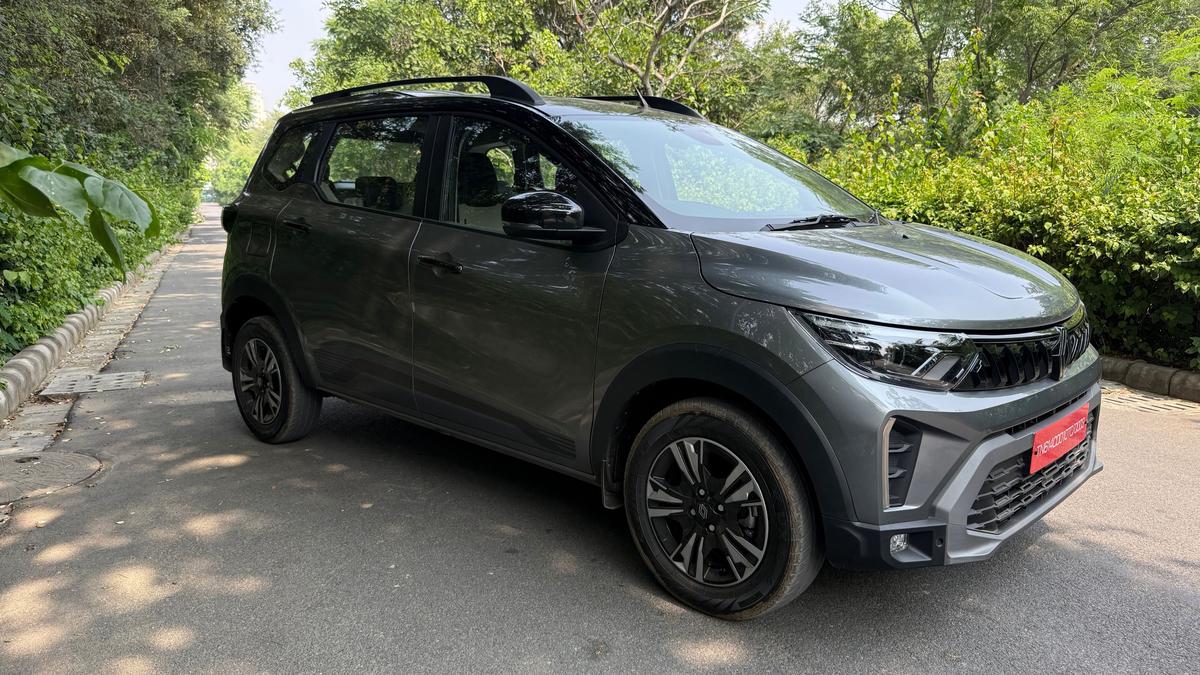
The Triber has never needed much help in the practicality department. Its compact dimensions make it easy to manoeuvre in the city, while its clever 2+3+2 seating layout allows it to carry seven people when required. The second row slides and reclines, while the third row can be removed completely when it is not needed, turning the Triber from a seven-seater into a remarkably useful cargo carrier. With the third row removed, there is up to 625 litres of luggage space, while even the rearmost seats are genuinely usable for shorter journeys. It remains one of the smartest examples of space utilisation in a car of this size.Practicality, perfectedWhat the Triber lacked was the performance to make all that versatility easier to exploit. The old 1.0-litre naturally aspirated petrol engine produced 72PS and 96Nm, and while that was adequate for an urban commute with a couple of occupants, the engine had to work hard once the car was loaded with people and luggage. Overtaking on the highway or climbing an incline with a full complement of passengers often required careful planning. The new 1.0-litre three-cylinder turbo-petrol changes that rather dramatically. Developing 100PS and 180Nm, it has 28PS more and, more importantly, 84Nm more torque than the naturally aspirated motor. The 100PS, 1.0-litre turbo-petrol engine gives the Triber stronger performance and a more responsive character. | Photo Credit: Special Arrangement Turbocharged characterThe engine is related to the HR10 turbo-petrol unit used in Renault’s Kiger and Duster, but the Triber gets its own engine management calibration that allows it to produce 180Nm. That torque arrives between 2,000 and 3,750rpm, and it transforms the character of the MPV. There is still a little hesitation below 2,000rpm, but once the turbo comes into its own, the Triber builds speed with considerably more urgency than before. The mid-range is where this engine works best, and that is particularly important in a family car because it means the driver does not have to constantly work the engine to make progress.The result is a car that feels genuinely peppy rather than merely adequate. Renault claims a 0-100kph time of 10.8 seconds, which gives some perspective on how much the performance has improved, but the bigger difference is felt in everyday driving. The turbo makes joining fast-moving traffic, overtaking and carrying a full load considerably less stressful. It also gives the Triber a willingness that the naturally aspirated version simply did not possess. There is a clear step in power as the turbo comes on around the mid-range, followed by a strong and useful spread of torque. For a car designed primarily around family duties, there is an unexpected amount of enthusiasm here. Reworked suspension and chassis components give the Triber Turbo better body control through corners. | Photo Credit: Special Arrangement Renault has paired the turbo engine with a new five-speed manual gearbox. It is not the slickest transmission in the business and requires a deliberate hand when moving between ratios, but the light clutch makes it easy enough to use in traffic. More importantly, the gearing works with the stronger engine to make the Triber feel far less strained at normal road speeds. An automatic option is expected later, but for now the turbo is available exclusively with the five-speed manual.Sharper dynamicsThere is considerably more to the Turbo than simply dropping a more powerful engine into the existing car. The Triber now sits on Renault’s heavily re-engineered Renault Group Entry Platform, or RGEP, which replaces the earlier CMF-A architecture. Renault has increased the use of high-strength steel and reworked several elements of the chassis to accommodate the additional performance and weight. The turbo version is around 80kg heavier than the naturally aspirated car, so Renault has also revised the suspension with enhanced springs, new valve technology in the dampers and anti-roll bars at both ends.Those changes are noticeable from behind the wheel. The Triber has always had a fairly comfortable ride, but the Turbo feels more settled when you start carrying speed. There is better control over vertical movements and, more importantly, less body roll through corners. It does not suddenly turn into a hot hatch, nor should it, but there is a reassuring composure to the way it handles a sequence of bends. For a vehicle that weighs around a tonne and is designed primarily to transport families, the level of control is impressive.Light steering, strong brakesThe steering is less successful. Renault has lightened it to compensate for the added weight of the turbo powertrain, and the result is exceptionally easy steering at low speeds. That is useful in crowded city streets and tight parking spaces, but as speeds increase, there is very little feedback through the wheel. It does not undermine the car’s stability, but it does mean the driver is more reliant on the chassis itself for a sense of what the front tyres are doing. The brakes, meanwhile, have been optimised and use low-drag calipers, with stopping performance remaining reassuringly adequate.A cabin built for familiesThe Triber’s greatest strength, however, remains its ability to adapt to different family requirements. With the third row in place, it can accommodate seven occupants, although adults will be better served by the rearmost seats on shorter journeys. Fold or remove that row and the character of the vehicle changes completely. The second row can slide, recline and split-fold, allowing owners to prioritise passenger space or luggage capacity depending on the day’s requirements. The rear also gets dedicated air vents, and there is a separate blower control, which is exactly the sort of thoughtful practicality that matters more to a family than a long list of cosmetic additions.The rest of the cabin carries forward the Triber’s familiar strengths. It is not a premium interior, but it is functional and sensibly laid out, with useful storage areas, a cooled centre console, wireless smartphone charging and an 8-inch touchscreen with wireless Android Auto and Apple CarPlay. Higher variants also get a 7-inch digital instrument cluster, cruise control, automatic climate control and other conveniences that make the Triber well suited to both daily commuting and longer family trips. Safety equipment includes six airbags, ABS with EBD and brake assist, electronic stability control, traction control, hill-start assist, tyre-pressure monitoring and ISOFIX mounts. The Triber Turbo retains its clever 2+3+2 seating layout and flexible cabin configuration. | Photo Credit: Special Arrangement There have been virtually no visual changes to distinguish the Turbo from the rest of the Triber range, apart from the Turbo badging. That is not necessarily a bad thing. The existing design remains practical and upright, with its sub-four-metre dimensions making it particularly well suited to Indian urban conditions. What matters here is that Renault has concentrated its engineering effort where the Triber needed it most.And that is ultimately what makes the Triber Turbo such an interesting proposition. This is still fundamentally a family car, and Renault has not tried to turn it into something it is not. Instead, it has addressed the one major criticism of the Triber with an engine that gives it the performance it always deserved. The improved chassis makes the extra power easier to exploit, while the inherent versatility of the cabin remains intact. In fact, the combination of a genuinely useful seven-seat layout, compact dimensions and a 100PS turbo-petrol engine makes the Triber something of an outlier in the Indian market. It is currently the only compact seven-seat offering of this kind with a turbo-petrol engine, giving it a unique combination of practicality and performance.The complete TriberThere are compromises, of course. The gearbox could be smoother, the steering could offer more feel and the engine is not completely free of three-cylinder vibrations and noise when pushed. Road and tyre noise also become noticeable at higher speeds. But these are relatively minor shortcomings when set against the fundamental improvement in the car’s character. The turbo engine does not merely make the Triber quicker. It makes it feel more complete. The Renault Triber Turbo is offered in Evolution, Techno and Emotion variants, with prices starting at ₹7.84 lakh. | Photo Credit: Special Arrangement For families, that distinction matters. A seven-seater needs to be able to cope with school runs, shopping trips, airport runs and weekend getaways, often with a full complement of passengers and luggage. The Triber has always been exceptionally good at the practical side of that equation. Now, with 100PS and 180Nm on tap, it finally has the performance to match its clever packaging. At ₹7.84 lakh for the Evolution Turbo, ₹8.53 lakh for the Techno Turbo and ₹8.99 lakh for the Emotion Turbo, ex-showroom, the Triber Turbo is not simply a more powerful version of Renault’s compact MPV. It is the version that makes the most sense.Motorscribes, in association with The Hindu, brings you the latest in cars and bikes. Follow them on @motorscribes
Renault Triber Turbo review: More performance without losing its family-friendly strengths
Full Article
Original Source
Read the full article at Thehindu →KhanList aggregates and links to publicly available news content. We do not host full articles from third-party sources. Always verify important information with original sources.