
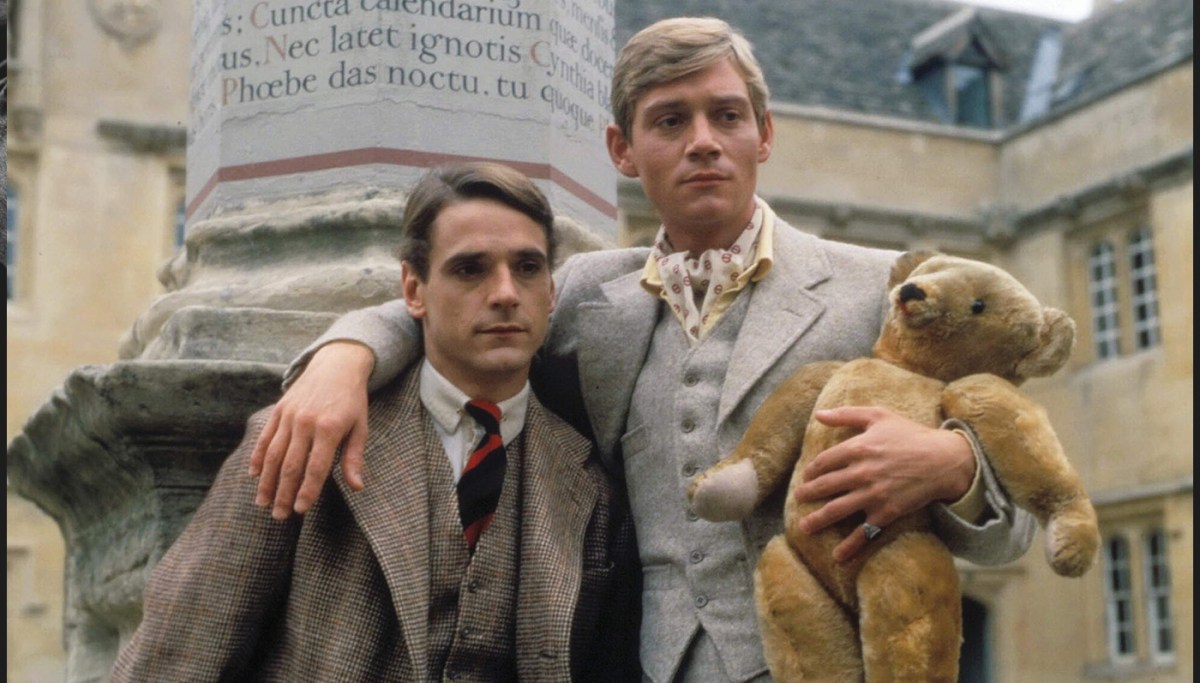
Five years ago, I met a young man of Eastern European descent who sounded exactly like the Queen of England. He wore a cravat, dark nail polish, and a velvet smoking jacket, and was a closeted gay person whose type in men were poor waiters just getting off a 12-hour shift. It turned out he shared a publicist with socialite-turned-infamous scammer Anna Delvey, which was pretty impressive considering that he had no job and nothing whatsoever to publicize. Depending on which business card he landed on, some evenings he was a journalist, an art critic, “in luxury real estate,” or, if he was feeling particularly drunk and honest, rich and unemployed, dahhling. I had never met anyone like him, and could never work out how such a life was decided on and paid for, until last month, when I sat down with all 11 episodes of ITV’s Brideshead Revisited, first broadcast 45 years ago this month. My friend, the Lord — he really does go by Lord — has been doing a decadelong impression of the stuttering aesthete Anthony Blanche. Recommended Stories This was the first of several lightbulb moments during what was, embarrassingly, my first encounter with Evelyn Waugh’s 1945 novel. For the uninitiated, the story is told through a series of flashbacks by the expressionless Charles Ryder (Jeremy Irons), a weary army captain in 1943 whose company is posted at a crumbling castle he once knew intimately, 20 years earlier, when as a less-than-grand Oxford undergraduate, he fell under the spell of Lord Sebastian Flyte (Anthony Andrews), who is golden, idle, and heartbreakingly funny. Sebastian takes him home to Brideshead Castle, where Charles meets the rest of the aristocratic English Catholics in his family who are ruled by a pious, suffocating mother (Claire Bloom), while their father (Laurence Olivier) sulks in Venice with his Italian mistress. Over the following two decades, after getting kicked out of Oxford, Sebastian drinks himself into exile, and near death, Charles falls in love with Sebastian’s sister, Julia (Diana Quick), and the Flyte family is plagued by death and misery and impending war.Having grown up in a part of Britain where nobody sounds like the Queen but everyone resents those who do, and where the nearest thing to a cravat is a scarf in the colors of the local football club, I had always nursed a suspicion that the people who talk like that are simply putting on. What I had never established was who they were copying. Well, now I know. Every bumbling Old Harrovian, every backbencher with a floppy fringe, every 23-year-old in his grandfather’s tweed: They are all understudies from the production of Brideshead Revisited that has been running since 1981 and — unexpectedly to all concerned — changed the way two nations dressed, drank, and spoke. Jeremy Irons and Anthony Andrews in “Brideshead Revisited.” (Courtesy of IMDB) If Britain lost its head, America lost its mind. When the series reached PBS in January 1982, the Washington Post‘s Henry Mitchell called it “the best series ever seen on American television.” Each episode of the American airing was remarked upon at the end by William F. Buckley Jr. One critic writing for Newsday commented that Buckley was like the uptight eldest Flyte brother, writing: “He has a certain lack of humor about his condition. His face is set in perpetual grimace, a pained expression which is contagious. He even sounds more British than Bridey.”Within a month of the miniseries, the novel was top of the paperback bestseller lists, and Bloomingdale’s soon opened a shop pegged to the show that sold Oxford bags and low-waisted linen dresses. The Washington Post‘s own Jonathan Yardley grumbled that gullible Yankees had been conned. “We’ve been duped!” he wrote. “It’s just a British bore, a soap opera for the educated and moderately affluent gentry that gets its politics from public radio and its economics from Louis Rukeyser.” He was half right, of course. It was a posh soap, directed, in the end, by the inexperienced director Charles Sturridge, who cut his teeth on Coronation Street, the working-class soap opera that has been a weekly staple for British families since 1960. But it was high art, too. And for a generation of Americans desperate to dip their toe in the murky waters of British aristocracy, it also served as a finishing school of sorts.I know a handful of American men who went to Oxford, and every one of them arrived with Brideshead in his heart — they came from Ohio or New Jersey or Boston, and within a term they’d bought a signet ring and started regularly using the word “frightfully.” They also had opinions on claret that nobody had asked for, and learned to wince at anyone who didn’t know.A NEGLECTED BOOK MAKES THE CASE FOR BIRDS Waugh wrote his novel in 1943 and 1944 as a eulogy. The crumbling castles and the class of people who lived in them, he was sure, were finished. The interwar decadence and the ruins of modernism had begun to feel ominous to the novelist, who famously took refuge in Catholicism, like so many redpilled men in the digital age. The work and the feelings behind it were ahead of their time in another way, too: Much of the film and literature of the millennial and Generation Z sets works harder at establishing a “vibe” than weaving a tale. In Brideshead, the story and the characters Waugh wrought, while compelling, were almost beside the point — the point was to create a portrait of a moment in society as represented through its elite.Waugh needn’t have worried about the grand houses, which were the dilapidated private country homes of an aristocracy that couldn’t afford them then and are now simply the dilapidated hotels of the bourgeois, who enjoy gawking at what the aristocracy could once afford. It was the aesthetic of a time and a class in Britain that proved immortal, and it no longer needed a house at all. Whatever Britain may actually be, it is understood and understands itself as a sort of brand identity, a mood board of tweeds, tea, doting butlers, and Oxford’s limestone buildings. Thanks to Brideshead, to be a bumbling, champagne-swigging dandy costs nothing. It’s why my friend the Lord never needed a real title or a castle, just a costume.Kara Kennedy is a contributing writer at the Free Press and writes for the Daily Telegraph.
Remembering the miniseries ‘Brideshead Revisited’ at 45
Full Article
Original Source
Read the full article at Washingtonexaminer →KhanList aggregates and links to publicly available news content. We do not host full articles from third-party sources. Always verify important information with original sources.