
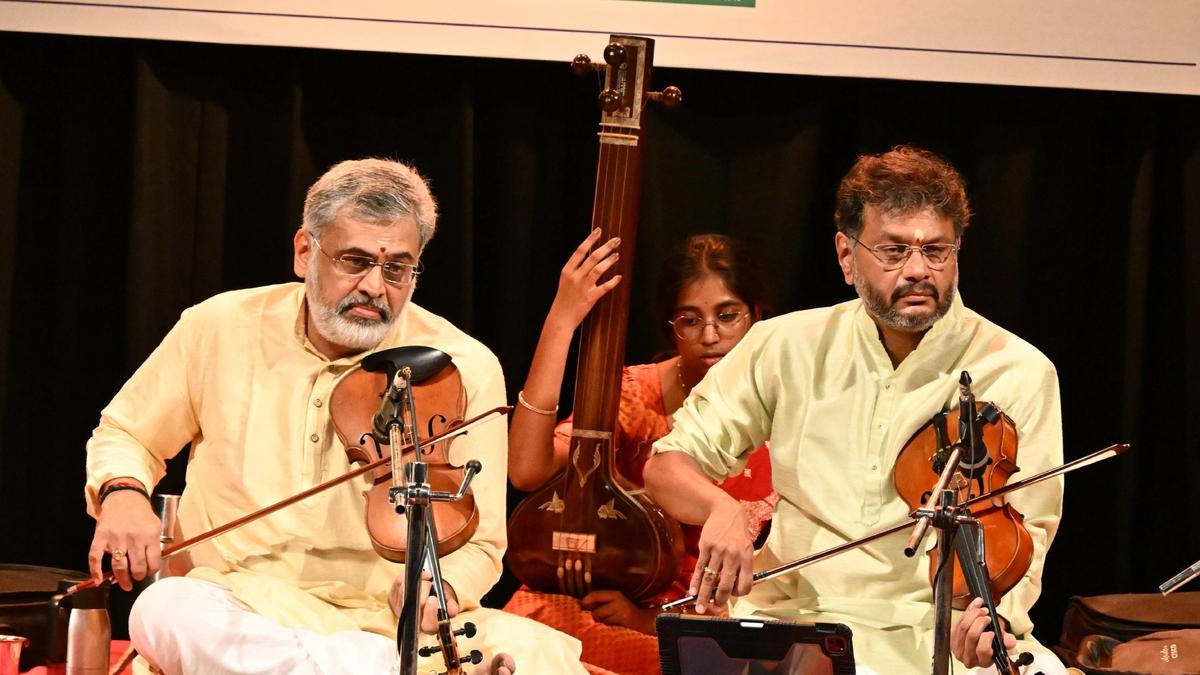
Violin duet by H.K. Venkatram and B.U. Ganesh Prasad performed at the Lalgudi G. Jayaraman Memorial Endowment concert. | Photo Credit: R. Ragu It was billed as a violin duet, and so it was, as H.K. Venkatram and B.U. Ganesh Prasad took the stage. However, their unison in playing style, identical tonal hue, control over myriad modulations and impressive sruti alignment combined to create cohesive music. This was a Lalgudi G. Jayaraman memorial endowment concert at Kasturi Srinivasan Hall, and one was reminded of the legend’s recitals with his son and daughter.That the concert would be bookended by a Lalgudi varnam and a thillana was almost a given, considering the composer’s specialisation in these genres. The judicious choices in between enhanced the performance, as did the support from accompanists Neyveli S. Skandasubramaniyam (mridangam) and Adambakkam K. Sankar (ghatam). That the first four of the six compositions were in Telugu, albeit by different composers, may be purely of academic interest in an instrumental recital.The Nalinakanti varnam, ‘Neeve gatiyani’, on Shanmukha, proved an ideal springboard: its vakra pattern in the ascent (sa ga ri) and its swaraksharas (ma pa ni) lent the music pleasing lilts. The staccato phrases leading to a crescendo in the muktayi swara, and the quickened tempo of the charanam and its swaras, were delivered with elan. So were the high-speed kalpanaswaras. H.K. Venkatram and B.U. Ganesh Prasad. | Photo Credit: R. Ragu The duo next took up ‘Guruleka etuvanti’ in Gowrimanohari, where Tyagaraja underlines the indispensability of a guru’s grace. The percussive synergy in this Khanda Chapu kriti was pronounced, embellishing the presentation.The duo next explored the regality of raga Begada, with Ganesh Prasad opening the essay and Venkatram taking over. The characteristic phrases that unfolded revealed the beauty of the vakra movements in the arohanam. Subbaraya Sastri’s prayer for succour to Kamakshi, ‘Sankari neeve’ in Rupaka tala, followed. The kalapramanam, though, could have been more relaxed.Mandhari is an interesting shadava-shadava raga with a seemingly dual character. The exclusion of just the dhaivatam from Kamavardhani, the 51st melakarta, gives it a Pantuvarali-like gravity, while the ‘ga ma pa ni’ sequence conjures a strong Amritavarshini flavour. Patnam Subramanya Iyer’s ‘Ninnu jeppa karanamemi’ — a touchstone composition that carries the raga’s imprint throughout, much like Tyagaraja’s ‘Paraloka bhayamu’ — was the one the duo presented. A compelling rendition of the kriti gave way to sprightly swara exchanges at the pallavi opening. H.K. Venkatram and B.U. Ganesh Prasad (violin duet) with Neyveli S. Skandasubramaniyam on the mridangam and Adambakkam K. Sankar on the ghatam. | Photo Credit: R. Ragu This set the stage for the evening’s main segment. Thodi was the chosen raga, which, like other major ragas, is akin to a deep mine with so much to explore and unearth. Venkatram began by dwelling on the lower registers long enough to form the base. He seamlessly wove spiralling phrases, imparting the right quotient of gamakas, while building the alapana up to the tara shadjam. Ganesh Prasad continued, showcasing the raga’s full facets in the upper octave with long, gamaka-filled rallies before concluding the essay in a measured manner. ‘Srikrishnam bhaja manasa’ was rendered with niraval and kalpanaswara at ‘Sankha chakra’ in two speeds. Skandasubramaniyam and Sankar shone throughout, and their tani avartanam in two-kalai Adi tala demonstrated their rhythmic versatility.The Desh thillana is methodical yet magical — a hallmark of Lalgudi’s craft. The sangatis build up organically, bringing out the raga’s contour in a serene flow. The leisurely pace of the rendition allowed the violinists to highlight this aspect, as the recital drew to a close. Published - October 07, 2026 01:41 pm IST
Remembering Lalgudi Jayaraman through a violin duet
Full Article
Original Source
Read the full article at Thehindu →KhanList aggregates and links to publicly available news content. We do not host full articles from third-party sources. Always verify important information with original sources.