
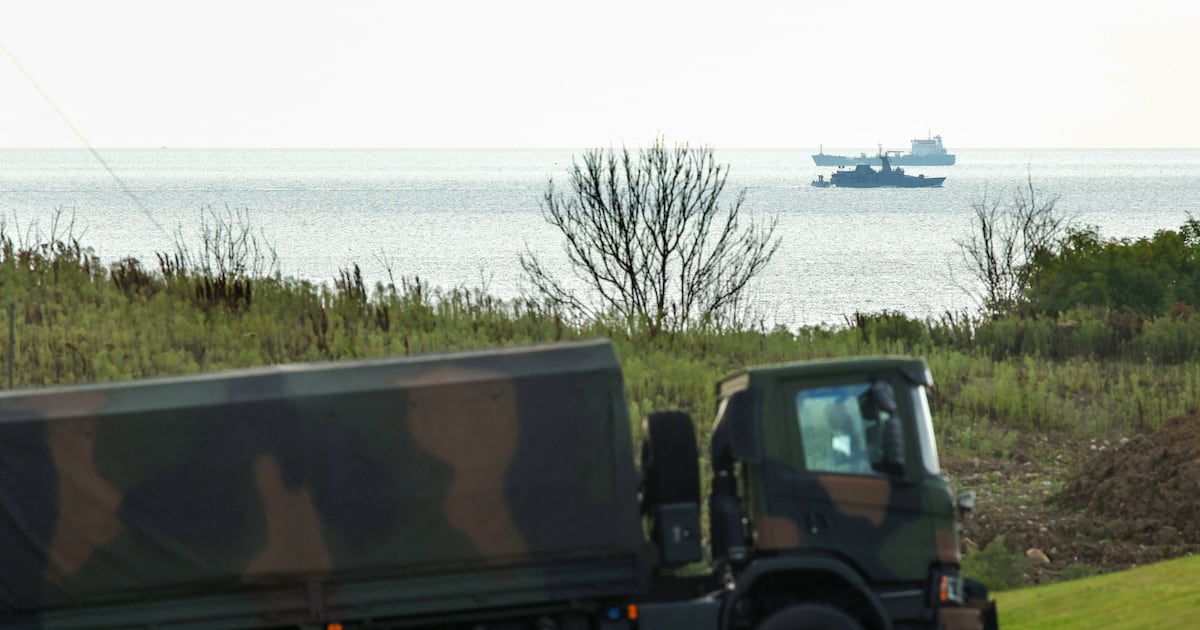
The presence of the French warship Aquitaine off the coast of Dublin in early July was not a very well-kept secret.The ship came to provide security during the arrival of heads of state in the capital to mark Ireland taking over the six-month presidency of the Council of the European Union. As is standard for naval ships on active operations, it had its publicly facing location transponder switched off. But it hardly mattered – the 142-metre-long frigate was easily visible to anyone flying overhead, including civilian passengers flying into Dublin Airport.READ MOREIt was a similar situation when a UK frigate arrived about 32km off the Irish coast late last week ahead of a meeting of EU defence and foreign affairs ministers in Co Wicklow.The ship also concealed its location from open-source trackers, but the Merlin helicopter operating from its deck kept its transponder turned on. On flight tracking platforms, the helicopter – equipped with advanced sensors for tracking surface and subsurface vessels and anti-submarine torpedoes – appeared, as if from thin air, in the middle of the Irish Sea on Monday morning.It flew a few loops and briefly inspected a Portuguese cargo ship before disappearing at the exact same spot it first appeared. EU foreign ministers including Minister for Foreign Affairs and Defence Helen McEntee (centre) and European Commission high representative and vice-president Kaja Kallas (second left, front row) during their informal meeting at Druids Glen in Wicklow, on September 2nd. Photograph: Paul Faith/AFP/Getty Punching those co-ordinates into open-source satellite software showed a blurry, grey smudge, roughly the shape of a naval ship. The length of the object, 130 metres, almost exactly matched the length of a Royal Navy Type 23 frigate, which is typically armed with 32 anti-air missiles along with an array of other weapons.Both the French and UK ships were there at the request of the Irish Government. The State does not possess advanced long-range air defence equipment of its own. The vessels sat under the flight paths of the jets ferrying in EU leaders to Dublin. Their main job was to prevent a repeat of last December’s incident when five drones were spotted on the flight path of Ukrainian president Volodymyr Zelenskiy’s aircraft shortly after he landed in Dublin.[ Drone wars: Irish Defence Forces watching the skies as EU presidency set to beginOpens in new window ]The ability of the two foreign ships to conduct this mission was complicated by a stipulation from Irish officials that they remained outside Irish territorial waters that extend 12 nautical miles (22.3km) from the Irish coast. This was to comply with the Irish Constitution. It was an Irish solution to an Irish problem which, according to military sources, only had a limited impact on the effectiveness of the warships.Minister-level EU meetings hosted in Ireland so far have passed off without any incident or disruption. A security breach – perhaps the appearance of a rogue drone controlled by a team sent or paid for by Russia – would be a source of serious embarrassment, and would pull the State’s low spend on defence into sharp focus. The need for French and British ships to provide cover is politically delicate, given Irish military neutrality. The Government has been preparing the ground for months for these events, both behind the scenes and in public. “I don’t think we should be afraid to seek assistance if it’s needed from other countries,” Minister for Foreign Affairs and Defence Helen McEntee remarked in February.Politicians have adopted a policy of not confirming details of what that military assistance looks like in practice. “I won’t get into security details; what I can say is that we have a significant security operation in place,” McEntee said this week in Wicklow. “We have worked closely with international and European colleagues for many, many years on many security matters, and we’re no different to any other member state in that regard,” she added. “This type of co-operation is not unusual in Europe,” a senior source involved in planning for the presidency said. The Government would have preferred if the precise nature of the help from its European neighbours had remained a secret, particularly the involvement of a British ship protecting an EU meeting in Ireland, years after Brexit.The presence of naval ships belonging to foreign powers highlight Ireland’s shortcomings in the realm of defence. Despite what McEntee claims is a 43 per cent increase in defence spending, Ireland remains bottom of the EU table. It invests just 0.2 per cent of gross domestic product (GDP) in defence. By contrast, neutral Austria invests about 1 per cent.The Naval Service is only capable of putting two ships to sea at a time, and even these lack basic functions, such as air search radars and electronic countermeasures for drones. The Air Corps lacks a primary radar system to detect airborne threats. It also lacks air interceptors to respond to a threat, even if one was detected.Security measures in place ahead of an informal meeting of EU defence ministers at Druids Glen in Wicklow, on September 1st. Photograph: Paul Faith/AFP/Getty On land, the situation is not much better. The Army operates about six ground-to-air missile systems with a maximum range of 9km as well – hence the requirement for British and French assistance.However, that does not mean the Defence Forces have been sitting on their hands. In March, the military established Operation Fianna, which co-ordinates Army, Naval Service and Air Corps units to mitigate potential threats to the EU presidency events. These are assisted by special forces, cyber, medical and intelligence units.Despite the limited resources available, Fianna is a sophisticated, complicated and, to date at least, successful operation which involves at times up to 10 per cent of Defence Forces personnel.Anyone tracking the path of the British Merlin helicopter on Monday would have also spotted Wolf 1 and Wolf 2, two Air Corps helicopters flying near Dublin Airport, armed with door-mounted machine guns to shoot down any potential rogue drones.Further south, three turbo prop PC-9 aircraft, with the call sign Panther and fitted with machine guns and rockets, patrolled at low altitude over Wicklow, while Kraken, a maritime patrol aircraft, inspected ships in the Irish Sea in co-operation with the British vessel. Another helicopter with the call sign Raven provided sniper cover. Individual soldiers, known as air sentries, were armed with shotguns and radio jammers to complement anti-drone defences on the ground. [ What would happen if Russians landed at Shannon and took over the airport?Opens in new window ]In the water, Irish naval vessels the LÉ George Bernard Shaw and Samuel Beckett patrolled the sea, while various smaller boats patrolled ports and rivers.The experience of other countries has shown that even when suspicious activity is picked up, it can be very difficult to trace who is behind it. For example, the night sky above Camp Borris, a military training site on Denmark’s remote western coast, had been clear and starry on September 28th, 2025. It was a couple of minutes past 8pm when several soldiers spotted an object flying through the air. The suspected drone was judged to be flying over the camp at about 150 or 200 metres of altitude, according to an investigation conducted afterwards by Danish armed forces.Several soldiers were tracking it through the scopes of their rifles. Acting on orders, they opened fire when the object passed above the camp’s shooting range, but the object was not recovered.This was one of several incidents where suspected drones appeared near airports and military installations in the week before Copenhagen hosted a major summit of European leaders, another of which will be staged in Dublin in November. The report from the Danish army, published this June, said thermal imaging equipment captured a cluster of drones over a separate airbase two days before the Camp Borris sighting. In another incident, four drones were spotted “circling” a navy ship before flying away.Minister for Foreign Affairs and Defence Helen McEntee and European Commission high representative and vice-president Kaja Kallas attend a joint press conference at an informal meeting of EU defence ministers at Druids Glen in Wicklow, on September 1st. Photograph: Paul Faith/AFP/Getty Danish prime minister Mette Frederiksen privately told fellow EU leaders at the time that Russia was likely behind the interference. The disruption had the hallmarks of a Moscow-backed “hybrid” operation to spark panic and undermine trust in European democracies and their institutions. Suspected drone sightings forced Copenhagen airport to shut its airspace temporarily several days before nearly 50 European heads of state and government were due to arrive. Denmark, a country of similar population size to the Republic, has a well-equipped military force and is a Nato member, but still sought help from allies to secure the high-profile European Political Community (EPC) meeting. France, Germany, the UK and Sweden sent military personnel and anti-drone equipment. Their presence on Danish territory was governed by a Nato co-operation agreement. Irish officials spent time studying the security operations put in place by Denmark and other EU countries which had recently managed the union’s rotating presidency, which passes between member states every six months. Ireland took over the deal-making role from Cyprus. The Mediterranean island is geographically close to the Middle East and found itself grappling with a very real military threat as the war in Iran spilled into the wider region. An Iranian-made drone believed to have been fired from Lebanon hit a UK airbase on Cyprus in March, prompting European governments to dispatch help. France, Germany, Italy and Spain sent naval ships to guard the skies. Greece, the small island’s closest ally, sent two frigates and F-16 fighter jets to assist. Speaking to The Irish Times, Constantinos Kombos, the foreign minister of Cyprus, said more “extreme” measures were not deemed to be required to safeguard EU meetings they had hosted. “In our case we did what we had to do in terms of ensuring the security. We have close relations with many countries,” he said. “We are not a country that’s part of Nato. We had to make sure that there was security.”This week, Ireland too had to rely on the kindness of neighbours to supplement its defences.
Relying on neighbours: foreign defenders step in to protect State in dangerous times
Full Article
Original Source
Read the full article at Irishtimes →KhanList aggregates and links to publicly available news content. We do not host full articles from third-party sources. Always verify important information with original sources.