
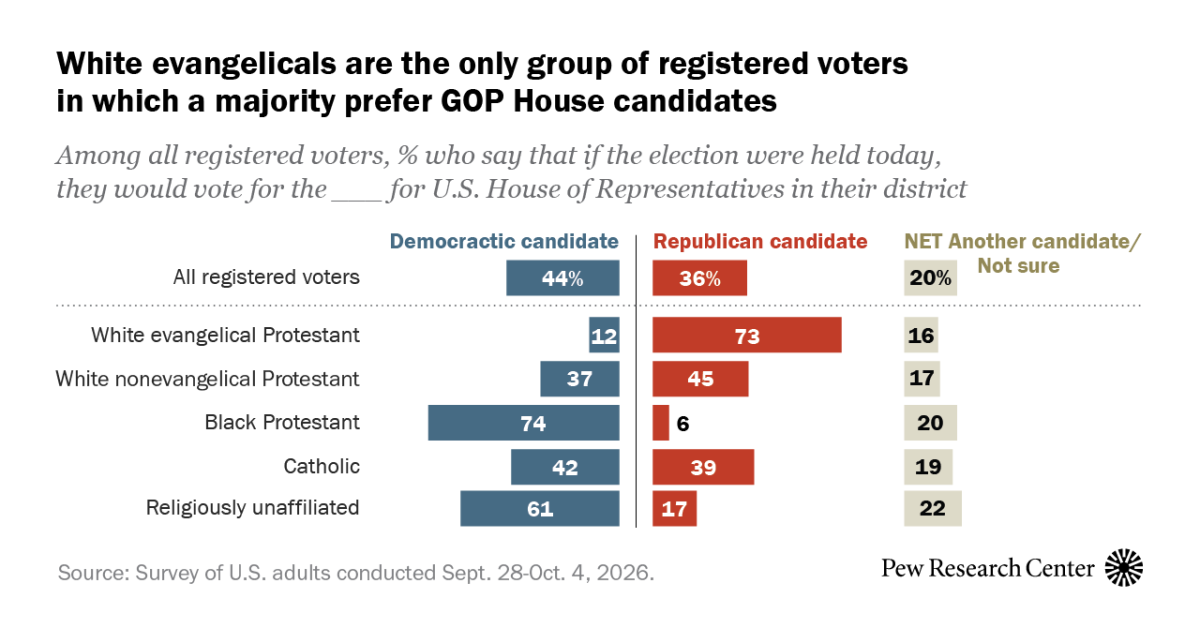
White evangelical Protestant and White Catholic registered voters prefer Republican candidates over Democratic candidates for the U.S. House of Representatives. Registered voters in every other religious group we can analyze either are split roughly evenly or favor Democratic candidates in this year’s midterm elections, according to a new Pew Research Center survey. Overall, registered voters are more likely to support Democratic candidates than Republican ones. And registered voters who support Democratic candidates are more engaged in the election and more motivated to vote than those who back Republican candidates. For a complete analysis of the survey results, read “With Americans in a Sour Mood, Democratic Voters Are More Engaged in Midterms.” The survey, conducted Sept. 28-Oct. 4, also finds that President Donald Trump’s approval ratings among members of every religious group we can study are among the lowest of his second term. Even religious groups who have traditionally been his strongest supporters see him less favorably than they used to. About this research This Pew Research Center analysis looks at midterm vote preferences and views of President Donald Trump across a variety of religious groups. Why did we do this? Pew Research Center does research to help the public, media and decision-makers understand important topics. We have studied religion’s role in politics for decades. Learn more about Pew Research Center. How did we do this? We surveyed 5,062 U.S. adults, including 3,917 registered voters, from Sept. 28 to Oct. 4, 2026. Everyone who took part in this survey is a member of the Center’s American Trends Panel. The survey represents the views of the full U.S. adult population. Here are the survey questions used for this analysis, the detailed responses and the survey methodology. Which religious groups are most likely to support Republicans or Democrats? White evangelicals are the only group of registered voters in which a majority prefer GOP House candidates Among all registered voters, % who say that if the election were held today, they would vote for the ___ for U.S. House of Representatives in their district Note: Based on registered voters. White and Black adults include those who report being only one race and are not Hispanic; Hispanics are of any race. In most cases, the survey used geographic information that respondents provided to show them the names and party affiliations of the candidates running in their congressional districts. Refer to the topline for more details. Source: Survey of U.S. adults conducted Sept. 28-Oct. 4, 2026. PEW RESEARCH CENTER White evangelicals are the only group of registered voters in which a majority prefer GOP House candidates Among all registered voters, % who say that if the election were held today, they would vote for the ___ for U.S. House of Representatives in their district groupDemocratic candidateRepublican candidateNET Another candidate/Not sureAll registered voters1443620Protestant2324919White evangelical Prot.2127316White Prot., not evangelical2374517Black Prot.274620Catholic2423919White Catholic2325018Hispanic Catholic2591921Religiously unaffiliated2611722Atheist281910Agnostic2751311Nothing in particular2482229 Note: Based on registered voters. White and Black adults include those who report being only one race and are not Hispanic; Hispanics are of any race. In most cases, the survey used geographic information that respondents provided to show them the names and party affiliations of the candidates running in their congressional districts. Refer to the topline for more details. Source: Survey of U.S. adults conducted Sept. 28-Oct. 4, 2026. PEW RESEARCH CENTER Roughly three-quarters of White evangelical Protestant registered voters (73%) now say they would vote for their congressional district’s Republican candidate for the House if the election were held today. A far smaller share (12%) say they would support the Democratic candidate. White Catholic voters also express more support for Republicans than for Democrats in their districts, though by a much narrower margin (50% vs. 32%). White nonevangelical Protestant voters are split about evenly. The difference between the shares supporting Republican candidates (45%) and Democratic candidates (37%) is not statistically significant. There is far more support for Democrats than Republicans among Black Protestants, Hispanic Catholics, atheists, agnostics and those who describe their religion as “nothing in particular.” This analysis is based on all registered voters, but many are not expected to vote in the midterm elections. For example, 46% of those eligible voted in the 2022 midterm elections. Our validated voter surveys include information about how various religious groups voted in the 2024 presidential election and the 2022 midterms. How different religious groups feel about Trump Since the beginning of his second term, Trump’s approval rating has dropped significantly among all U.S. adults. The downward trend is evident in every religious group. (Note that this analysis of presidential approval ratings is based on all respondents, not just registered voters.) Trump’s approval rating from every religious group is lower now than at the beginning of his second term % of U.S. adults who approve of the way Donald Trump is handling his job as president Note: White and Black adults include those who report being only one race and are not Hispanic; Hispanics are of any race. Source: Survey of U.S. adults conducted Sept. 28-Oct. 4, 2026. PEW RESEARCH CENTER Trump’s approval rating from every religious group is lower now than at the beginning of his second term % of U.S. adults who approve of the way Donald Trump is handling his job as president All ProtestantWhite evang. ProtestantWhite Prot., not evang.Black Prot.All CatholicWhite CatholicHispanic CatholicAll relig. unaffiliatedAtheistAgnosticNothing in particularJan-Feb 20255878571847593133172241Apr-255072511042512626151732Jun-255374511543542727132034Aug-255070511638482524121731Sep-25507252154156232692233Jan-26476946123952232481930Apr-26456543113549182191527Jul-264364401133442021121526Sep-Oct 202639583873039181781221 Note: White and Black adults include those who report being only one race and are not Hispanic; Hispanics are of any race. Source: Survey of U.S. adults conducted Sept. 28-Oct. 4, 2026. PEW RESEARCH CENTER Today, White evangelical Protestants are the only religious group in which more people approve than disapprove of Trump’s job performance (58% vs. 40%). In every other group, more disapprove than approve. Atheists, agnostics and Black Protestants are the most likely to disapprove of Trump’s handling of the job. In most religious groups, more people disapprove than approve of Trump’s job performance % of U.S. adults who ___ of the way Donald Trump is handling his job as president Note: Those who did not answer are not shown. White and Black adults include those who report being only one race and are not Hispanic; Hispanics are of any race. Source: Survey of U.S. adults conducted Sept. 28-Oct. 4, 2026. PEW RESEARCH CENTER In most religious groups, more people disapprove than approve of Trump’s job performance % of U.S. adults who ___ of the way Donald Trump is handling his job as president groupApproveDisapproveAll U.S. adults13068Protestant23958White evangelical Prot.25840White Prot., not evangelical23860Black Prot.2790Catholic23067White Catholic23959Hispanic Catholic21878Religiously unaffiliated21782Atheist2892Agnostic21287Nothing in particular22177 Note: Those who did not answer are not shown. White and Black adults include those who report being only one race and are not Hispanic; Hispanics are of any race. Source: Survey of U.S. adults conducted Sept. 28-Oct. 4, 2026. PEW RESEARCH CENTER Note: Here are the survey questions used for this analysis, the detailed responses and the survey methodology. Gregory A. Smith is a senior associate director of research at Pew Research Center.
Religious Groups Differ Widely in Their 2026 Midterm Preferences
Full Article
Original Source
Read the full article at Pewresearch →KhanList aggregates and links to publicly available news content. We do not host full articles from third-party sources. Always verify important information with original sources.