
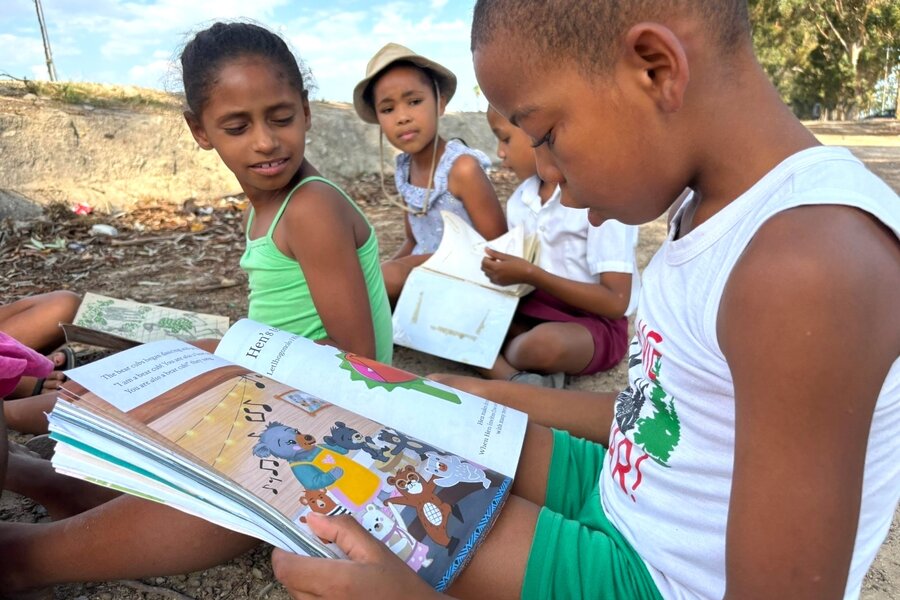
Around the world, there’s a quiet, transformative protest taking place. It doesn’t involve politics or economics, a street presence or placards.Rather, it’s about reviving the joy of reading – for connection and pleasure, and beyond academic learning. Communities, educators, parents, and students of all ages are embracing this approach. It’s an evolving response to concerns about poor reading abilities among children, as well as the decline in the share of people – young and old – who say they read for pleasure.This month, Britain’s National Literacy Trust hosted a global event to get the most people reading in a 12-hour period. It was joined by thousands. A few weeks ago, North Carolina announced a campaign encouraging the state’s children to read 10 million books of their choice in 2027. And in early September, the Library of Congress gave one of its 2026 international awards to the Nal’ibali Trust in Cape Town, South Africa, which helps children and caregivers engage in the sheer delight of reading aloud and storytelling. Mini libraries and reading groups are popping up, from laundromats in Wyoming to “bazaars, temples and bus stops” in rural India, according to the online magazine Reasons To Be Cheerful. Such initiatives speak to the innate human inclination to imagine and understand lives and worlds beyond one’s own. They are also expanding the concept of reading from being primarily a solitary pursuit to involving a wider family or community endeavor. Even formal school systems are making more space for the shared experience in approaches to teaching reading or literature. And they’re finding that, despite online distractions, young people are both eager and able to engage with longer narratives and deeper reflection.“We live in the age of the reel, ... the clip ... the excerpt,” according to Walt Hunter, a humanities professor at Case Western Reserve University in Ohio. As a result, “assignments have been abbreviated so dramatically ... [to] fewer than three books a year,” he wrote in The Atlantic this year. But recently, he shifted from this approach to one that allowed “tarrying” and “developing a relationship” with an author across several books.To his surprise, students fully engaged with the more extensive reading. And, in doing so, Professor Hunter observed, they had also “taken back their lives, for an hour or two each day.” Students are “tired of just reading excerpts,” a middle school principal told Chalkbeat, a nonprofit education site. “They’re begging their teachers. Can we just read a couple of chapters and read it straight through?”In fact, according to two researchers, young people’s love of reading might be underestimated. Concern about this cohort, they wrote in The Conversation in August, should acknowledge how members of Generation Z consume literature, which is “multimodally – bouncing between print, e-book and audiobook.”Compared with previous generations, “Gen Zers are more likely to experience reading as a social activity,” including through “silent reading parties,” where they find “community around books,” the researchers reported. And, they pointed out, the number of independent bookstores in the United States has risen by 70% over the past five years, and one national chain has planned to open 60 new stores in 2026. Deepen your worldviewwith Monitor Highlights.Politics with respectGet political stories with respectful analysis.There‘s a world of new ideas in everyBooks newsletter.There‘s more to life, enrich yours withCulture & Learning weekly.Follow humanity‘s discoveries withScience & Nature stories in your inbox.Gain a spiritual perspectivefrom the stories in your inbox.Want to understand the deeper impact of critical events? Learn the Monitor‘s insight.Already a subscriber? Log in to hide ads. According to Tom Bober, a school librarian in Clayton, Missouri, the pressure of state curricula and literacy mandates forces the question: “Can every child read?” What Mr. Bober prefers to ask, he told Education Week, is slightly different: “Does every child want to read?”That’s a subtle yet meaningful distinction. And, with the help of creative initiatives and adaptations in communities and schools, the answer still appears to be yes. ALREADY A SUBSCRIBER? LoginReal news can be honest, hopeful, credible, constructive.The Christian Science Monitor was founded in 1908 to lift the standard of journalism and uplift humanity. We aim to “speak the truth in love.” Our goal is not to tell you what to think, but to give you the essential knowledge and understanding to come to your own intelligent conclusions. Join us in this mission by subscribing.
Reigniting the joy in reading
Full Article
Original Source
Read the full article at Csmonitor →KhanList aggregates and links to publicly available news content. We do not host full articles from third-party sources. Always verify important information with original sources.