
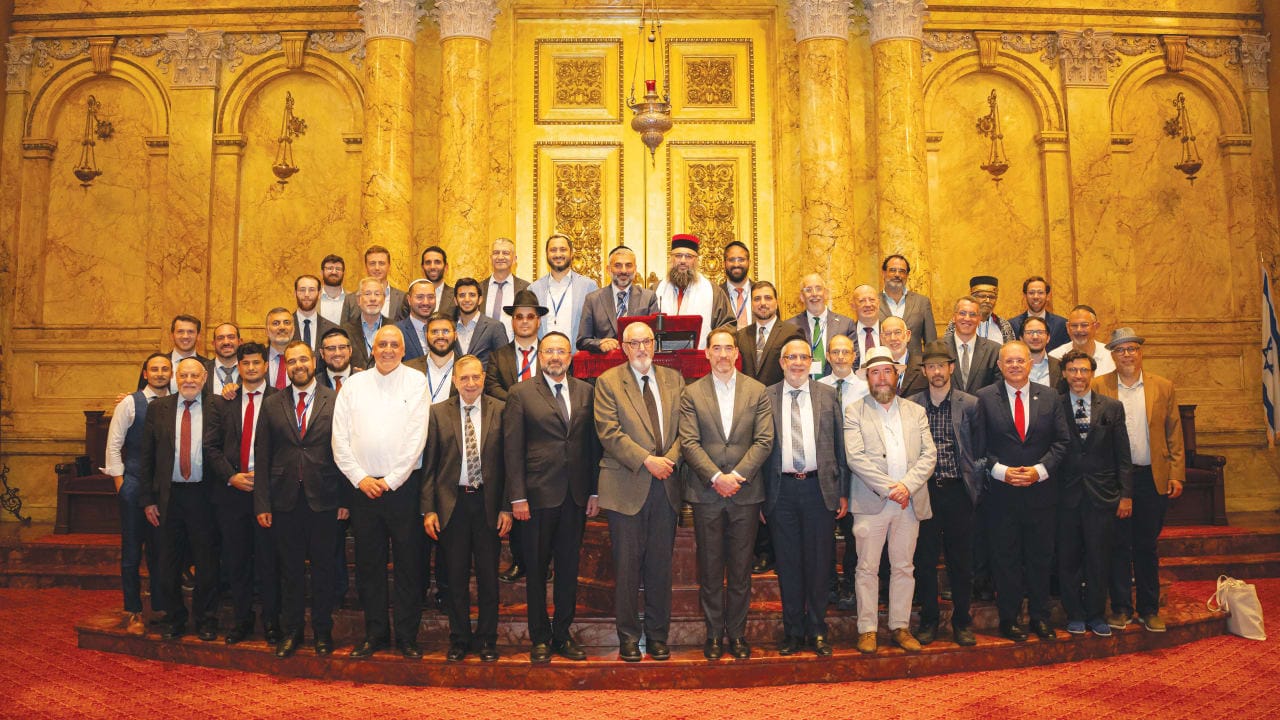
NOVEMBER 6, 2026 20:07On a summer evening in August, in the sanctuary of Manhattan’s Congregation Shearith Israel, more than 150 rabbis, scholars, and communal leaders sat down to listen to a concert of Sephardic liturgy. They had come from over a dozen countries to attend the second Sephardic Rabbinic Conference, “The Art of Leadership.” Over two days, the program ran from halachic decision-making and pastoral care to AI and Israel advocacy.Those addressing the conference, in person or on video, included: the rosh yeshiva of Birkat Moshe in Ma’ale Adumim, Rabbi Haim Sabato (a recipient of this year’s Presidential Medal of Honor); the chief rabbi of Kiryat Ono, Ratzon Arussi (the leading disciple of Rabbi Yosef Qafi); the rosh yeshiva of the Ramat Gan hesder yeshiva, Rabbi Benzion Algazi, who is also the founder of the Tzurba M’rabanan Institute; the consul general in New York, Ofir Akunis; and the World Zionist Organization chairman, Yaakov Hagoel.The conference is the visible part of something that mostly happens far from any stage.On a weekday evening in London, a rabbi opens a laptop and begins a class on the introduction to Maimonides’s Mishne Torah. In Mexico City, it is early afternoon; in Jerusalem, it is nearly bedtime. Nothing about the scene looks like a revolution.There is a text, a teacher, and a few hundred people in a dozen time zones who have decided that this is how they want to spend an hour.A year earlier, the first conference drew some 50 rabbis from six countries. This year, the delegates came from Turkey, the United Arab Emirates, Mexico, Spain, the UK, Israel, and Argentina, serving the Syrian, Persian, Moroccan, Greek, Bukharian, and Spanish and Portuguese communities. The conviction was that a way of being Jewish, which once stood at the center of Jewish life and was pushed to the edges, can be brought back.The worldly traditionThe thing being reclaimed has a name in the movement’s own literature: worldliness. It describes a posture toward knowledge worked out by the geonim, the spiritual and legal leaders of the Jewish world from the late sixth century to the 11th century of Babylonia. This knowledge was carried to its height in medieval Spain and Provence, in which grammar, logic, medicine, astronomy, and philosophy were treated as instruments of Torah study.The reasoning is short enough to fit on a card, and The Habura – the study community at the center of all this – prints it on its website (thehabura.com): the author of the Torah is the author of the world.It was also a tradition of the middle. Maimonides built his ethics on the mean between extremes. His halachic heirs in Spain, North Africa, and the Ottoman lands ruled in a way that let Jews live in the world that they found themselves in.When the great quarrel over Maimonides broke out in the 13th century, the voice that has aged best was that of Rabbi Menahem Meiri of Perpignan, who refused to join either camp, valued philosophy openly, and declined to throw out a book full of gems on account of two or three doubtful lines.That quarrel is the subject of The Battle for the Jewish Mind, published this year by Sina Kahen, co-founder of The Habura and founder of Da’at Press. In the winter of 1232, in the marketplace of Montpellier, Dominican friars burned the writings of Maimonides at the invitation of Jews who believed they were defending the faith. The controversies that followed, Kahen argues, never properly ended.“The ashes cooled a long time ago,” he writes. “The fire itself has not.”What happened to it?From mainstream to minorityHow a tradition that was once the mainstream became a minority position is a story of numbers and institutions. In the 11th century, nearly all Jews were Sephardic. By the 1930s, more than nine in 10 were Ashkenazi, and the Ashkenazi world had spent two centuries building modern religious institutions, above all the yeshiva, which survived World War II and then set the terms of what counted as traditional Judaism.The Sephardim built little that was comparable.The political scientist Daniel Elazar, writing a generation ago, judged that the Sephardic rabbinate was well on the way to “Ashkenazification” by the time Rabbi ben-Zion Uziel, the Sephardi chief rabbi of Mandatory Palestine, died in 1953.Sephardic Jewry failed to build the educational institutions and “metivta” (the traditional Jewish academies for boys that focus on Talmudic and religious studies). Instead, a tradition foreign to Sephardic ethos became dominant.Leadership formed in one world onlyThe consequence is a leadership class formed almost entirely in one educational world. Its graduates can be superb. Most have never been shown the older worldly method as a complete system, with its own sequencing, its priority of Bible and grammar, its way of handling aggada (non-legal portions of classical rabbinic literature) and the sciences.“A method that is never taught as a whole cannot compete as a whole,” Kahen says. “So communities kept the customs and lost the formation. A Sephardic synagogue today can have Moroccan melodies, a Syrian kiddush, and a rabbi whose entire training was Lithuanian.“Nobody planned that. It is what happens when you have no institutions of your own.”The response has come in three parts, and the people behind them are candid that any one alone would fade.The Habura, founded by Kahen and Avi GarsonThe Habura is the study hall. Founded by Kahen and Avi Garson, it teaches more than 2,000 students in English, Hebrew, and Spanish in more than 20 countries, with in-person groups in Britain, the United States, Mexico, Brazil, and Israel; and records over 1,000 hours of Torah study a month.Its rosh bet midrash is Rabbi Joseph Dweck, who served as senior rabbi of the Spanish and Portuguese Sephardi community of the United Kingdom from 2013 to 2025, and who holds the Rabbi Levy Chair of Jewish Wisdom at the London School of Jewish Studies. Its teachers include dayanim (religious court judges) and rabbis alongside historians and scientists, which is the point.The Da’at Press libraryDa’at Press is the library. Its catalogue reads like the syllabus the movement wishes every yeshiva had: Sadiya Gaon on the Book of Job, Maimonides’s son on how to read the sages, the Meiri on the chain of tradition, Shem tov ibn Falaquera’s medieval consolation for grief, Elia Benamozegh’s essays on truth from every source, and the correspondence on kabbalah between Rav Avraham Yitzhak Kook and Rabbi Yihye Qafi of Yemen.The books are sold worldwide through Amazon and daat.press, and in Israel through Jerusalem’s Pomeranz bookstore. The press sends copies free to yeshivot and schools.“For eight centuries, these works either sat in manuscript or out of print lists,” Kahen says. “Today, a student in Buenos Aires or Jerusalem can hold Rabbenu Sadiya and Ibn Ezra in English.”Sephardi ethos unitesThe rabbinic conference is focused on leadership. Garson, the COO at the Jewish Wisdom Society, co-founded it along with Ethan Marcus of the Sephardic Brotherhood of America. At the inaugural gathering last year, Dweck called it “unprecedented for Sephardi rabbis worldwide to unite around a classical Sephardi ethos rooted in Maimonides and the sages of East and West.”RABBI JOSEPH DWECK is head of The Habura’s beit midrash and former senior rabbi of the UK’s Spanish and Portuguese Sephardi community. (credit: COURTESY SEPHARDIC RABBINIC CONFERENCE)The meeting, he said, held out the promise of advancing “a pragmatic, humanistic, and scholarly Sephardi voice within the Jewish world.”Garson is precise about the conference’s purpose. “This is not a nostalgic reunion, and not a call to go back to Aleppo,” he said. “The public face of Sephardic Judaism has too often been either imported haredi rhetoric or something so diluted it has left halakha behind. The classical tradition is neither. It is rooted, and it is not rigid.”The rabbis in that room understood what was at stake, and for the first time, found a home, a forum, and a community of like-minded leaders who could study together, join forces, and collaborate across communities and countries.Planning and engagementWorking groups on curriculum, yeshiva planning, and campus engagement emerged from the first conference.The second gathering brought some 150 rabbis and lay leaders together to confront the practical demands of contemporary Jewish leadership while sharpening the larger vision: a Sephardic Judaism grounded in halacha but intellectually open, committed to Jewish peoplehood and Zionism, and confident enough to engage modern society without retreating from it or dissolving into it.The accompanying anthologies From Generation to Generation (2025) and From Leaders to Leaders (2026) published by Da’at Press, gave these emerging conversations a more permanent intellectual expression.Whose tradition?One correction the movement makes constantly is to the assumption that all this is ethnic. In the popular mind, “Sephardic” is associated with a cuisine, a set of melodies, and a family history in Spain, North Africa, or the Middle East. The people running these institutions use the word the way a philosopher uses “Aristotelian”: it names where a method came from and says nothing about who may use it.History supports them. The tradition was kept alive for centuries in Yemen, where philosophical study and strict observance were the communal norm together, and in Italy, where it reached Elia Benamozegh in 19th-century Livorno.It had defenders at the heart of Ashkenaz, too. Rabbi Moses Isserles, the Rema, whose glosses define Ashkenazi practice to this day, wrote in his responsa that the sages never forbade inquiry into the nature of existence, since through it the greatness of the Creator becomes known.Modes of thinking“Sepharad and Ashkenaz, as we use them, are modes of thinking,” Kahen said. “You will find many Ashkenazi Jews who are committed to this tradition today, while many Sephardi Jews have never once been taught it. The name tells you where the method was kept safest. It does not tell you who owns it.”Garson noted that the timing is no accident. “For generations, Jewish communities were preoccupied with preservation. Today we have the luxury – and the responsibility – of thinking more ambitiously about what we want to build.” This must be about developing new institutions, training leaders, strengthening education, and bringing rabbis across countries and communities into sustained collaboration, he added.“There are serious problems facing Jewish life, and this tradition has something serious to say about them,” he noted.The answer beginning to emerge is larger than any one institution. The Habura is the engine creating community around these ideas; Da’at Press is putting neglected texts back into circulation and giving the scholarship a home; and the Sephardic Rabbinic Conference is connecting the leaders who can carry those ideas into synagogues, schools, and communities.Around them are now thousands of students, teachers, writers, rabbis, and communal leaders across the world, alongside plans for new curricula, educational programs, and exciting initiatives.Renewal of Sephardic energyA century ago, Rabbi Henry Pereira Mendes called from a London pulpit for a renewal of Sephardic energy, and for Jews whose lives would demonstrate that culture and fidelity could coexist.A hundred years later, 150 leaders gathered in the sanctuary of Shearith Israel, the oldest Jewish congregation in the United States, to heed his call and take up that challenge anew.The conference’s intention was not to turn back the clock, nor to suggest that one tradition holds every answer. It is to restore to the Jewish conversation a confident, faithful, and sophisticated voice that once helped Jews navigate faith and reason, tradition and change, particular communities and a wider world – and to build the institutions capable of making that voice consequential again.For those behind The Habura, Da’at Press, and the Sephardic Rabbinic Conference, this is no longer simply an exercise in preservation. It is a wager on the Jewish future.Dweck summarized the task before the next conference in four words: “The center must hold.”The conference was co-hosted by The Habura, the Sephardic Jewish Brotherhood of America, and the UJA-Federation of New York, with support from the Orthodox Union, Rabbinical Council of America, World Zionist Organization, and KKL-JNF.■Follow us on Google
Reclaiming the Jewish learning tradition that once defined Sephardic Judaism
Full Article
Original Source
Read the full article at Jpost →KhanList aggregates and links to publicly available news content. We do not host full articles from third-party sources. Always verify important information with original sources.