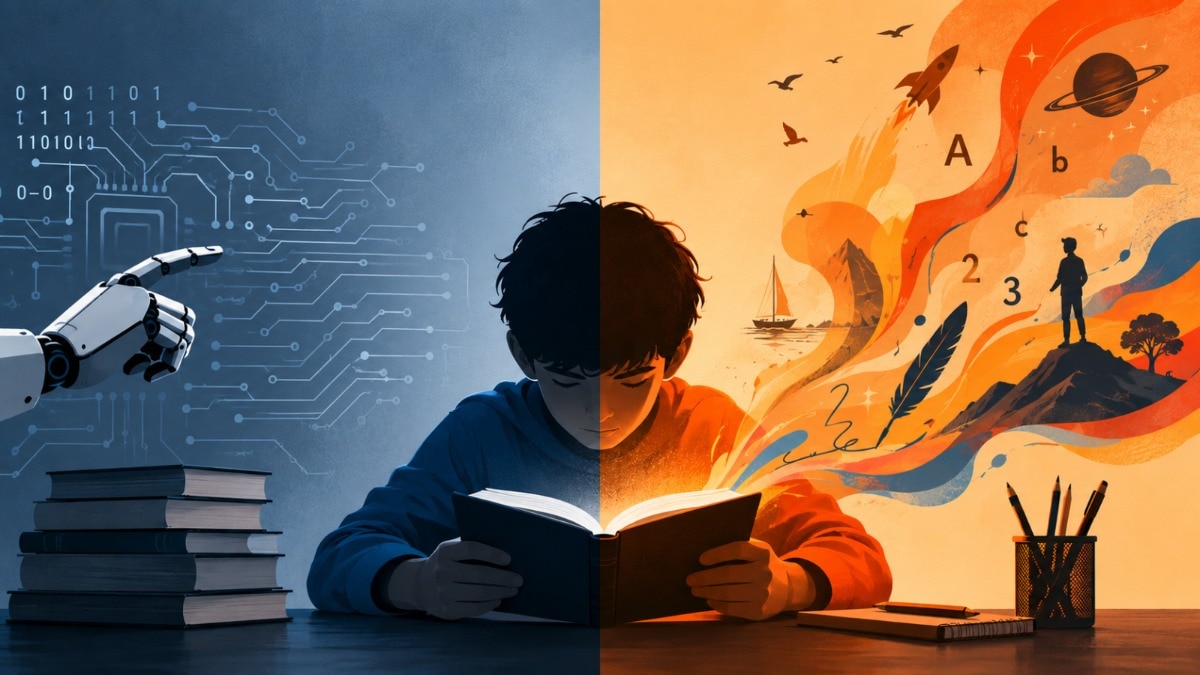
Machines can replicate the procedural layer of reading, writing and arithmetic with astonishing efficiency, but the imaginative core that gave these capacities civilizational significance remains deeply human.The real values of reading, writing and arithmetic were never mechanical, their deepest function was imaginative. (Representational image made with AI)This framework made perfect sense in the industrial age where societies required disciplined workers capable of processing information reliably and executing repeatable cognitive tasks efficiently. But artificial intelligence has exposed a profound flaw in this understanding.Large language models can already read faster than humans, summarize vast archives instantly, generate coherent prose and perform calculations at scales impossible for the human mind. Goldman Sachs estimated in 2023 that generative AI could automate tasks equivalent to 300 million full-time jobs globally, while McKinsey projects sweeping transformation across analytical and administrative work.If the three R’s were merely procedural skills, machines have already surpassed human beings. Yet civilization still depends on these capacities because their real value was never mechanical. Their deepest function was imaginative.Reading, for instance, is not simply the recognition of words but the construction of meaning from symbols. Walter Ong, in Orality and Literacy, argued that literacy fundamentally restructures consciousness itself because reading allows human beings to inhabit worlds beyond immediate experience. Two people never truly read the same text because meaning is never extracted passively from language; it is reconstructed through memory, culture, context and emotion. A machine can process syntax statistically, but it does not experience interpretation as consciousness. The same is true of writing, which is often misunderstood as a technology for storing information. Lev Vygotsky, in Thought and Language, argued that language does not merely express thought but actively forms it. Human beings frequently discover what they think only in the process of writing. Constitutions, religions, political movements, economic systems and entire nations were first written into existence before becoming social reality. Writing is therefore not transcription but imagination taking conceptual form. AI-generated prose may display fluency, but fluency is not thought. Prediction is not intention. Statistical coherence is not imagination.Arithmetic reveals the same misunderstanding even more sharply. If mathematics were merely calculation, it should have become educationally redundant the moment calculators entered classrooms. Yet mathematics never disappeared because its true purpose was never computation alone. Numbers themselves are imagined abstractions constructed by human civilization. Zero, one of India’s greatest intellectual contributions, required humanity to conceptualize absence itself. Algebra asks the mind to reason about unknowns, while calculus enables societies to conceptualize motion, uncertainty and change before they become physically observable. Mathematics allows civilizations to model futures, simulate systems and imagine realities that do not yet exist. Far from being the opposite of imagination, arithmetic may represent imagination in its most disciplined and structured form. The problem is that education systems increasingly reduced these capacities into procedural exercises because procedures are easier to standardize than imagination. Decoding could be tested, grammar could be marked and computation could be scored. Interpretation, abstraction and original thought were far more difficult to evaluate at scale. Over time, the measurable shell became mistaken for the essence itself.Artificial intelligence is now exposing that compromise with brutal clarity. Machines can replicate the procedural layer of reading, writing and arithmetic with astonishing efficiency, but the imaginative core that gave these capacities civilizational significance remains deeply human. Reading as interpretation, writing as thought formation and arithmetic as abstraction continue to resist mechanization because they are not merely acts of information processing but acts of meaning-making.This may ultimately become the defining paradox of the AI age: the more machines master the mechanics of intelligence, the more valuable imagination becomes. The three R’s were never merely utilitarian skills for economic productivity. They were humanity’s oldest disciplines of imagination, through which societies learned not only to process reality but also to envision realities that did not yet exist.(Dr Ruchi Tewari is the Associate Professor and Associate Dean – Marketing, Communication and Public Affairs, Chief Marketing Officer at MICA. An academician with over 25 years of experience, she holds a PhD in Management with a focus on CSR communication in the Indian IT sector. She also holds an MPhil and an MA in English Literature.)- EndsPublished By: Armaan AgarwalPublished On: Jul 19, 2026 10:45 IST
Reading, Writing and Arithmetic are tools of imagination; not mere skills
Full Article
📰 Original Source
Read full article at Indiatoday →KhanList aggregates and links to publicly available news content. We do not host full articles from third-party sources. Always verify important information with original sources.