
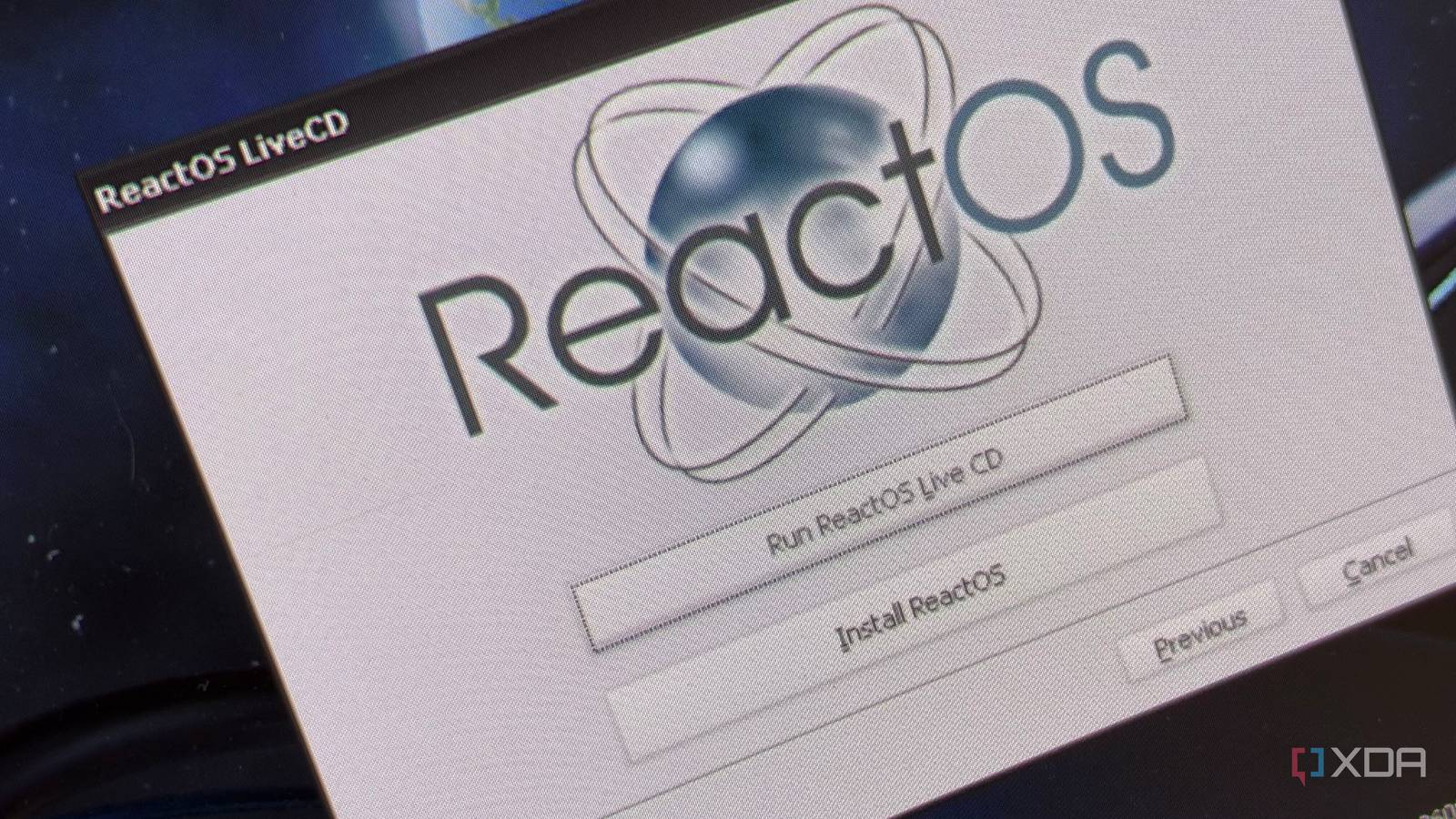
Published Nov 23, 2026, 8:00 PM EST His love of PCs and their components was born out of trying to squeeze every ounce of performance out of the family computer. Tinkering with his own build at age 10 turned into building PCs for friends and family, fostering a passion that would ultimately take shape as a career path. Besides being the first call for tech support for those close to him, Ty is a computer science student, with his focus being cloud computing and networking. He also competed in semi-pro Counter-Strike for 8 years, making him intimately familiar with everything to do with peripherals. Whenever there's a paid version of a piece of software, naturally, there will be a handful of free alternatives that spawn to fill the user base that doesn't want to pay or pirate the premium option. Windows was no different, and even in 1996, when ReactOS was created, there were users that wanted an open-source, clean environment that they could trust with their applications and data. ReactOS is a free, open-source operating system that was built to run Windows programs and drivers without any of Microsoft's own code. It's quite the reverse engineering effort, and the contributions date back to over 30 years ago, long before the advent of AI agents. It's still considered to be in an alpha state, but regardless, I gave it a test drive in a VM to see just how useable it is, and it surprised me in a lot of areas. ReactOS and how it got here It has been a long road ReactOS was born out of FreeWin95, which was an attempt to build a free clone of Windows 95. That project largely got stuck in the planning phase and never released a build, but in 1998, developer Jason Filby took it over and renamed it to ReactOS. With this new name came a much more lofty goal, which was targeting Windows NT instead of 95, which became the foundation for every Windows version since. Progress was very slow going at the start of the project, with version 0.1 of ReactOS arriving in 2003. You were able to boot from a CD but there was no GUI to speak of. Another flashpoint came in 2006, when there were growing concerns that some contributors to the project might've seen leaked Windows source code, which lead to a freeze and audit on the project. That slowed development down even more for a few years. The jump to 0.4 in 2016 came with a much more Windows-like desktop, and releases have been dotted around since then. The latest version is 0.4.16, which is what I tested. Everyday stuff does work Installation and normal apps are fine I started by installing the 32-bit build of ReactOS in a VM on my home server, and after that went off without a hitch, I went straight to installing apps. I went for a web browser first, and while ReactOS does ship with one, I installed the latest version of Firefox posible, which is 52.9.0 ESR. This was the last release Mozilla shipped for Windows XP and Vista. It loaded firefox.com over HTTPS just fine, and it's only complaint was that the browser was out of date, but despite that, it rendered a pretty modern page cleanly enough. Office-style work went just as well, as OpenOffice worked just fine, GIMP and Notepad++ were functional, and 7-Zip and WinRAR were also good, license nag and all. Even qBitttorrent connected to peer-discovery perfectly fine, too. Using the Applications Manager meant I was getting the last version of each of these apps that actually supported Windows XP, which doesn't necessarily mean it's the original release from that era. It's a lot more practical for me to test these, as they have a much better chance of actually working over the original, worse behaved versions. Drivers run on ReactOS, too Not just apps This is where ReactOS really separates itself from something like Wine. Wine is a compatibility layer that alets Windows programs run on Linux and macOS, and ReactOS does borrow a lot of Wine's code, but the difference is it's a complete operating system that can load kernel drivers Windows uses. CPU-Z is a prime example of this in action, because it needs a kernel driver. It's small, but it allows it to read processor details, which is something Wine couldn't do. On ReactOS the driver loaded, and CPU-Z reported the virtual CPU's clock speed and supported instruction sets. It got the processor's name wrong, but that's to be expected in a virtual environment like this. It's still fragile underneath They call it an alpha, and that's what you should expect I ran into a lot of crashes and issues just installing certain applications, and that's not really a huge surprise since this is still an operating system in an alpha state. The original release of .NET Framework 2.0, without the service pack, crashed the entire operating system. At the step where the installer starts "Installing native images," ReactOS hit a blue screen with a MEMORY_MANAGEMENT error. I rolled back and tried three more times, first with 2GB of RAM and then upping the VM to 4GB, to see if that might've been an issue, but it crashed at the same point every time. Even when things did work, they sometimes still threw errors or crashed: Foxit Reader, which I used in place of Adobe Reader, blue-screened the system the first time it launched from the installer, but after a reset it launched normally. Media playback was patchy. VLC played audio, but its default video output showed only a black window. MPC-HC wouldn't play anything, not a web stream and not even one of ReactOS's own startup sounds. I'm unsure if this is due to it running in a virtual environment or because of the OS itself, but I wasn't able to get it working regardless. It's far from a Windows replacement, but it's a neat project ReactOS is far from being a daily-driver, but it's a fascinating effort to bring Windows functionality to something that is completely free and open-source. Even as a free, contained way to run XP-era software without a Windows license, it's far more capable than people might give it credit for. ReactOS
ReactOS has spent decades trying to be a free Windows, so I ran my oldest apps on it
Full Article
Original Source
Read the full article at Xda-developers →KhanList aggregates and links to publicly available news content. We do not host full articles from third-party sources. Always verify important information with original sources.