
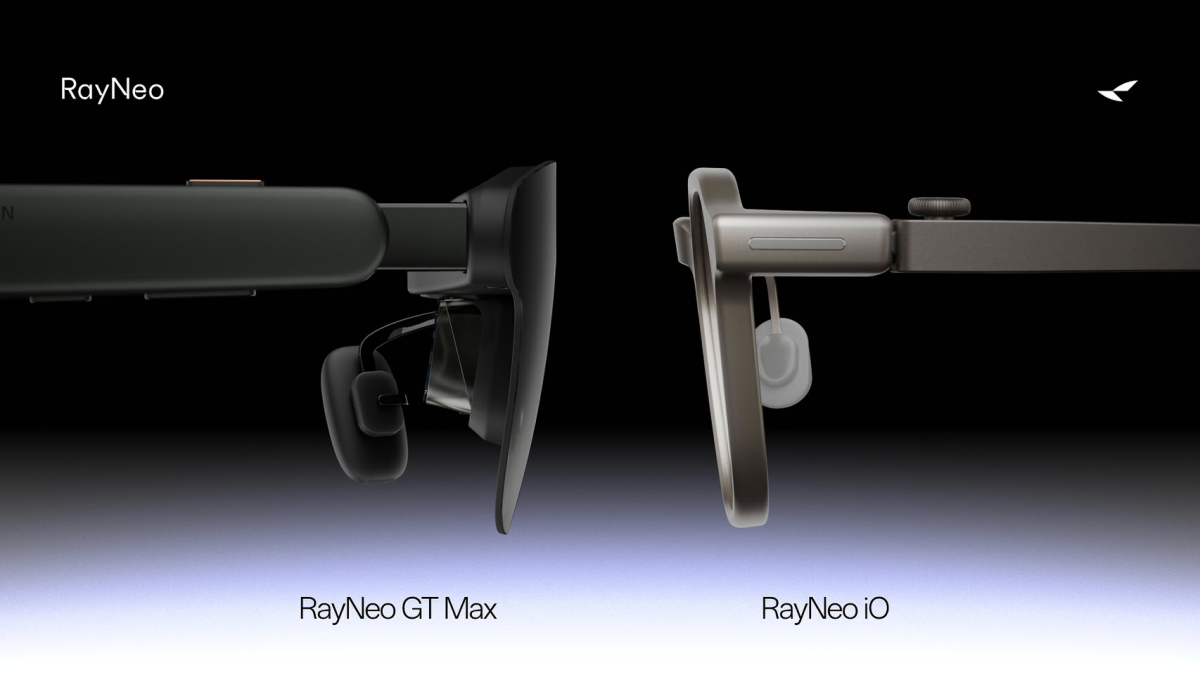
Stephen Johnson Stephen Johnson Senior Staff Writer ExperienceStephen Johnson is a senior staff writer at Lifehacker covering pop culture and technology, including the columns “The Out-of-Touch Adults’ Guide to Kid Culture” and “What People Are Getting Wrong This Week.” Read Full Bio August 24, 2026 Add as a preferred source on Google Add as a preferred source on Google Credit: RayNeo Key Takeaways RayNeo announced the RayNeo iO and the RayNeo GT Series. The iO features a monochrome display; the GT features high-def video. Both product lines release on September 4, 2026. Table of Contents Smart glass company RayNeo announced two new lines of smart glasses today: the minimal-display, AI-focused RayNeo iO, and the RayNeo GT and the GT Max, which are portable monitor glasses. They will all be available on Sept. 4 through RayNeo's site and on Amazon, but no prices were announced.The company is aiming at two distinct segments of the smart glasses market with these models. The IO is productivity-minded, with a minimal monocular display, audio capability, and AI integration, where the GT series are tethered display glasses mainly for entertainment. What to know about RayNeo's IO productivity glassesRayNeo's IO glasses are a definite change for the company. Its last display glasses, RayNeo X3 Pros, are built around a full-color, high-definition display. I found them technically impressive, but not especially practical. These new glasses, though, seem like they will be a lot more useful. Here's what they bring to the table: Lightweight frame designed for comfort. These glasses weigh only 33 grams, as light as an average pair of non-display glasses. A minimal, monochrome waveguide display that's only visible to the wearer. Integrated Ambient AI. Powered by Gemini's AI, RayNeo says their "Life Log" operates in the background and can "capture schedules and conversation contexts." It will extract action items and schedule calendar updates after meetings too. Translation and teleprompter features: There's no audio, so translations and audio are all handled in the display. Long battery life: The company promises two days of typical usage per charge.Overall, the IO glasses sound a lot like Even Realities' excellent G2 smart glasses. The main negative for these and any glasses with a waveguide display is that the lenses have to be totally flat, so they're generally small, or else they look very strange. What do you think so far? What to know about the RayNeo's GT SeriesThe GT series from RayNeo are designed to stream content and provide a second monitor, as opposed to being worn all day. They are basically an improved version of RayNeo's "wearable monitor" style glasses like the RayNeo Air 4. Here's what the GT series bring to the table:59° field of view. This is a big improvement over the 47° FOV of the Air 4 and puts it in the same league as the industry-leading display glasses, XReal's One Pro. Peacock optical engine 3.0 Max and a 5.5th-gen tandem MicroOLED display that's the equivalent of a 307" monitor. Dolby Vision support: Paired with the RayNeo Pocket TV Pro, the GT Series supports native Dolby Vision playback alongside real-time AI SDR-to-HDR conversion.Bang & Olufsen spatial audio: A quad-speaker system supports head-tracked spatial audio and directional sound transmission.The GT Max comes in three physical Interpupillary Distance (IPD) sizes for better clarity across different face shapes and sizes. Maybe the most notable thing about these glasses is what they lack: Neither has a camera, even though RayNeo's last generation of display-style glasses did. Huge tech companies like Meta and Snap have bet bigs on people wanting face-cameras, but with the IO, RayNeo seems to be taking the stance that discretion and a low-key utility are a stronger position. Lifehacker has been a go-to source of tech help and life advice since 2005. Our mission is to offer reliable tech help and credible, practical, science-based life advice to help you live better. Our Mission Our Team Newsletter © 2001-2026 Ziff Davis, LLC., A ZIFF DAVIS COMPANY. ALL RIGHTS RESERVED. Lifehacker is a federally registered trademark of Ziff Davis and may not be used by third parties without explicit permission. The display of third-party trademarks and trade names on this site does not necessarily indicate any affiliation or the endorsement of Lifehacker. If you click an affiliate link and buy a product or service, we may be paid a fee by that merchant.
RayNeo Is Launching Two New Lines of Smart Glasses
Full Article
Original Source
Read the full article at Lifehacker →KhanList aggregates and links to publicly available news content. We do not host full articles from third-party sources. Always verify important information with original sources.