
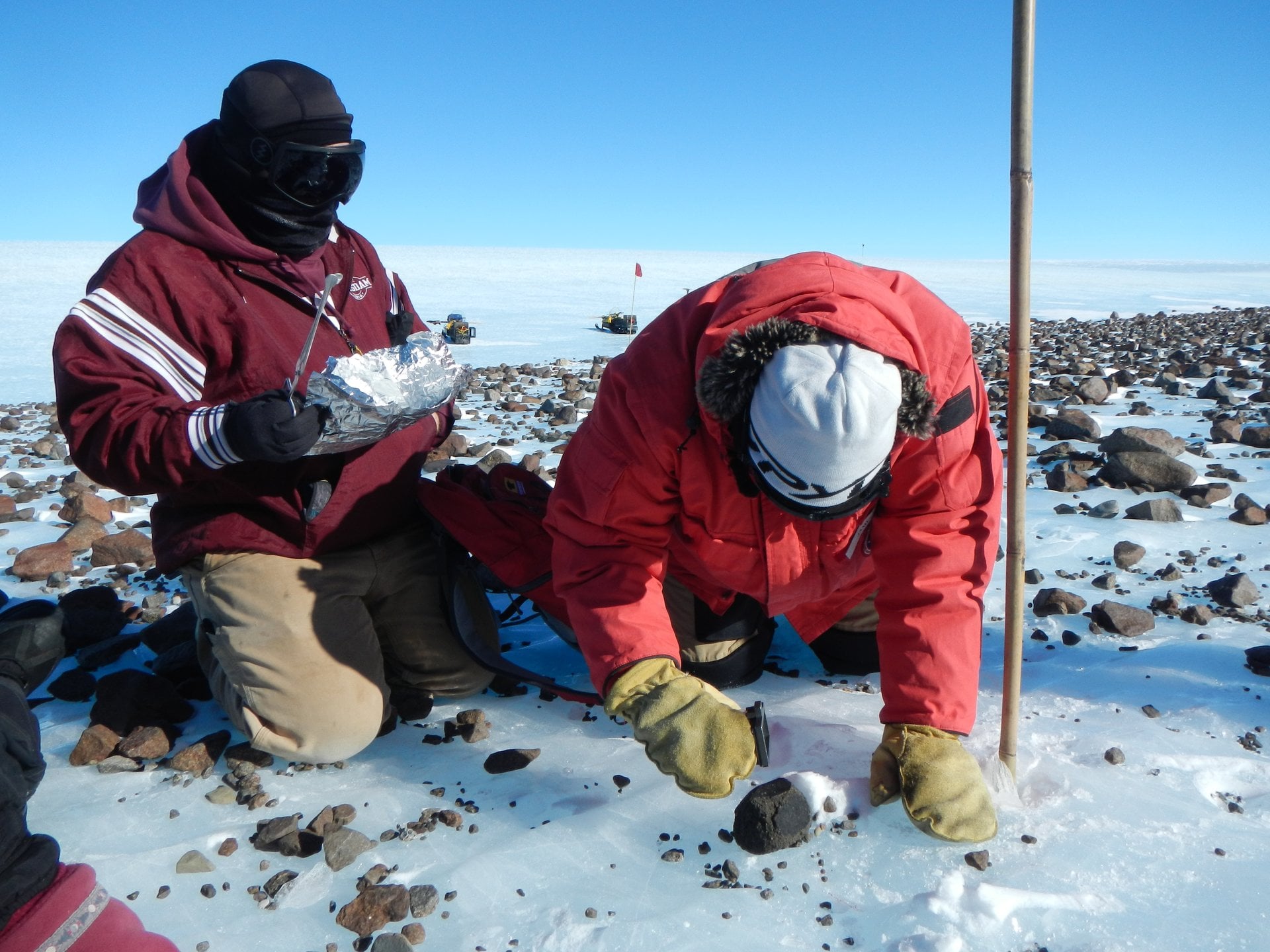
Lunar meteorites --- literally pieces of the Moon’s surface that have been displaced into Earth or solar orbit and have burned their way through our thick atmosphere --- arrive on our planet’s surface as often overlooked pieces of space rock. But they are extraordinarily valuable as scientific fodder since they offer lunar scientists a precious window onto the Moon’s earliest formation. In some ways, they scientifically surpass the multitude of lunar rocks thus far returned to Earth by spacecraft. That's because they are thought to originate from literally all over the lunar surface, including the far side. Even so, only 835 lunar meteorites have been verified as such, representing 0.7% of all meteorites that fall to Earth. And the most pristine lunar samples still arrive here via robotic or crewed spacecraft. Three Soviet Union Luna missions collectively returned some 300 grams, and China’s Chang’e 5 and 6 missions some 3.7 kg of samples, the authors of a 2025 paper appearing in the journal Elements note. The six Apollo landings collected some 382 kg of lunar samples, the authors note. Yet lunar meteorites provide a more representative sampling of the Moon than Apollo, Randy Korotev, Research Professor Emeritus in the Dept. of Earth, Environmental, and Planetary Science at Washington University in St. Louis, told me via email. At the time of Apollo, we did not know that five of the six landing sites were in or near a geochemically anomalous part of the Moon, Korotev told me. A Random Distribution Lunar meteorites in contrast come from almost randomly distributed locations on the Moon’s surface, says Korotev. But we don't know for sure where any of them come from, he says. Most lunar meteorites have been found in Antarctica, Oman and in the deserts of Northwest Africa, with a few from deserts in Australia and Botswana, the authors of a 2013 paper appearing the journal Astronomy & Geophysics. The first identified lunar meteorites, Yamato-791197 and Yamato-793169, were collected in Antarctica in 1979 by the Japanese meteorite-hunting program, they write. Deserts and barren wastelands make good areas to look for such meteorites because desert playas and Antarctic ice make them easier to spot. The Vernadsky Institute in Moscow has estimated that “several tens or a few hundred kilograms” of lunar rocks strike Earth’s surface every year, Washington University in St. Louis (WUSTL) reports. Over a period of a few years to tens of thousands of years, those orbiting the earth eventually fall to the surface, says WUSTL. Those in orbit around the Sun may also eventually strike Earth up to a few tens of millions of years after they left the Moon, WUSTL notes. Mare Imbrium. Credit: Wikipedia An Anomalous View Of The Moon Korotev has argued that our view of the Moon would be very different if we had studied its meteorites first. From the point of view of a scientific study, Apollo was done wrong; we had no orbital data, except gray-scale photography by which to choose the landing sites, says Korotev. We did not have mineralogical or compositional data obtained from orbit, he says. We now know that all of the Apollo and China’s Chang’e 5 missions visited a geochemically atypical region of the lunar near side --- nicknamed the Procellarum KREEP Terrane, the Elements paper authors write. It’s an acronym for potassium, rare earth elements, and phosphorous, they write. Apollo was also stymied by the fact that missions 14 through 17 took samples from a highly geochemically anomalous area of the Moon in the vicinity of the Imbrium Basin. That is, a very large, dark lava plain that covers the Moon’s northwestern quadrant. Apollo was a political not a scientific program, says Korotev. Some forward-looking scientists had to argue with NASA to have the astronauts collect samples, he says. Remaining Conundrums One outstanding question is how the lunar highlands crust formed. Researchers still don’t know if the near side crust was created in the same way as the far side crust. Lunar meteorites are key to this story as they potentially provide us with pieces of the Moon's ancient crust and some of these must have come from the far side, Katherine Joy, professor of lunar and planetary science at the University of Manchester in the U.K., told me via email. We can use the chemistry and age of these types of lunar meteorites to test the lunar magma ocean (LMO) hypothesis, she says. The LMO is a hypothetical global ocean of magma that is theorized to have covered the moon up to several hundred km deep very early in the Moon’s history. As for what’s most puzzling about these meteorites? Each stone tells this amazing picture of the Moon's past, but not knowing exactly where the rock came from is like missing the center pieces of a puzzle, says Joy. The Bottom Line? It would be incredible to be able to identify a sample from somewhere really geochemically unique on the Moon, like a highly evolved magmatic region like Aristarchus, or to have a sample that contains large pieces of the Moon's mantle, says Joy. These sorts of samples would tell us incredibly interesting things about the Moon's interior and thermal history, she says. Sources: Randy Korotev Katherine Joy Washington University in St. Louis Elements Astronomy & Geophysics
Rare Lunar Meteorites Could Fill Gaps In Moon’s Evolution
Full Article
Original Source
Read the full article at Universetoday →KhanList aggregates and links to publicly available news content. We do not host full articles from third-party sources. Always verify important information with original sources.