
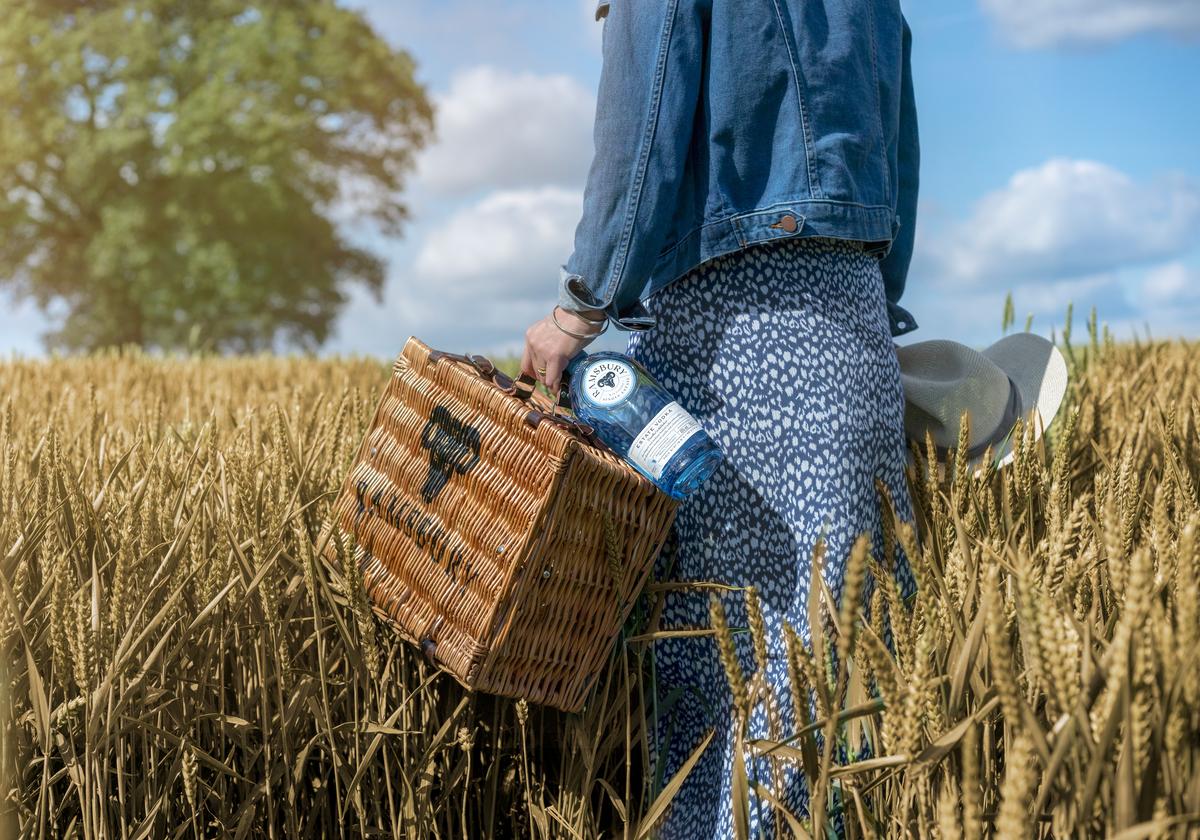
Leaving behind The Bell at Ramsbury, and its paintings depicting unusually cheerful US presidents, I climb into a Defender with Nik Fordham and head for higher ground. There is a point, somewhere above the village, when the bottles begin to make sense. Fordham gestures across cereal fields, hedgerows and woodland. ‘If you look around here, basically everything is ours,’ he says, then corrects himself. ‘Ours, as in Ramsbury.’That distinction matters. Ramsbury is not a distillery with a photogenic field conveniently attached. The wider estate covers some 19,000 acres across Wiltshire, Berkshire and Hampshire, around 7,000 of them farmed directly. The brewery and distillery sit within a considerably larger agricultural system.Wheat for the spirits grows here, as does barley for the brewery. Water comes from the chalk beneath the estate. Spent grain and distillers’ lees feed cattle. Woodland supplies fuel for a biomass boiler. Wastewater is treated through reed beds. Even the coordinates of the field in which the grain was grown appear on the bottles.‘Complete traceability all the way through the field, all the way into the bottle,’ says Fordham.‘Field to glass’ is one of those phrases drinks marketing has nearly worried to death. At Ramsbury, unusually, you can drive through the field. Fordham, Ramsbury’s General Manager and Master Distiller, is a particularly useful person with whom to do so because his fascination lies in how things work.He studied chemistry and biology before distilling found him. By 2008 he was Distillery Manager at Beefeater, subsequently becoming Master Distiller and Head of Operations at Bombay Sapphire, and helping deliver the move to its showpiece Laverstoke Mill distillery. From 2017 came five years at Tarquin’s Gin, latterly as Head of Operations, before he joined Ramsbury in 2022. Along the way he earned a diploma in distilling and the Worshipful Company of Distillers’ scholarship award for excellence.Ramsbury EstatePRESS HANDOUTIt explains why he looks across farmland and sees engineering. The vast CLAAS combines are GPS-guided. Satellite imagery can monitor crop emergence. Soil analysis determines where inputs are required, while sophisticated sprayers can avoid covering the same ground twice.Inside the grain store, a machine uses 16 cameras and compressed-air jets to inspect two to three tonnes of grain an hour, ejecting individual kernels which fall outside tolerance. Fordham says it cost around £75,000 and may be required for only a couple of months each year. It is less Constable than control room.This year brought another example. After a wet winter came prolonged dryness, leaving some grain at around 12% moisture. Rather than waiting for the day to warm, GPS-guided CLAAS combines were sent into dewy fields earlier in the morning, allowing the crop to regain a little moisture before harvesting. Weather here is not picturesque background. It enters the production equation.Fordham wants more children to see this world.‘We’ve lost a generation of engineers,’ he says.His ambition is to bring schoolchildren through the farm and distillery and show them that modern agriculture folds together chemistry, biology, computing, engineering, environmental science and economics. Farming, in other words, is not an unsophisticated activity occurring behind a hedge while the technological world happens elsewhere. ‘Clarkson’s done more for farming in five years than I’ve found in 35.’Whatever one thinks of Clarkson’s Farm, Fordham admires the fact that millions of people who might never open an agricultural journal have suddenly watched the weather ruin a crop, machinery break, regulations multiply and margins disappear.The unpredictability also encourages experimentation. When Fordham arrived, Ramsbury relied principally on one variety of wheat. He considered that a vulnerability, so four varieties were tasted separately through mashing, fermentation and distillation. Three were selected for future use. A surplus tonne of another became a 47% distiller’s cut vodka, made simply, as Fordham puts it, ‘because we can’. The episode encapsulates the advantage of controlling the process from soil onwards. Ramsbury does not buy neutral alcohol and furnish it with a provenance story later. Its gin begins with its vodka. Estate-grown winter wheat is milled, mashed and fermented before rectification through a 43-plate copper still. Some spirit becomes Ramsbury Vodka. Some is redistilled with 14 botanicals to make gin, including fresh quince grown beside the distillery.Nik Fordham, Master DistillerPRESS HANDOUTWar, Woodland and What Returns to the LandThen the Defender turns into woodland and the century abruptly changes. The 506th Parachute Infantry Regiment of the US 101st Airborne Division was stationed around this part of Wiltshire before D-Day. Its 3rd Battalion was based at Ramsbury, and the regiment trained in the surrounding fields and woods. Easy Company of the 506th would later become internationally familiar through Band of Brothers.Read MoreNearby RAF Ramsbury tells a separate American story. The 437th Troop Carrier Group was based there, and in the early hours of 6 June 1944, 52 C-47s left the airfield towing gliders carrying elements of the 82nd Airborne Division towards Normandy. It is worth keeping those two histories distinct. The 506th did not depart for D-Day from Ramsbury. But there is something uncanny about travelling from computer-guided combines into woods where young American soldiers once rehearsed for an invasion from which some would not return.The estate maintains interpretation boards recalling their presence. It reinforces the sense that Ramsbury is not countryside manufactured to support a bottle. Layers of farming, forestry, villages, war and industry existed here long before anyone thought to market provenance.Fordham's approach to the land is similarly unsentimental. Wasps, he points out, consume significant numbers of weevils.‘They need PR,’ someone suggests.Deer and squirrels receive a less glowing assessment, given the damage they can inflict on young woodland. Nor does Fordham pretend productive agriculture is environmentally weightless. Instead, he argues that economics increasingly pushes farming in the right direction. Diesel, fertiliser and pesticides cost money. Driving unnecessarily over a field costs money and compacts the soil.‘If you don’t have to put fertilisers in, don’t do it. You don’t have to put pesticides on, don’t do it. And if you have to do it, do it as effectively and efficiently as you can.’That pragmatism is more persuasive than a perfectly buffed sustainability slogan. Spent brewing grain and distillers’ lees become cattle feed. Estate timber goes into the biomass system. Wastewater from brewing and distilling travels by gravity through a four-stage reed-bed treatment system.Beside the latter is a lake whose inhabitants have become unexpectedly important to Fordham. Carp introduced several years ago have reached eight or nine pounds. He produces photographs on his phone with the pride normally reserved for children. The fish look magnificent. No ESG presentation is required. There is an enormous carp.Lunch follows in The Orchard, amid damson trees laden with plump berries. Quince grows here too, while honey collected on the estate finds its way into drinks. A Honey Highball brings together Ramsbury Vodka, orange bitters, estate honey and ginger ale. It is long, bright and dangerously easy, a welcome reminder after discussions of grain moisture, soil structure and rectification plates that alcohol is ultimately intended to give pleasure.Fordham puts it more succinctly.‘I love booze. Booze is fun.’Then he qualifies it. ‘It’s about memories, it’s about social engagement. It’s not about drinking as much as you possibly can.’Estate VodkaPRESS HANDOUTThe drinks themselves have been collecting serious recognition. Ramsbury Vodka earned a third consecutive Double Gold at the San Francisco World Spirits Competition in 2025, qualifying it for Platinum certification, while Ramsbury Gin was named Gin of the Year and UK Spirit of the Year at the 2025 London Spirits Competition. Consistency, Fordham believes, is one of the clearest measures of quality.But the day ends not with medals or industrial machinery, but with a row of miniature copper stills. At Ramsbury’s Gin School, juniper provides the necessary backbone before guests build their own recipe from an apothecary of botanicals. Mine draws on watercress, Sichuan pepper and fresh quince from the estate.What smells beautiful in a jar may disappear in distillation. Something apparently innocuous can dominate. The exercise becomes a small practical lesson in volatility, balance and restraint, with Fordham’s world of engineering colliding rather neatly with the ingredients growing outside.Eventually there is a bottle to take home whose recipe I selected and distilled myself, using a base spirit which began with wheat grown a few fields away. And that, rather than the medal cabinet, explains Ramsbury’s appeal.Individual elements of the operation are not unprecedented. Farms use satellite mapping. Breweries feed spent grain to cattle. Distilleries employ biomass. Estates manage woodland.What is unusual is having so much of it connected in one place, with the drink embedded in the agricultural system rather than merely borrowing its scenery.The most persuasive detail on a Ramsbury bottle may therefore be its least decorative: the reference to the field.Plenty of distilleries can tell you a story about where their spirit comes from. Ramsbury can take you there.Gin School costs £85 per person. Ramsbury spirits are sold direct, online and through selected Waitrose and Sainsbury’s stores; ramsbury.com
Ramsbury: Where the Field Becomes the Bottle
Full Article
Original Source
Read the full article at Standard →KhanList aggregates and links to publicly available news content. We do not host full articles from third-party sources. Always verify important information with original sources.