
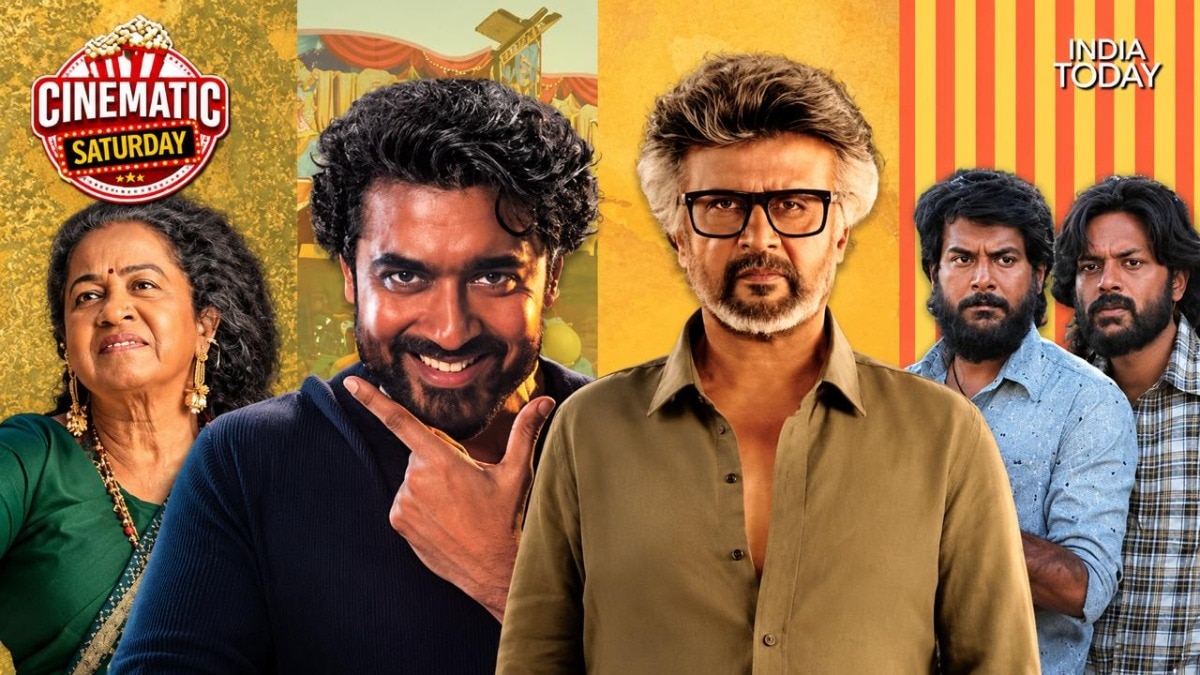
2025 was a frustrating year for Tamil cinema. There were big expectations, ambitious projects and star-led releases, but not enough films that made audiences excited about buying a theatre ticket. The industry seemed caught between chasing bigger box-office numbers and repeating formulas that had worked before. But 2026? That's been a rather different story.This year, Tamil cinema has made room for everyone. A film about an older woman could find a massive audience, a small romantic drama could hold its own, a gangster could discover his softer side through a child, and a superstar sequel could become a box-office juggernaut. And the best part? None of them had to compete for the same space.That's perhaps the biggest takeaway from Tamil cinema in 2026. It hasn't given up on big stars or larger-than-life entertainment. It has simply stopped behaving as though that's the only thing audiences want. New directors have found their footing, actors have stepped outside familiar images, women have had characters worth talking about, and Suriya seems to have rediscovered the joy of playing men who don't always have to be heroic.If 2025 felt like a year of missed opportunities, 2026 has been a reminder that Tamil cinema is at its best when it doesn't restrict itself to one definition of success. Small films, big conversationsOne of the nicest things about Tamil cinema this year has been the way audiences have embraced smaller films. And Thaai Kizhavi is perhaps the biggest example of that.Sivakumar Murugesan's directorial debut put an older woman at the centre of its story, with Radikaa Sarathkumar delivering a performance that refused to make age a limitation. There was no conventional young hero, romance or action formula to fall back on. Instead, the film gave us a woman with agency, contradictions, humour and a personality of her own. And audiences showed up for her. Madhan's With Love went in a completely different direction. This romantic drama relied on familiar emotions rather than scale, proving that a film doesn't need a massive canvas to make people feel something. Modha Rathri, meanwhile, found comedy in the awkwardness and anxiety surrounding an arranged marriage. Debutant Raja Karuppasamy brought humour and humanity to a situation that could easily have become crude comedy. Its theatrical run also showed just how far good word of mouth can take a modest film.Then came films that took familiar genres and gave them an interesting spin. In Balaji Tharaneetharan's Baththa, Vijay Sethupathi plays a feared gangster whose world changes after he encounters a child. Master Sai Prithviraj's Sabari becomes an unlikely mirror for a man who has built his entire identity around violence. The interesting bit? The film doesn't rely on another display of gangster power. It finds its turning point in vulnerability.Blast, directed by Subash K Raj, brought martial arts and action into the mix, with Preity Mukundhan taking on a physically demanding role. Nooru Saami, led by Swasika, added another woman-centred story to the year's line-up. Different genres, different budgets and different storytelling styles, but all found room to make their mark.New voices, and a different idea of a heroThe year has also been a good one for new filmmakers. Sivakumar Murugesan with Thaai Kizhavi, Madhan with With Love, Raja Karuppasamy with Modha Rathri and Subash K Raj with Blast have all brought distinct storytelling approaches to the table. Ken Karunas made his directorial debut with Youth, while Mathimaran's Mandaadi showed how a rooted premise could be turned into a visually ambitious theatrical experience.The idea of a leading man has also become a little more interesting. Lokesh Kanagaraj stepping in front of the camera with DC was an unusual choice, considering audiences have largely known him as a filmmaker. Rishikanth and Sananth, meanwhile, took the lead in Dorothy, a film that moves away from conventional ideas of masculinity through its queer setting. Their performances anchor a story that explores friendship, patriarchy, caste and queer identity. Keerthy Suresh gets a character with emotional weight, while Muthukumar and Jeeva Subramaniam add depth to the world around them.Abishan Jeevinth, best known for directing Tourist Family, also made his presence felt as a leading man. These choices point towards an industry that's slowly looking beyond the usual star-making route. A hero doesn't necessarily need an established fan following or a familiar screen image. Sometimes, all a film needs is the right person for the story.Women were not just part of the castIt's easy to call 2026 a good year for female actors because several of them had notable releases. But there's a more interesting question here: what did these films actually allow them to do?Radikaa Sarathkumar's Thaai Kizhavi put an older woman at the centre of the narrative. Keerthy Suresh's Dorothy gave her a role that was central to the film's exploration of patriarchy and an ally to transpeople. In Nooru Saami, Swasika played Selvi, a single mother who refuses to let motherhood become her entire identity. Preity Mukundhan went the action route in Blast, playing a martial arts-trained woman who holds her own in the fight sequences.In Mandaadi, Mahima Nambiar's Angel is closely connected to Soori's Kaali and the emotional conflict driving his journey.Mamitha Baiju brought youthful energy to Maddy, the young woman who turns Suriya's carefully ordered life upside down in Vishwanath and Sons. Wamiqa Gabbi played Chandra, a woman fighting to reclaim her agency in DC, while Anishma Anilkumar's Muthuselvi found herself at the centre of the marital chaos in Modha Rathri. These films aren't making the same point about women, and they don't have to. What's encouraging is that female actors have been part of stories with different genres, emotional demands and perspectives. The next step is making sure this variety becomes the norm, rather than an occasional exception.Supporting actors made the worlds believableA film is rarely just about the person whose face appears on the poster. Some of the most enjoyable performances this year have come from actors who make the world around the lead feel real.Take Modha Rathri, for instance. Its ensemble makes the chaotic family dynamics work. Abdool Lee plays Kannan, Maruthu's fiercely loyal brother-in-law, while Sumithra Devi is Keerthi, Maruthu's sister. Their affectionate equation reveals a much softer side to him.In Jailer 2, Namo Narayana's Moorthy, a seemingly ruthless but rather clueless gangster, became one of the film's biggest comic attractions. Suraj Venjaramoodu brought menace to Dileep, the Malayali smuggler who becomes part of Tiger's conflict. Suhas made a strong impression as Saattapuli, Soori's greedy rival in Mandaadi, giving the film a formidable antagonist. In Dorothy, Muthukumar's Whistle Veeraiya is part of the family at the heart of the story, while Jeeva Subramaniam plays a transgender woman who helps Subbu through his transformation.And then there's Master Sai Prithviraj in Baththa. His Sabari is much more than a child caught in a gangster's world. After accidentally locking Baththa inside his school toilet and later letting him out, he becomes the unlikely person who brings out the rowdy's softer side.These characters may not always get the biggest share of the spotlight, but they make a huge difference. And that's what good supporting performances do.The mass hero is still alive. He's just changingOf course, Tamil cinema hasn't suddenly fallen out of love with its larger-than-life heroes. Far from it. Jailer 2 has reminded everyone just how powerful that appeal remains.Nelson Dilipkumar brought Rajinikanth back as Tiger Muthuvel Pandian, and the sequel emerged as the year's biggest Tamil box-office phenomenon after its Rs 900-crore haul. But it wasn't just Rajinikanth's star power doing the heavy lifting. The supporting characters, humour, music and that familiar swagger all came together to create a theatrical experience.Suriya's Karuppu also delivered a major commercial success, crossing Rs 300 crore worldwide according to trade estimates. It showed that the actor could command a mass audience while exploring a different screen persona. Mathimaran's Mandaadi, led by Soori, offered another kind of spectacle. Its boat-racing sequences gave the film a distinct visual identity, drawing from its coastal setting instead of depending entirely on familiar action templates. Mahima Nambiar and Suhas also found room to make their presence felt in the ensemble.Then there's Vijay's Jana Nayagan, positioned as his final film before his political journey takes centre stage. Its pre-release leak and the attention surrounding its release added an unusual layer to its box-office story. With collections estimated at over Rs 300 crore worldwide, the film also underlined the continuing pull of Vijay's stardom.Different films, different audiences and different kinds of spectacle. But one thing is clear: the mass hero is going nowhere.Suriya's year was about more than the numbersIf there's one actor whose 2026 deserves a closer look, it's Suriya. With Karuppu, Vishwanath and Sons and Scene, he has had three very different outings, each crossing Rs 200 crore worldwide.The numbers are impressive, but the more interesting part is the variety of characters he's chosen to play.In Karuppu, he embraced the energy of a commercial entertainer by playing a deity. Vishwanath and Sons, directed by Venky Atluri, placed him in a more personal drama, with Mamitha Baiju bringing a different dynamic to the story. Scene, meanwhile, continued his recent willingness to poke fun at the very image of the conventional hero he has built over the years.Across these films, Suriya seems increasingly comfortable playing men who are flawed, self-aware and occasionally ridiculous. And honestly, that's refreshing. An actor of his stature doesn't have to treat every role as an opportunity to reinforce his heroic image. He can be funny, vulnerable, awkward and even the butt of a joke. That doesn't make him any less of a star. If anything, it makes watching him more interesting. After years of expectations surrounding his choices, 2026 feels like a year in which Suriya has allowed himself to have fun again. Audiences seem to be enjoying it too.The music kept the year movingMusic has been another big part of Tamil cinema's 2026 story. It wasn't just about delivering chartbusters. Composers also found sounds that suited the worlds of their films.Ilaiyaraaja's work in Dorothy was a standout. Muthumani, created specifically for the film's climax, came out of a conversation between the composer and director Karthik Subbaraj about what the scene needed. His background score was just as effective, moving from the rugged intensity of the first half to the quieter, more tender portions of the second.Anirudh Ravichander explored two very different musical spaces with DC and Jailer 2. The DC album moved across classical influences, rock, rap and melodies to reflect the film's dark, unconventional world. Jailer 2, on the other hand, leaned into swagger and mass appeal. Tracks such as One Sun One Moon and Veramaari added to its larger-than-life tone. The sequel's music, however, also had to contend with comparisons to the hugely popular soundtrack of the first Jailer. Sai Abhyankkar had an especially interesting year with Karuppu and Baththa. While Karuppu was driven by energetic folk rhythms, rap and high-voltage tracks such as Verappa, Baththa gave him room to explore a wider emotional palette. From the tenderness of Chellame Magale and Mozhiye to the playful Cheen Dapak Dum Dum and the choral intensity of Baththa Lacrimosa, the album showed a different side to his music.With Dhanush and Mammootty's OM still ahead, Sai has another opportunity to build on that range.And 2026 isn't finished yetThere's still plenty to look forward to. Dhanush and Mammootty's OM is among the films to watch, while Vijay Sethupathi's Train could add another chapter to the year's cinematic conversation. With more films waiting to reach theatres before December 31, it's too early to call this the complete picture of Tamil cinema in 2026.But the direction is already clear. The biggest takeaway isn't simply that a few films made hundreds of crores or that several newcomers got their moment. It's that Tamil cinema has shown signs of making room for more than one kind of storytelling.Thaai Kizhavi could find a place on the same list alongside Jailer 2. Dorothy could open up conversations about identity and masculinity, while Mandaadi could turn a traditional boat competition into a theatrical spectacle. Suriya could enjoy a commercially successful year without being confined to one version of stardom.And that's what makes 2026 worth celebrating. Tamil cinema doesn't have to choose between a small film and a big spectacle, a new face and a superstar, or entertainment and experimentation. The sweet spot is perhaps right there, in allowing all of them to coexist.- Ends
Rajini, Suriya, Radikaa and the year Tamil cinema found sweet spot with bold stories
Full Article
Original Source
Read the full article at Indiatoday →KhanList aggregates and links to publicly available news content. We do not host full articles from third-party sources. Always verify important information with original sources.