
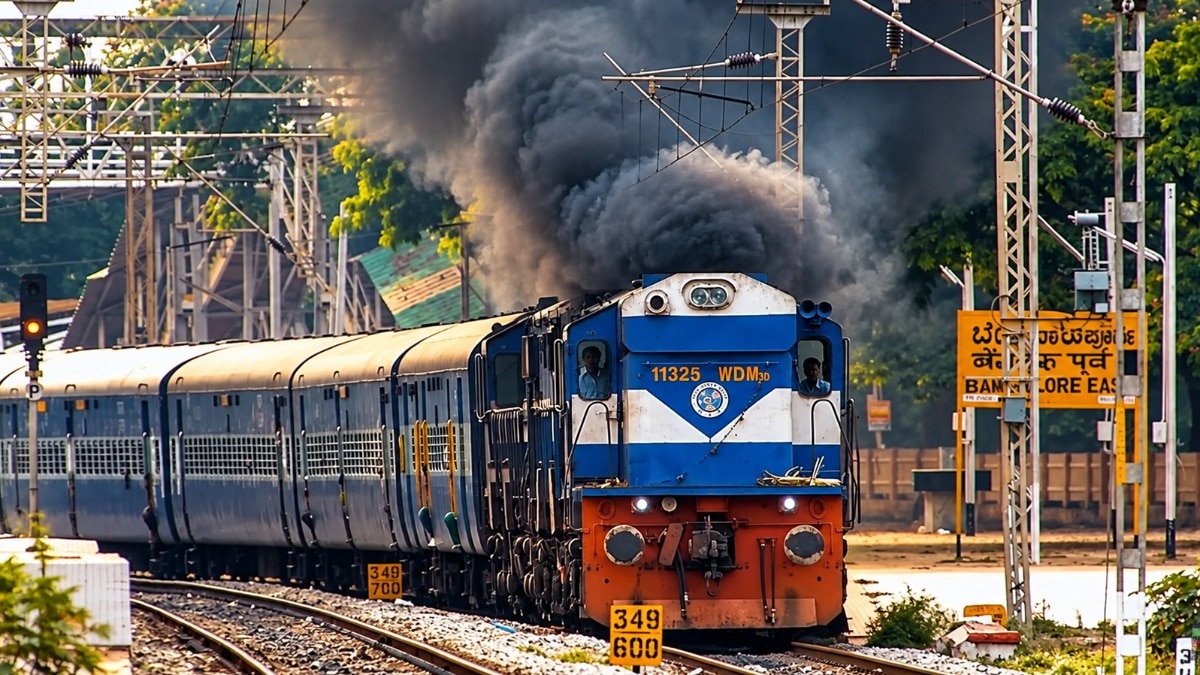
There was a time when a train announced its arrival into a station with a plume of smoke. First, steam locomotives, and then those powered by diesel, chugged in, spreading fumes, noise and soot. That sight, sound and experience have almost disappeared from India. That's because, out of 70,142 route kilometres (RKM) of the Indian Railways' broad-gauge network, around 69,873 RKM had been electrified by March this year. This has taken the network's electrification to more than 99.6%.The remarkable bit is the speed of the change. In 2009-10, just 18,927 RKM of the Indian Railways network was electrified. By March 2014, it had risen to 21,614 RKM. Twelve years later, by March 2026, the figure stood at 69,873 RKM.Before we go further, let's understand that RKM, or route kilometre, measures the distance between two points on a railway route, regardless of how many tracks run alongside one another.The electric taction transformation of the Indian Railways was hailed last week by Union Home Minister Amit Shah. He was flagging off India's first LNG-powered train in Gujarat's Sabarmati. "In 2015-16, Railways used 293 crore litres of diesel. By 2024-25 it will be 108 crore litres, and by 2030 it will be reduced to zero. We will save currency. This is a great achievement which does not come to people's attention," Shah said on September 27. He also said Indian Railways would soon achieve 100% electrification. And 100% electrification, whenever the remaining broad-gauge stretches are completed, will be an enormous milestone. But there is a catch. Electrifying 100% of the network would not necessarily mean Indian Railways can say tata, bye-bye to diesel.In fact, the LNG train that Shah flagged off offered a clue. The Indian Railways wouldn't be completely free of diesel. For example, the train Shah inaugurated, uses a dual-fuel LNG-diesel system. Indian Railways added nearly 51,000 electrified route kilometres between 2009-10 and 2025-26. If Indian Railways has slashed the usage of diesel, why can't it move away totally from the fuel? If almost the entire broad-gauge network is electrified, why does the Indian Railways still need diesel locomotives? An equally fascinating story is the network's transformation from steam to diesel and then electricity. High-speed trains are months away and restrained semi-highs are on the tracks. Will also have a look at how much diesel the switch has saved. Let's start from the beginning.INDIAN RAILWAY'S LONG ROAD FROM STEAM TO DIESEL TO ELECTRICIndia's electric-railway story is actually a century old. The first electric train ran between Bombay Victoria Terminus and Kurla Harbour in 1925. But progress was slow. At Independence, only 388 route kilometres were electrified. Steam remained dominant for decades, while dieselisation gathered pace after Diesel Locomotive Works at Varanasi began production in the 1960s.By the 1980s, Railways began systematically phasing out steam in favour of diesel and electric traction. By this time, electric traction had made inroads into India's eastern mineral heartland (southern Bihar, West Bengal and Odisha). The last official broad-gauge steam service ran between Jalandhar and Ferozepur in 1995. However, steam locomotives still survive on heritage services that people can book and enjoy.By the 1990s, diesel had won the first transition. It replaced steam on regular services. From the 2000s, electricity was destined to win the next one. The shift accelerated sharply after 2014. India's first diesel-electric locomotive marked the beginning of a new era in railway traction. (Photo: National Rail Museum/Facebook) By 2014, India had electrified 21,801 RKM. Between 2014 and March 2026, the figure more than tripled to 69,873 RKM. Another way of seeing the acceleration is the daily pace. According to the Ministry of Railway, the pace of electrification averaged just 1.42 km a day during 2004-14, but it became more than 15 km a day during 2019-25.In other words, electrification covered less than a third of the Indian Railway's broad-gauge network in the last decade. Now it's virtually the entire network.HOW RAILWAY'S DIESEL BILL COLLAPSED WITH ELECTRIFICATIONThe impact of the massive electrification is easiest to understand through the data of the Indian Railway's diesel consumption. As electric locomotives took over more routes and trains, Indian Railways needed less diesel to move passengers and freight.Railway Ministry data show that diesel consumption for traction fell from 293 crore litres in 2015-16 to 108 crore litres in 2024-25. That is a reduction of 185 crore litres, or about 63%, in nine years.According to a Ministry of Railways estimates published by the PIB on April 15, 2026, electrification saved around 180 crore litres of diesel in 2024-25, fuel that would otherwise be needed to run trains. The government said this reduced India's requirement for imported crude oil, while electric traction is about 70% more economical than diesel traction and electrification has generated savings of around Rs 6,000 crore, said the Railway Ministry. Indian Railways' locomotive fleet is now dominated by electric engines, though more than 4,000 diesel locomotives remain in service. This is important as India imports most of the crude oil it consumes. So, every litre of diesel that Railways does not burn reduces its exposure, at least at the margin, to imported crude and global oil-price volatility. This has also helped India save its precious foreign exchange reserves.This is therefore not just a story of using cleaner energy. Electrification has changed the energy economics of one of the world's largest railway systems. Electric traction also improved acceleration and braking. Newer air-conditioned electric locomotive cabs have offered relief to loco pilots who earlier worked in harsh conditions. In summers, the temperature inside older cabs sometimes crosses 60 degrees Celsius.THEN WHY NOT THROW OUT THE DIESEL LOCOS?Because an electric locomotive has one fundamental weakness that a diesel locomotive does not. It needs its electricity supply infrastructure to be working. When power grids in northern India collapsed in July 2012, hundreds of trains, including long-distance Rajdhani and Shatabdi services, had to be hauled by diesel locomotives.Also, an electric route depends on overhead equipment, or OHE. A cyclone in West Bengal brought the swanky Vande Bharat to a halt after a tree fell on the overhead wires.The Ministry of Railways told Parliament in March 2026 that diesel locomotives are "crucial to the crisis management plan of Indian Railways."In a 2024 response to Parliament, Railway Minister Ashwini Vaishnav said, "The use of diesel engines and its withdrawal from service is an ongoing process on Indian Railways, subject to network approach, operational feasibility, availability of resources, etc. Diesel locomotives shall, however, be required for disaster management, strategic purpose, shunting etc." A Tughlakabad-based WDS-6 shunter-class diesel locomotive at Anand Vihar Terminal in New Delhi. (Photo: Wikimedia Commons/KoolNerd123) Diesel locomotives are needed in railway yards and sidings. They are used to shunt empty rakes between platforms, yards and maintenance sheds. Diesel also remains important in India's small surviving metre-and narrow-gauge network. These include routes such as Kalka-Shimla, Kangra Valley, Darjeeling and the Nilgiri lines. Steam locomotives are used on limited heritage runs. But diesel locomotives handle much of the regular haulage.New railway lines, coming up in the Northeast, generally begin operations with diesel traction, then comes electrification, and later the doubling of tracks.The Indian Railways have also explained the logic behind developing dual-mode locomotives, like the one inaugurated by Amit Shah. Diesel, in other words, provides operational insurance. Moreover, the Indian Railways Annual Report and Accounts 2023-24 shows that 100 new broad-gauge diesel locomotives were commissioned in 2022-23 and another 100 were put on the line in 2023-24.The report also noted that newly manufactured diesel locomotives from the Marhowra factory are fitted with auxiliary power units (APUs) to reduce fuel consumption while idling.So, the Indian Railways might soon have electric wires over virtually its entire broad-gauge network. But diesel traction is important for emergencies, shunting, strategic needs and newly commissioned routes where electrification is yet to catch up.- Ends
Railways is 99.6% electrified, but can't say tata, bye-bye to diesel. Why?
Full Article
Original Source
Read the full article at Indiatoday →KhanList aggregates and links to publicly available news content. We do not host full articles from third-party sources. Always verify important information with original sources.