
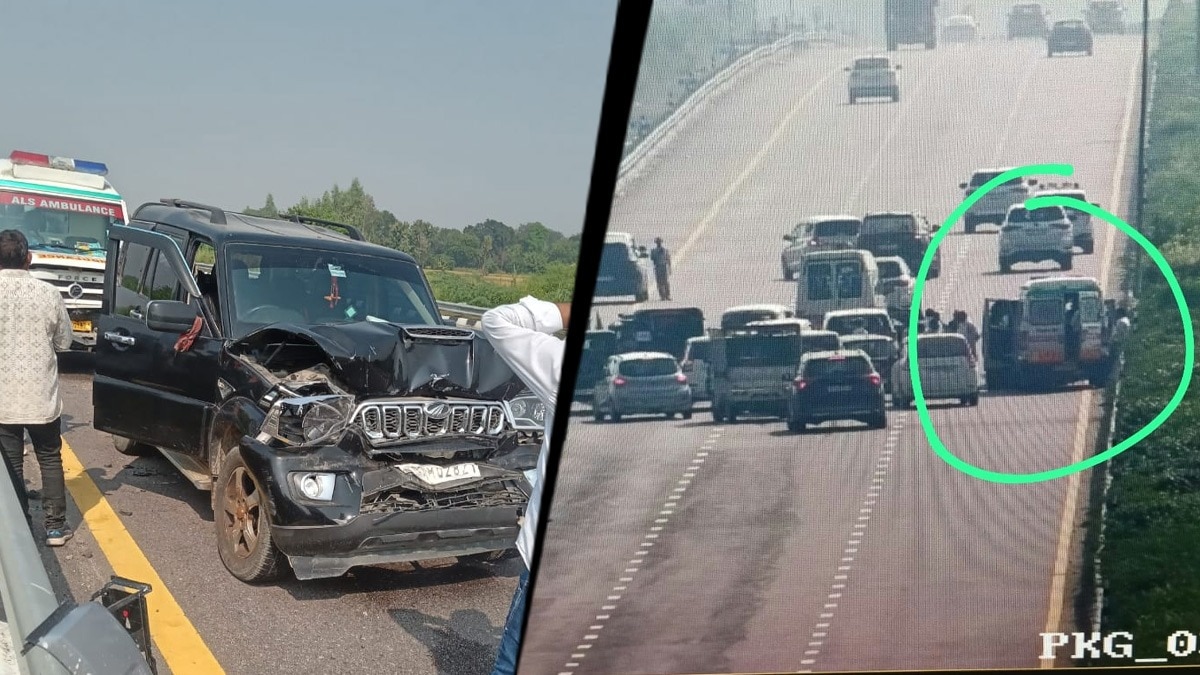
The collision involving Rahul Gandhi's convoy on the Purvanchal Expressway highlights crucial road safety lessons, from maintaining lane discipline and safe distances to using indicators and avoiding fatigued driving.Rahul Gandhi’s convoy crash highlights four essential road safety lesson. (Credits: Nitish Srivastava)New Delhi,Oct 30, 2026 12:01 ISTThe collision involving multiple vehicles in Congress leader Rahul Gandhi’s convoy on the Purvanchal Expressway in Uttar Pradesh’s Sultanpur district serves as a reminder of how quickly a minor driving error can trigger a chain reaction. While Gandhi’s car was not involved in the crash, several vehicles, including an ambulance travelling with the convoy, were damaged.According to a police officer quoted by PTI, the incident occurred around 10.15 am near the 89.5-km mark of the expressway when a private vehicle at the front of the convoy braked suddenly for an unspecified reason, causing vehicles behind it to collide.While the exact circumstances of the collision will determine what went wrong, the incident highlights some fundamental road safety practices that every motorist should follow. From maintaining lane discipline to leaving enough space between vehicles, these simple habits can go a long way in preventing accidents, particularly on high-speed expressways.Follow lane discipline and avoid sudden manoeuvresLane discipline remains one of the most commonly overlooked aspects of driving on Indian roads. Many motorists switch lanes abruptly, weave through traffic or occupy lanes without considering their speed and the movement of surrounding vehicles. On expressways, where vehicles travel at high speeds, such behaviour leaves other drivers with very little time to react. A sudden lane change or an unexpected manoeuvre can force vehicles behind to brake sharply, increasing the risk of a collision.Drivers should stay within their designated lane, overtake only when it is safe and avoid unnecessary lane changes. If a manoeuvre is required, it should be planned well in advance, with adequate space available to complete it safely.Use indicators before changing lanes Indicators are an essential communication tool, yet many drivers either fail to use them or switch them on only while making a turn.An indicator gives other road users advance notice of a driver's intentions, allowing them to adjust their speed or position accordingly. Without this warning, a vehicle moving into another lane can catch surrounding motorists off guard and lead to sudden braking or a sideswipe collision.Drivers should signal well before changing lanes or overtaking, check their mirrors and blind spots, and move only when there is sufficient space. However, using an indicator does not automatically give a driver the right to move into another lane. The manoeuvre must still be safe.Maintain a safe distance from the vehicle aheadFollowing another vehicle too closely is particularly dangerous at high speeds. When the vehicle ahead brakes suddenly, a driver travelling close behind may not have enough time or distance to react and bring the car to a complete stop.This risk increases in a convoy, where multiple vehicles travel in succession. If the first vehicle brakes abruptly, the vehicles behind may be forced into emergency braking, potentially triggering a chain collision.Drivers should maintain a safe following distance and increase it in poor weather, low visibility or heavy traffic. A useful rule of thumb is to leave at least a three-second gap in good conditions, increasing it when road or weather conditions deteriorate. At expressway speeds, this gap translates into a substantial stopping distance.It is also important to remember that a vehicle's stopping distance includes both the distance travelled while the driver reacts and the distance required for the brakes to bring the vehicle to a halt.Never drive when sleepy or inadequately restedFatigue can affect driving ability in ways that are not always obvious to the driver. Sleep deprivation slows reaction times, reduces concentration and impairs judgement. In severe cases, drivers may experience microsleeps, briefly losing awareness of the road.On expressways, even a momentary lapse in attention can have serious consequences. A fatigued driver may fail to notice slowing traffic, react too late to a vehicle braking ahead or struggle to maintain a consistent speed and lane position.The takeawayThe collision involving Rahul Gandhi's convoy is a reminder that road safety depends on more than driving skills or vehicle safety features. It also requires anticipation, patience and responsible behaviour behind the wheel.Maintaining lane discipline, signalling intentions, keeping a safe distance and driving only when well-rested are basic practices that can help prevent avoidable accidents. On high-speed roads, where there is little margin for error, following these rules can make the difference between a close call and a serious collision.Subscribe to Auto Today Magazine - Ends
Rahul Gandhi's convoy collision: Are you making these common driving mistakes?
Full Article
Original Source
Read the full article at Indiatoday →KhanList aggregates and links to publicly available news content. We do not host full articles from third-party sources. Always verify important information with original sources.