
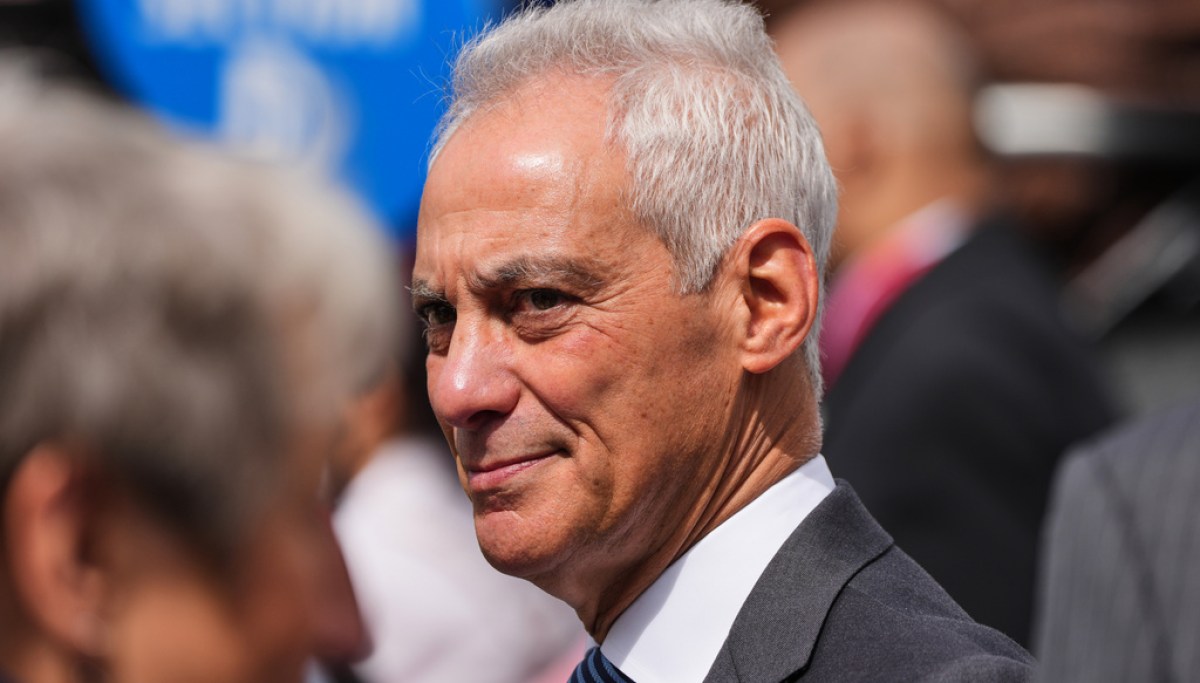
In Focus delivers deeper coverage of the political, cultural, and ideological issues shaping America. Published daily by senior writers and experts, these in-depth pieces go beyond the headlines to give readers the full picture. You can find our full list of In Focus pieces here. The Midwest has spent the past decade moving toward Republicans. Former Chicago Mayor Rahm Emanuel thinks Democrats may finally be in a position to win some of it back.Emanuel pointed to Democratic candidates in Iowa, Ohio, Michigan, Wisconsin, and Minnesota as evidence that the Midwest could be returning to its role as the nation’s political bellwether in a Wall Street Journal op-ed. Former White House Chief of Staff Rahm Emanuel mingles ahead of the Obama Presidential Center dedication ceremony Thursday, June 18, 2026, in Chicago. (AP Photo/Alex Brandon) But political strategists and analysts say the emerging competitiveness in some of those races does not necessarily mean Midwestern voters are moving back toward the Democratic Party. Instead, they believe the 2026 elections could be testing something more politically complicated — whether voters who have moved away from Democrats are becoming less attached to Republicans, too.“I’m not convinced the Midwest is becoming Democratic,” Mark Cohen, a former Air Force JAG and agricultural-law attorney running as an independent in Nebraska’s 3rd Congressional District, told the Washington Examiner. “I think Midwestern voters are becoming more willing to judge candidates individually.”That distinction could be critical for Democrats hoping to turn several competitive 2026 races into a lasting realignment.A region that moved sharply right Emanuel’s argument comes against a backdrop of significant Republican gains across the Midwest.President Donald Trump won Iowa by 13.2 percentage points in 2024, a sharp departure from former President Barack Obama’s victories there in 2008 and 2012. Ohio has undergone a similar political shift, moving from a closely watched presidential battleground to a state where Trump won by a double-digit margin in 2024.Yet several 2026 races are now competitive.In Iowa, Democratic state Auditor Rob Sand is running against Republican Zach Lahn for governor. A recent polling average had Sand ahead. In Ohio, Democrat Amy Acton and Republican Vivek Ramaswamy are running a close race for governor. A polling average as of Sept. 18 put Acton at 47.5% and Ramaswamy at 46.1%. Michigan also has a competitive gubernatorial contest, with Democratic nominee Jocelyn Benson leading Republican John James in several recent polls. FILE – Iowa Democratic gubernatorial candidate Rob Sand speaks during a campaign rally, June 7, 2026, in Des Moines, Iowa. (AP Photo/Charlie Neibergall, File) Emanuel said he sees those races as evidence that the Midwest is becoming “the nation’s pre-eminent battleground” again.But Garry South, a veteran Democratic political strategist, said Democrats cannot assume competitive races translate into durable change in party allegiance.“Whether Democrats can truly become competitive again in parts of the Midwest depends on three things: putting up good candidates who resonate in their particular state, running good, well-funded campaigns, and engaging in party building in off years,” South told the Washington Examiner.He pointed to Obama’s victories in Iowa and Ohio as evidence that Democrats can compete in states that later moved sharply right.“It is possible,” South said, “but the party needs to invest in infrastructure and voter registration in these states on an ongoing basis, not just in election years.”Democratic comeback or a Trump backlash? Democratic strategist Jared Kamrass, a Midwest-based partner at Techicolor Campaigns, argues the 2026 environment is particularly difficult for Republicans because Trump is not on the ballot, while voters are focused heavily on economic concerns.“Midwestern states look very different in years when Trump is on the ballot than when he isn’t,” Kamrass told the Washington Examiner.He noted that Democrats rebounded in the 2018 midterms after Trump carried the region in 2016, including winning an Ohio Senate race that year.“This year, the political environment looks even worse for Republicans because the economy is in much worse shape,” Kamrass said. “And voters put the blame squarely on Trump.”Kamrass said Democrats have also nominated strong candidates in a number of Midwestern races, but he sees a longer-term challenge for Republicans beyond this election cycle.“They simply can’t recreate their Trump-led coalition, especially when he will never appear on a ballot again,” he said.That gets to the heart of Emanuel’s argument – whether strong Democratic performances in the Midwest in 2026 would signal a durable shift in voters’ party preferences or a temporary reaction to the political environment.Michael Fahey, a political strategist, said it is too early to make that determination.“I think we have to be really careful about declaring a political realignment based on one election cycle,” Fahey told the Washington Examiner. “There is clearly something happening in the Midwest right now. Democrats are competitive in places that, on paper, they probably should not be this competitive. But competitive races and a rebuilt coalition are two very different things.”He added: “The test isn’t whether Democrats win a governor’s race in Iowa or Ohio in a favorable midterm environment. The test is whether they can take those voters who are willing to cross over in 2026 and keep them in 2028, 2030 and beyond.”Fahey described the current environment as “an opening,” but said calling it a realignment would be premature.Candidate quality One of Emanuel’s main points is that Midwestern Democrats are running candidates who look different from the national party and are more focused on economic issues and bipartisan governing.Sand has emphasized corruption and utility costs in Iowa, while Acton has focused on issues including prescription drug prices. Emanuel also points to Acton’s previous work for a Republican governor as evidence of the bipartisan credentials he believes Midwestern voters value.Fahey said candidate quality may be one of the most important variables in determining whether Democrats can capitalize on the current environment.“Rob Sand doesn’t look or sound like a national Democratic stereotype,” he said. “Amy Acton has a personal identity and public profile that exists beyond partisan politics. That matters.” Democratic gubernatorial candidate Dr. Amy Acton speaks at a primary election night campaign event after winning the party’s nomination for governor Tuesday, May 5, 2026, in Columbus, Ohio. (AP Photo/Jay LaPrete) But he cautioned against extrapolating too much from individual candidates.“Sometimes the lesson isn’t ‘the Midwest is moving left.’ Sometimes the lesson is simply that the right candidate can make voters reconsider their normal partisan habits.”Cohen, who is running in rural Nebraska, sees a similar phenomenon among voters he encounters.“I meet voters who are pro-gun, skeptical of tariffs, worried about health care and think billionaires should pay more in taxes,” Cohen said. “Those voters don’t fit neatly into a red or blue box.”For Cohen, the real test of Emanuel’s argument will come outside the cities.“Show me movement outside the cities,” he said. “If Democrats start making real gains in rural counties, agricultural communities and small towns, that tells us something. One or two statewide wins with strong candidates don’t necessarily mean the underlying coalition has changed.”Democrats are trying a different message Emanuel writes that Midwestern Democrats are benefiting by avoiding some of the cultural fights that have hurt the party in previous elections and instead concentrating on economic issues.His examples include Sand’s focus on corruption and utility costs and Acton’s proposals to reduce prescription drug costs.That strategy has appeal beyond Democratic circles, Fahey said, because it addresses issues that cross partisan lines.“What stands out to me is less what these candidates aren’t talking about and more what they are talking about,” Fahey said.Cohen similarly said the voters he encounters focus on everyday economic concerns.“Farmers are dealing with tariffs. Rural hospitals are struggling. Housing and health insurance are expensive,” he said. “People want politicians talking about those problems instead of constantly finding new reasons for Americans to fight with each other.”Irina Tsukerman, a geopolitical analyst and president of Scarab Rising, Inc., said the approach may help individual Democratic candidates, but the national Democratic brand remains a hurdle in many working-class communities.“Individual candidates can distance themselves from unpopular positions, yet Republicans can still connect them to national Democratic politicians, activist groups, and cultural debates,” Tsukerman told the Washington Examiner.She said a strong performance by Midwestern Democrats could also spark an internal debate within the party over how much emphasis to place on economic populism, cultural moderation, local issues, and independence from national activist priorities.The rural test South and the other strategists agree that Democrats cannot rebuild their Midwestern coalition solely through presidential-year campaigns or by winning suburban and urban voters.“You can’t rediscover rural America every two years and expect people to immediately believe you understand them,” Cohen said.Fahey made a similar argument, saying Democrats lost ground with working-class and rural voters over the past decade but that it remains unclear whether those voters are permanently aligned with Republicans.“People aren’t static demographic categories,” Fahey said. “Their priorities change. Their economic circumstances change. Candidates change.”That could make the 2026 results particularly revealing — not necessarily because of which party wins individual races, but because of where each party gains or loses support.The question is whether Democrats can make inroads in rural counties and small towns, rebuild local political organizations and persuade voters who have abandoned the party that they have a reason to return.TRUMP GOT A SECOND CHANCE. HE’S BLOWING ITEmanuel argues that the Midwest is ready to teach Washington a lesson about coalition-building and pragmatic politics.The more cautious interpretation may be that Midwestern voters may simply be demanding something neither party can take for granted: candidates who compete for their votes rather than assuming their allegiance.“The bigger lesson may be that writing off large groups of voters is dangerous for either party,” Fahey said.
Rahm Emanuel says Democrats can win back the Midwest. Is he on point or too optimistic?
Full Article
Original Source
Read the full article at Washingtonexaminer →KhanList aggregates and links to publicly available news content. We do not host full articles from third-party sources. Always verify important information with original sources.