
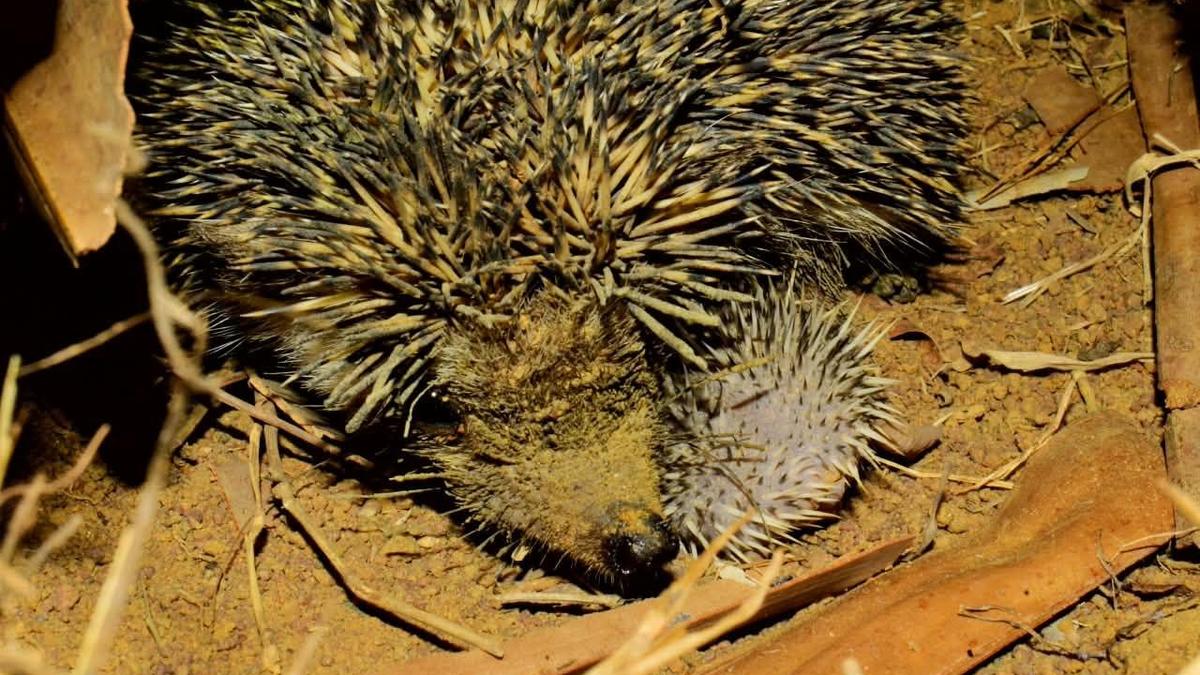
MH01, one of the three Madras hedgehogs that were radio-tagged, which recently gave birth. | Photo Credit: SPECIAL ARRANGEMENT A radio-tagged Madras hedgehog (Paraechinus nudiventris) has given birth to a hoglet at the grassland landscape region of Peikulam in Thoothukudi district, adding a significant dimension to the ongoing study of the little-known nocturnal mammal endemic to southern India.The Madras Hedgehog Conservation Project 2025-2026 was initiated under the State government’s conservation of lesser-known endangered species in Tamil Nadu. Under the scheme, ₹20.50 lakh was allocated for this little mammal found in semi-arid landscapes of the State. The project is spearheaded by the Advanced Institute for Wildlife Conservation (AIWC), focusing on assessing the species’ distribution, habitat requirements, ecological characteristics and major conservation threats across selected districts of Tamil Nadu. This includes Thoothukudi, Kallakurichi, Tirunelveli and Salem districts.According to the Forest Department, as part of the study researchers surveyed 480 respondents across 24 villages around Kuthiraimozhi red sand dunes in Thoothukudi district. The result revealed substantial local ecological knowledge alongside widespread concern about the species’ decline.Around 91% of the respondents reported seeing Madras hedgehogs much less frequently than in the past, while about 95% perceived a decline in their populations. Hunting and poaching were the most frequently identified threats accounting for 34.4% of responses followed by habitat loss and deforestation and pesticide use or chemical pollution.A land use and land cover analysis in Thoothukudi also revealed substantial landscape changes over the past two decades, highlighting the potential consequences of land conversion and habitat fragmentation for hedgehog persistence and landscape connectivity.To understand the species’ home range, movement patterns and habitat use, the AIWC team deployed very high frequency (VHF) radio telemetry, comprising animal mounted transmitters, a receiver, and directional antenna. The tagging was carried out by an AIWC team comprising foresters, followed by a research team and a veterinary doctor from the Nalumavadi Veterinary Hospital, providing veterinary support during the procedure. So far, three Madras hedgehogs, identified as MH01, MH02, and MH03, have been fitted with VHF radio transmitters for monitoring their movements and habitat use. MH01 and MH03 were tagged in the grassland landscapes of Peikulam and Sathankulam respectively, while MH02 was tagged in Theri Kaadu Reserve Forest.Monitoring of MH01 commenced on September 24, followed by the continued tracking of all three hedgehogs. On October 11, MH01 gave birth to a hoglet. After it had remained inside the burrow for three consecutive days without emerging, researchers placed a camera near the burrow to investigate its activity while minimising disturbance. The photograph revealed that MH01 had given birth.Speaking to The Hindu, Thoothukudi District Forest Officer M. Ilayaraja said the Madras hedgehog was a unique and ecologically important species, yet much about its life cycle and behaviour remained unknown. “Through this conservation initiative, we are working to bridge these knowledge gaps and translate research into meaningful conservation action. The observation of a hoglet during our study is an encouraging milestone, offering valuable insights into the species’ breeding behaviour and highlighting the importance of protecting its habitat,” he said.He added that conservation could not succeed through research alone, it required the collective responsibility of the Forest Department, scientific institutions, and local communities. “By protecting the Madras hedgehog and its habitat, we are safeguarding the ecological balance of our landscapes,” he added.“Our commitment is to ensure that this lesser-known species receives the scientific attention, protection and public awareness it deserves, so that it continues to thrive in its natural environment for generations to come,” he said. Published - October 18, 2026 11:30 pm IST
Radio-tagged Madras hedgehog gives birth, offering insights into breeding behaviour
Full Article
Original Source
Read the full article at Thehindu →KhanList aggregates and links to publicly available news content. We do not host full articles from third-party sources. Always verify important information with original sources.