
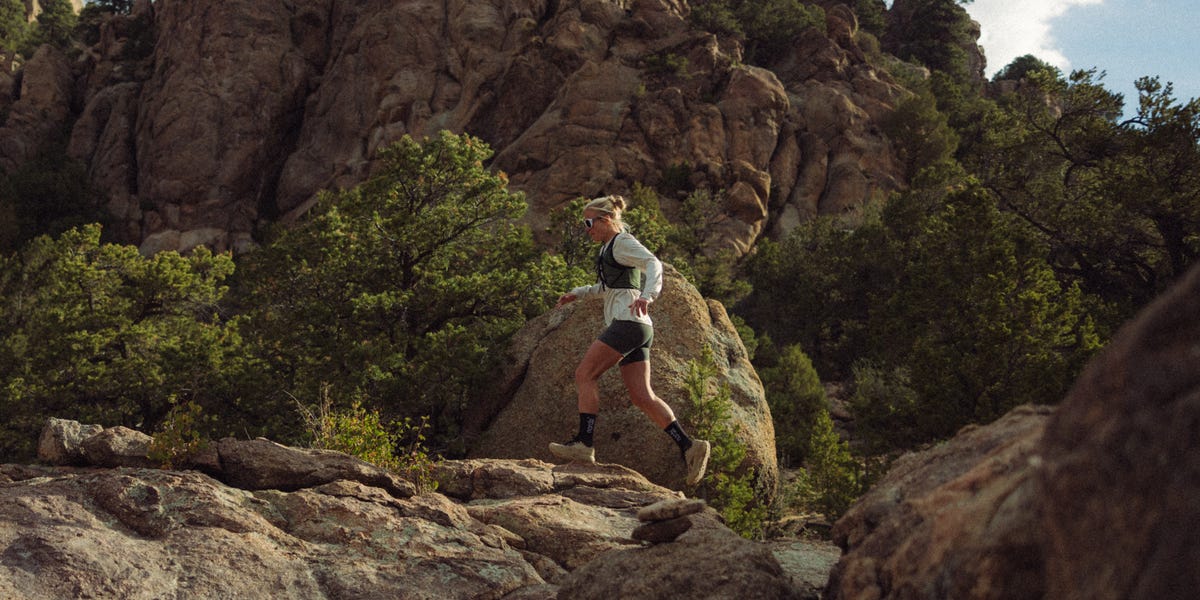
People came from far and wide to witness Rachel Entrekin perform her miracle. Entrekin, who was 34, had been running for more than two days straight. She’d run through the desert and over mountains, through the darkness of night and in the heat of day. She had started with a pack that included some of the strongest men and women on the planet, and she had dropped each of them one by one until it was she alone, out front, a small figure in white leading a 250-mile footrace across Arizona.The first and most memorable of the witnesses was a woman who identified herself as Hopi. Dressed in street clothes, she appeared at the base of Elden, the final mountain that loomed between Entrekin and the finish line in Flagstaff. In a mixture of her native tongue and English, she told the golden-haired runner that she had heard about what she was doing and hiked out here to see it herself, and that what she was about to accomplish would have ripple effects beyond what she could currently comprehend. Entrekin wept in awe and bewilderment.Next, at the top of Elden, Entrekin was visited by a tall, trim, and unmistakable figure: that of ultrarunning legend and four-time Western States 100 champion Jim Walmsley. “It’s downhill from here,” he told her sagely.“Someone has to lead this race. Why not me?”After Entrekin emerged from the scrubby foothills and entered the gridded city limits, she ran past hospital staff clapping in their scrubs, parted crowds cheering in the streets, ruffled dogs brought by fans like believers tote their babies to be blessed. (Entrekin famously pets dogs mid-race.) Forty thousand more who couldn’t make the pilgrimage watched the live stream on YouTube.At 1:09 p.m. on May 6, 2026, the 5-foot-3 runner sprinted down the finishing chute with a vigor that seemed superhuman after 253 miles. (The race’s second-place finisher, Kilian Korth, would eke out just a shuffle here an hour and 19 minutes later.) She seized the finish-line tape with both hands and clutched it to her heart. She had won the Cocodona 250 ultramarathon outright in 56 hours, 9 minutes, and 48 seconds, beating every other male and female racer and breaking the overall course record by more than 2.5 hours.In the days that followed, national news relayed her feat: WOMAN MAKES HISTORY WINNING BRUTAL 253-MILE ULTRAMARATHON. People loved this part of the story: that Entrekin, already a two-time women’s race winner at Cocodona, had taken the lead early at 61 miles and momentarily wondered if she was making a mistake. But then she had said to herself, “Someone has to lead this race. Why not me?”The stories touted Entrekin’s cheer and chill. She cracks wise mid-race and drinks beer at finish lines. She only began doing speedwork this year. At Cocodona, she slept just 19 minutes over nearly two and a half days. Her public persona shared notes with that of Courtney Dauwalter, ultrarunning’s most famous man-trouncer, who was likewise known for smiling often, fueling on candy, and setting out on training runs with nary an idea of how far she’d go. “Rachel Entrekin Runs on Joy,” said Rich Roll on his podcast. “The Pure and Joyful Relentlessness of Being Rachel Entrekin,” wrote Outside. Some stories suggested her victory reflected a female advantage at extreme distances—an increasingly popular narrative, even though the science is more nuanced.Such is the magic and mythmaking that surrounds girls who beat boys. These headlines glossed over the realities of Entrekin’s remarkable journey. The truth is that Rachel Entrekin has battled demons, including an eating disorder that could have killed her. That she plugged away at ultrarunning for 13 years in obscurity. That she was once told: “No one cares about the races you do.”To break through, she had to prove the nonbelievers wrong. And she had to start with herself.Kersten Vasey BowersEntrekin running in the Midland Railroad Tunnels in Buena Vista, Colorado, July 2026.Karen Entrekin’s children were different from the beginning: Matthew, her son, so still in the womb that she went to the doctor during her eighth month to make sure he was still alive; Rachel, her second, wouldn’t stop somersaulting and kicking in the amniotic fluid. “This kid is gonna be a soccer player,” Karen told her husband, Robin.As a kid, Rachel remained in constant motion, clambering on rocks and splashing in mud. “I tried my best to get her a little more feminine, and it didn’t really work,” Karen says, chuckling. One Easter, she made her daughter a ruffled, lace-covered dress to wear; Rachel ripped a hole in it before they even left the yard.Rachel had an unusually high pain tolerance: bumps and bruises elicited no tears. But she was thin-skinned in other ways, deeply attuned to others and often worried she’d somehow upset her friends. She wanted to do everything well. When learning to ride a bike took longer than she expected, she ran into the house crying in frustration. “She put a lot of pressure on herself,” Karen says.As her mother predicted, Rachel played soccer—and basketball, and softball. She wasn’t a star, but she loved running up and down the field and the court, and never wanted to be subbed out. Yet her activities were second-priority in the family. “My mom was really into my brother’s sports,” Rachel notes. At his basketball games, Karen fussed at the refs while Rachel ran the clock.Rachel’s parents and brother agree that she never had great self-confidence as a kid, and during the angsty years of high school she became particularly uncomfortable with her body. Compared to her friends, she felt short and overweight, she says; her best friend was a gazelle-like girl named Laura who occasionally modeled. All the boys Rachel had crushes on wanted to date Laura. The one who finally showed an interest in Rachel wound up cheating on her during her senior year, after he left for college.From these experiences, Rachel drew a conclusion that seemed logical to her vulnerable young mind: life would be easier if she were thinner. During this time, her family was dealing with some issues—she’d prefer not to share the details publicly—and Rachel stopped wanting to come home after school. Instead, she started going to the gym.Then one day that spring, as if in a movie, she came home to find a small circle of family and friends waiting for her. She had walked into her own intervention.This was probably the earliest and darkest inclination of her preternatural abilities. Rachel was very good at doing one thing for a long time. She could spend hours on the elliptical machine or the treadmill, “and not blink an eye,” she says. Meanwhile, she all but stopped eating. It felt addictive, almost as if she was competing with herself, she says now: seeing how much she could do on as little nourishment as possible.She dwindled to 82 pounds. It’s still painful for Robin to think about this time. “It was like watching somebody commit suicide slowly,” he says. But to Rachel, it was validating. Life indeed felt easier: her junior year she didn’t have a date to prom. Her senior year she would go to six proms. Then one day that spring, as if in a movie, she came home to find a small circle of family and friends waiting for her. She had walked into her own intervention.She went to a rehab facility in North Carolina twice, delaying her first year of college to do so. There, therapists taught her what she calls “feeling words,” like I’m sad, or angry, or scared, which were new to her; her family didn’t talk about their emotions, she says.In rehab, she and the other patients, most of whom were young women like herself, ate their meals dutifully, then went around the table to talk about how it made them feel. Her counselors called this “opposite action”: choosing to perform the opposite of their urges, then sitting with the discomfort instead of trying to escape it.To break the connection between exercise and calorie control, Rachel wasn’t allowed to run in rehab, which made her realize how much she had actually enjoyed it. When she went to college at the University of Alabama at Birmingham in 2010, she began racing marathons, finishing her first in 3:45, a solid if not showstopping time. But herein lay a second clue to some potentially freakish ability: she felt totally fine the next day.Kersten Vasey BowersEntrekin always makes time for dogs, including Sasha, whom she met on the trail during the photo shoot for this story in July. At this year’s Cocodona, she announced, “Sorry, priorities!” after taking a moment to lavish attention on fan’s dog in Prescott, Arizona.She raced her first ultra three years later, a 50K in South Carolina where she wound up on the podium. She was delighted by the casual atmosphere of trail running—the quirky personalities, the gummy bears and other junk foods at the aid stations. She ran three 50Ks in three months. In 2014, while enrolled in a doctoral program for physical therapy at UAB, she bested all the women in a race for the first time. In 2017, she began beating all the guys, too.Her results from that spring seem prodigious: first overall at a 12-hour race in Georgia, first overall at a 12-hour race in Alabama, first overall and course record at a 24-hour race. Over the next several years, Entrekin won or podiumed most races she entered, often outright.Friends say that one of her superpowers is that she runs the same pace no matter the conditions. But some of their stories suggest that that toughness didn’t always come from the healthiest place. “She’s always had an attitude,” says Steven Palmer, one of Entrekin’s oldest running partners. “Earlier on it was kind of a reckless attitude—just diving headfirst into everything, with not much regard for her own well-being.” Once, on a mountainous run in Washington state, the pair hit a primitive trail lined with briars and stinging nettles. Running in shorts, Entrekin never broke pace, even as the vegetation wailed on her legs. “I’m like, what is wrong with you, it’s OK to walk,” Palmer says. “I remember her saying, ‘I don’t care about myself.’” (Entrekin says she was probably joking. “I just don’t really care about picking my way through plants if I’m inevitably going to get scraped or stung by them anyway.”)Entrekin acknowledges that it took her several years after rehab to achieve a healthy relationship with running, including learning how to fuel. Even after she believes she got healthy, calorie intake remained what she calls her “Achilles heel.” She moved to Los Angeles in 2021, and on weekends in the Eastern Sierra, friend Jake Vail says, they’d run 40 miles from dawn to dusk. When they’d refill their packs for the next day, she’d pull out most of her food uneaten. “She’d be like, ‘I think I had a couple gummy bears or something,’” he recalls. Vail insists that Entrekin didn’t seem malnourished. “It was just this weird thing Rachel can do.”Vail and Entrekin met in 2022, when they both DNFed a 100-mile race in Santa Monica. Around this time, Entrekin admits, winning had become her source of self-worth. Desperate for redemption after that DNF, she overtrained for a 100-miler two months later, took too many NSAIDs during the race, and threw up what looked like coffee grounds. As a medical provider, she immediately recognized it as a sign of a stomach bleed, a known side effect of NSAIDs. She crossed the finish line and walked straight into an ambulance.The medical scare was a wake-up call. Entrekin vowed to start setting different goals in her racing, ones that focused on her process instead of her results. But shucking the lifelong sense that anything short of perfection was failure would be a process, too.Kersten Vasey BowersEntrekin is a good hang—“wildly funny,” says friend and pro trail runner Addie Bracy, and easy to feel comfortable around.On the road into the funky, high-desert outpost of Salida, Colorado, 13ers and 14ers rise imposingly above the valley floor. The first time Entrekin saw these mountains, she thought, “This place slaps.” She moved here in January, and tells me she plans to never leave.It’s early July, and I’m supposed to climb one of these peaks with her tomorrow: Yale, a 14er. But today the giants look hazy in the distance. Smoke from wildfires raging throughout the state jeopardizes our plans.Over dinner at the clean, modern Craftsman-style condo where Entrekin rents a room but, between racing and other commitments, barely stays, we discuss alternatives. She’s not ready to give up on the alpine adventure yet. “Yale should still be Plan A,” she says, “because Yale would be rad.”We’re eating leftovers from a party she and her boyfriend, local runner Will Anderson, threw last night, for which she had cooked three lasagnas. “Anyone’s-invited” pasta parties are her pre-race tradition too: two nights before Cocodona, while most athletes would put their legs up and draw their circles close, she and Vail, her crew chief, cooked for more than 20 fellow racers and friends. Now she cuts us each a big slice of vegetarian lasagna with a spatula and pours us two goblets of white wine, refilling both generously during our meal. A teetotaling type A marathoner she is not.Entrekin is a good hang—“wildly funny,” as friend and Nike-sponsored runner Addie Bracy describes her, and easy to feel comfortable around. She’s a natural storyteller, recounting how she found her cat Bowie as a kitten in a dumpster in L.A., and often stops for hitchhikers, once letting an 18-year-old German student she picked up in Yosemite crash on her couch for two nights.As an athlete, she appears to be supremely chill. Her program consists of whatever seems most fun that day, Bracy says—whether that’s jumping into a friend’s workout or recruiting them for her own type two-fun backcountry mission. “I did this so you don’t have to,” she titled a recent run on Strava. “👏jump👏in👏lakes👏nekkid👏,” she captioned another.But there’s a logic to her method. Entrekin says that throwing herself into wild-card situations with different partners prepares her for the thousand deaths of a 250-mile race. “It’s always nice when the race isn’t the hardest thing you’ve done,” she says. And “if I’m slacking in some department, usually a run with someone else will tell me.”Kersten Vasey BowersKersten Vasey BowersUnlike other pros, including Dauwalter, who doesn’t post to Strava, Entrekin shares her workouts publicly. She’s likewise surprisingly unguarded as an interview subject, answering my most probing questions without hesitation and opening up about toxic exes.She’s also still the soft-hearted girl her family described. At this year’s Cocodona, professional Ironman triathlete-turned-ultrarunner Heather Jackson had been hunting Entrekin as the second-place woman until she succumbed to a terrifying, sleep-deprived delirium and fell asleep just four miles from the finish at the final aid station. Because Jackson’s team was verboten there, Jackson tells me that Entrekin—having not slept since she herself finished—drove there to encourage her, though the two women barely knew each other. Finding her competitor asleep, Entrekin left a handwritten note, which Jackson eventually carried to the finish line. “It’s hard as shit until it’s over,” Entrekin had written, “then it’s the best thing you’ve ever done.”In Colorado, I witness Entrekin’s generous nature as we troubleshoot our plans. She has to get a run in the next day, and the smoke could be an excuse to downsize our time together. Yet, after dinner, she continues to text alternatives for big hikes that could be less smoke affected. Her last resort: “Or we can just do S mtn and Pano [a short local hike] and hit up the arcade in town and I can school you in ping pong lol.”But the following morning, Salida is surrounded in red on the AQI map and the arcade is closed. The air is hot and windless; the prospect of exercising outside grim. I give Entrekin the out: we don’t have to do anything if she’s uncomfortable with the air quality. Yet she amiably agrees to give what’s now plan D a go. And so, under a rose-gold sky, we start powerwalking up S-Mountain, the giant, exposed anthill rising above town.Entrekin’s unfiltered quality means she often swings between swagger and humility. As our feet crunch on the dirt-road climb, I mention a running influencer we’ll call Joe, who’s garnered big-brand sponsorships by racing 200-milers. Entrekin gives him credit for his following, but adds, “I think if Joe and I are in a head-to-head race, I’m beating Joe.” When I ask about her goals for the Ultra Trail du Mont Blanc, her next race, in August, she says she’s just focused on training and racing smart. Then: “I mean, it’d be sick to top-10, but how can I be upset if I don’t? I’ve never done it before.”Despite her early successes, for most of her career Entrekin didn’t believe she could compete at the highest level.Confidence that’s both brash and tenuous feels deeply familiar, and female, to me. Despite her early successes, for most of her career Entrekin didn’t believe she could compete at the highest level. “Professional running was something other people did,” says Vail, who repeatedly encouraged her to jump into bigger races. “Her belonging there, you couldn’t even get her to understand that.” In interviews with myself and others, Entrekin has said that working full-time—at one point as the director of an L.A. hospital’s oncology PT program—prevented her from being able to travel to the most prestigious races. But in her blog, she admits to talking herself out of events like Western States and Hardrock even after qualifying. “I discounted my efforts and talent,” she wrote.Some of that doubt was instilled upon her. In 2021, Entrekin registered for the Bandera 100K, then among an elite cadre of events known as Golden Ticket races because top finishers secure automatic entries to Western States. On a podcast predicting contenders, pundits mentioned her wins but added that she hadn’t done many big races. “It kind of gives you a chip on your shoulder,” she says. “Like, ‘I’m sorry, but which races have you won?’” She was mad. But she was also afraid they were right.Kersten Vasey BowersAfter her 2025 Cocodona win, sponsorships finally started coming in, including Canadian trail-shoe brand Norda.It’s possible that Entrekin could have jogged on as, basically, a very good amateur forever if the phenomenon that is Cocodona hadn’t happened. Launched in 2021, the race rapidly achieved cult status thanks to a combination of relentless promotion and savvy storytelling by its organizers. Today, compared to races like Western States, the world’s oldest 100-miler, Cocodona “punches above its weight” in terms of visibility and, arguably, competition, says Jason Koop, ultraendurance coach and podcaster.Cocodona intrigued Entrekin. Still, she didn’t enter for a few years. Who do you think you are, she thought. But in 2024, Vail convinced her to race. “When I was lamenting my own lack of capability, Jake laughed in my face,” she recounts in her blog. “‘You’ve been preparing for a race of this caliber your entire running career, Rachel,’ he said.”Vail was right. Entrekin won, in 73.5 hours. She was sure the sponsorship offers would come. Crickets. She didn’t even know who to contact at brands, so she sent a bunch of blind emails to customer service and had her heart broken in the ensuing talks. One brand strung her along for months, then told her they had no budget—shortly before offering a male runner $80,000 a year, she says. An agent told her point-blank that “no one cares about the races you do,” before Entrekin watched a male Cocodona winner get signed by Salomon.“It felt like there were rules I didn’t understand,” she says.She signed up for her second Cocodona in 2025. Then Dauwalter announced her entry. Listening to a pre-race podcast, Entrekin was stung to hear that she, last year’s champion, wasn’t even mentioned as a challenger for the win. She managed to keep her mind off the pressure until about five minutes before the start. Then she saw Dauwalter in person, looking as tall and rangy as a thoroughbred, and thought, “I have to race that?” She hugged Vail and cried with nerves.Dauwalter dropped at mile 108 with stomach issues, and Entrekin ran to her second win, and the women’s course record, in just under 64 hours. This time the sponsors followed, beginning with Precision Fuel & Hydration and, eventually, Canadian trail-shoe brand Norda. In June 2025, Entrekin quit her job. Finally, she could train and run full-time.Kersten Vasey BowersOf approach to Cocodona in 2026, Entrekin says she decided, “If I can’t have as much airtime being the first woman, I’ll just be the first person.”It is thrilling, and vindicating, to sit for interviews with The New York Times and ESPN, as Entrekin recently has, to have a brand offer to buy out all your sponsors, to be able to say, I told you I was this good. But there’s a spot that’s still tender, too, from being underappreciated for so long.On stage for a panel discussion in Lake Tahoe in June, Entrekin quips that she won Cocodona because she figured, “If I can’t have as much airtime being the first woman, I’ll just be the first person.” On our hike, I ask about an open letter she wrote last summer to the Hardrock 100 race organizer, requesting one of his coveted discretionary entries. She never heard back, she says, but a male runner with similar bona fides was chosen. “It’s like, c’mon dude!” She throws up her hands.This soreness is one I know, too, that festers around all the mystifying black-box interactions over the years—the brands and editors who reach out then ghost, the plum opportunities that keep going to the same kind of man. “I don’t like to make the blanket assumption I’m going to receive less based on my gender,” Entrekin says during the panel in Tahoe, but while opportunities for sponsorship within trail running have moved closer toward gender parity in the past five years or so, says Corrine Malcolm, a running coach and commentator, before that, most of the top ten women at Western States had other jobs.There was, however, also a hard and ungendered truth to that agent’s blunt message. Most sponsorships go to runners who toe the line at trail running’s big three—Western States, UTMB, and Hardrock—and their feeder races. Before Cocodona, Entrekin had raced mostly “tier two and three” events, says Koop. Without head-to-head competition against the best, “it was hard for people to contextualize how talented Rachel is,” says Malcolm.Cocodona may have won Entrekin her fame, but Chianti is where she won the respect of trail-running’s old guard.In March, Entrekin gave them that context. She lined up for the Chianti 120K, a UTMB qualifier in Italy. Despite arriving in Europe sick and lying in bed awake with jet lag and then anxiety for three weeks, Entrekin battled Dauwalter and Norwegian UTMB CCC champion Yngvild Kaspersen to an exciting third-place finish, the three women running within sight of one another “like a pack of she-wolves” for the majority of the race, as she later recounted on her blog.Cocodona may have won Entrekin her fame, but Chianti is where she won the respect of trail-running’s old guard, says Malcolm. In August, at UTMB, she believes that Entrekin will be considered a contender for the win.“I think during Chianti I proved a lot of things, and since then everyone just needs to shut up,” Entrekin says. “And people have. They have given me my flowers.”As we descend S-Mountain on a winding segment of singletrack, I ask why, given all the success she saw early on, it took her so long to believe in herself. Would she have had the confidence to go for it earlier if she were a man? “I don’t know if I can answer that question. I do think men tend to have much more confidence when they haven’t done anything to warrant it, necessarily,” she says, thinking aloud. “I guess probably, but who knows. Because I was born a chick.”Entrekin tells me that one time she beat a male teacher for first overall in a race, and his students made fun of him, calling back the old schoolyard dis: “Haha, you got beat by a girl.” The teacher himself gave her props, though, as do all the men she beats in races and about 80 percent of the peanut gallery, she guesses. But there are always the keyboard warriors—“probably incels,” she adds—who will observe her 13:30 pace at Cocodona and say she “wasn’t even running that fast.”People do act funny when girls beat boys. To start with, the headlines about the supposed advantages women enjoy at longer distances are debatable. Sandra Hunter, PhD, chair of the movement science program at the University of Michigan, has studied sex differences in athletic performance for more than 20 years, and tells me that men have myriad athletic advantages including bigger hearts, bigger lungs, and more muscle mass than women. Women, meanwhile, carry more fat on our bodies and less oxygen in our blood, and have wider hips that increase our risk of injuries, among other handicaps. It’s true that at extremely long distances the performance gap shrinks, as women may burn fat more efficiently and fatigue less dramatically on account of our higher ratio of slow-twitch muscle fibers, which tire far less quickly than power-generating fast-twitch fibers. But decades of research on endurance events have made it clear, says Hunter: even at very long distances, on a pure physiological basis, “these advantages do not outweigh the disadvantages.”“We’re talking about these one-off performances because they are one-offs. But 99 percent of all other performances show that,” she says, “the best male outperforms the best female.” In sports relying on endurance, muscle strength, speed, and power, men outperform women by 10 to 30 percent on average, according to a 2023 review by the American College of Sports Medicine.The key word, however, is average. As any female runner who’s ever passed a dude working himself into a froth to stay ahead of her on the trail knows, women beat men on an individual basis daily. And as athletes like Entrekin and Dauwalter have shown, they do so, occasionally and spectacularly, even at the elite level. We have an understandable reflex to point to categorical advantages that might explain why women can do this, Malcolm says: “It’s inherently feel good, the David and Goliath aspect of a woman winning outright.”The point is not that we have any advantage. The point is that [men] have almost every advantage—and we still win.But in searching for the advantages we hope all women have, we may be missing a simpler truth: Most men are faster than most women, but some women still beat most men. The point is not that we have any advantage. The point is that they have almost every advantage—and we still win.There’s also a “dissonance in wanting to celebrate the women,” says Malcolm, “but also comparing them to the men.” As well-deserved as the media hype around Entrekin was, it also proved that it’s still not enough for women to win races or break records, as Entrekin had already done in 2025. To get us to pay attention to her, she had to win the men’s race, too—and along the way, fight for the visibility and support that seemed more easily bestowed upon her male counterparts.It’s so hard to be a woman. But you still got beat by a girl.“Oh my God, I’m so hungry,” says Entrekin. That’s how she greets me when I walk into a coffee shop in Buena Vista, Colorado, where she just finished the shoot for this story. “That was a five-hour photo shoot,” she tells me, with an edge, before ordering vegan breakfast tacos, a chai latte, and a glistening cinnamon bun—one that, having sampled almost a dozen, she can attest is the best in the valley, she informs me once we’re seated. She’s calmer now, with a fork in her hand.When Entrekin left rehab, a counselor told her that she would have to be vigilant against her eating disorder for the rest of her life. “Once an anorexic, always an anorexic,” he said. Ultraendurance athletes often joke about being addicts, and research by Jill Colangelo, a sports psychiatry researcher at the University of Bern in Switzerland, has indeed found that there is a higher risk of depression, anxiety, and eating disorders among this group than in the general population. Like any coping mechanism, exercise can become maladaptive, Colangelo says. When it does, usually, “people are looking for an answer to a very basic question,” she says. “‘Am I OK?’”Kersten Vasey BowersKersten Vasey BowersThroughout my time with Entrekin, of course I can’t help but wonder: has she recovered? Entrekin did not seem offended to be asked. “Maybe,” she said. “My parents for a really long time thought I just did an addictive transfer. But ultrarunning is the only addiction that’s ever made me a better person. I don’t look at it like an addiction. Maybe it’s an addiction.”Yet if Entrekin has the humility to stop short of declaring her dragon slain, she won’t endorse the idea that she has to watch over her shoulder forever. “I know girls who actually died who I went to rehab with,” she says. “But I don’t think I agree with that statement. And I actually think it’s pretty harmful—it takes the free will out of your hands. You can get over it if you practice it enough. If you do opposite action enough, it becomes the thing you do. And I think that’s what happened to me.”Today, remembering her young, anorexic self feels like remembering a different person, she says. Food slaps. Food is gas for the car. During races, she’s trying to figure out how to eat more of it. She takes rest days, and “loves them,” says Vail, a sign an athlete has a healthy relationship to sport, according to Colangelo. (Colangelo declined to comment on Entrekin specifically.) Her parents are finally comfortable with her running. One reassurance, Karen says, is Rachel’s lack of defensiveness around the subject: “That lets me know she’s mentally in a good place.”“Earlier on, when I met her, she didn’t have the confidence she has now,” says Palmer, her old running friend. “Now she’s one of the mentally healthiest people I know.”Going for the three-peat at Cocodona this year may be one of the clearest signals of that hard-earned aplomb. “Once you’ve won, you can almost walk away and say ‘I’ve done it,’” Malcolm muses. “It’s almost dangerous to come back.” The “gumption” to do so, she says, “is a distinct character trait not every athlete has. And it’s kind of a scary one.”It’s a trope within sports that seeing a woman achieve something can be broadly empowering, to both women and men. We often hear that it’s because women are relatable: If she can do it, so can I.It feels like a backhanded compliment, but it’s also one that acknowledges what women are up against. Doing hard things as a woman makes them seem easier to others, but being successful and relatable is by definition not easy at all. Staying cheerful or eating candy while smashing records doesn’t on its own make you relatable. Smashing records while battling impostor syndrome and the fragility of your own self-worth in a world enamored with men, and their accomplishments, does. You prove that you can perform miracles even while you’re still figuring your shit out. You can be both kind and scary-tough. You can have a heart bigger than your physical heart.“We call her the people’s champ,” says Vail. “People relate to her.”That day, as Entrekin descended Elden toward her historic finish in Flagstaff, the camera followed her. We watched via live stream as she picked her way down the boulder-strewn trail carefully and without drama, small and unassuming. There was no rush. The race was already won. The chat scrolled endlessly: “Goosebumps,” said one viewer. The announcer waxed: “Allow yourself to be inspired…”Watching her, I cried. So many of us were crying: “Crying real tears.” “Crying in Canada.” “I’m not crying.” She was David versus Goliath. She was the proof we keep on needing, that we’re as good as we say we are. And though we wrapped her in lore when we first saw her feat, now you know the truth.She was better than magic or myth. She was one of us.Gloria Liu is a journalist based in Lake Tahoe, California. She has written for publications including The New York Times, The Atlantic, National Geographic, Outside, Travel + Leisure, Bicycling, Runner’s World, and more.
Rachel Entrekin Is Ready to Take What’s Hers
Full Article
Original Source
Read the full article at Runnersworld →KhanList aggregates and links to publicly available news content. We do not host full articles from third-party sources. Always verify important information with original sources.