
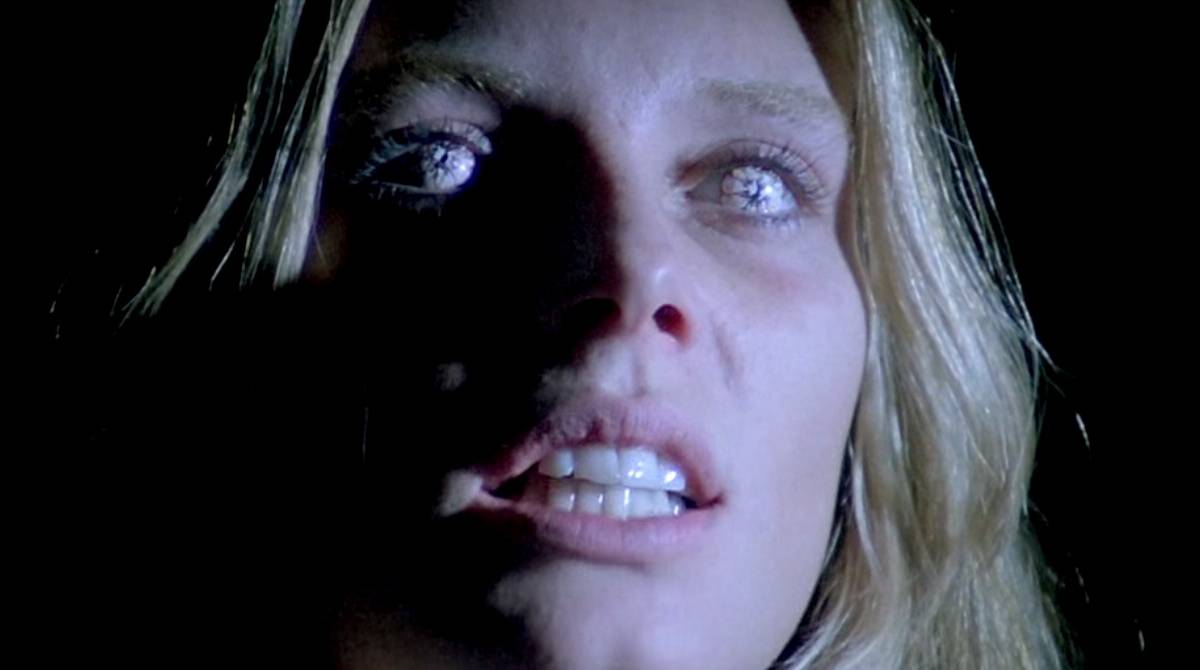
The average human body contains around 1.3 gallons of blood. But what if it actually contained 10 times as much blood, and that blood came geysering out of a person when their flesh, soaked to gelatinous consistency, was ripped open by a zombie? Lucio Fulci asks this essential question in his 1981 film The Beyond. Much like Leonardo da Vinci sketched cadavers to better understand the nature of man, Fulci uses goopy special effects to understand what a melting face or a dislodged eyeball would look like up close. That splash-zone approach to horror requires a refined taste that not all moviegoers possess. Roger Ebert notoriously hated The Beyond, so much so that he singled it out in his appropriately titled book, I Hated Hated Hated This Movie. “It's the kind of movie that alternates stupefyingly lame dialogue with special-effects scenes in which quicklime dissolves corpses and tarantulas eat lips and eyeballs.” He’s not wrong — tarantulas do eat a guy’s lips off in The Beyond. Image: Grindhouse Releasing Part of Fulci’s unofficial “gates of Hell” trilogy (along with City of the Living Dead and The House of the Cemetery), The Beyond centers on Liza (Katherine MacColl), a down-and-out lady from New York City who moves to New Orleans to renovate and reopen the Seven Doors Hotel. Unfortunately, the hotel is named as such because it sits atop one of the seven gates of Hell. Whoops! While a cerebral director like Stanley Kubrick walked nearly the same path for The Shining, and wound up with a psychological study of a tormented artist, Fulci instead rips across the superficial premise like a pro skimboarder. As he put it in a 1982 interview with Starburst Magazine, keeping the narrative simple was the entire point. “My idea was to make an absolute film, with all the horrors of our world. It's a plotless film: a house, people, and dead men coming from The Beyond. There's no logic to it, just a succession of images. The Sea of Darkness, for instance, is an absolute world, an immobile world where every horizon is similar.” Image: Grindhouse Releasing That might sound like a grandiose statement for a splatter director, but I side with Fulci here. Ebert’s wrong to rib The Beyond for simplistic plot and dialogue. In fact, Fulci’s vision isn’t far off from something like James Cameron’s Avatar: both reach for the otherworldly, images we didn’t know were possible to project on screen, and neither filmmaker wanted that quest to sink into the quicksand of complex drama. In the case of The Beyond, primal fear swirls around the mundanity of everyday life — bills, careers, middle-age anxiety — until literal hell on earth is unleashed in the most disgusting ways possible. No plot, Ebert? A decaying corpse does not simply emerge from a bathtub full of bloody, hairy muck without the proper setup! And the surrealism goes deeper than just gore; a moment where Liza drives across a deserted Lake Pontchartrain Causeway, only to meet a blind woman and her dog standing frozen in the middle of the bridge, feels right out of a David Lynch movie. If that sounds like a “so bad it’s good” defense, I would add that The Beyond stands out as maybe Fulci’s masterwork because it’s still tinged with theme. As many have delved into over the years, Sigmund Freud would have a field day peeling back the layers of Fulci’s dream imagery. Religion seeps into every corner of The Beyond, from the acknowledgment of Christian Hell to a seer’s premonition of the plagues that haunt Liza to tomes of cursed occult language that has literally blinded those who’ve read it. Like every kill in The Beyond, these are overtones, not subtleties. “I think each man chooses his own inner hell, corresponding to his hidden vices,” Fulci said in his career-spanning Starbust interview. “So I am not afraid of Hell, since Hell is already in us. Curiously enough, I can't imagine a Paradise exists, though I am a Catholic — but perhaps God has left me? — yet I have often envisaged Hell, since we live in a society where only Hell can be perceived. Finally, I realize that Paradise is indescribable. Imagination is much stronger when it is pressed by the terrors of Hell.” Critics at the time rejected The Beyond (it took three years after its Italian release for the film to cross over to North America, despite Fulci shooting it in Louisiana, and played under the alternate title 7 Doors of Death) but those with a stomach for its carnage eventually saw it as the diamond its director always meant it to be. In fact, none other than Quentin Tarantino helped get the film back into theaters in 1998, paving the way for proper reconsideration. At a time when Obsession’s bloody hijinks have triumphed over blockbusters and the Backrooms turns surreal nightmare into song of the summer, you might think Fulci’s brand of early ‘80s “video nasty” must be dated, a response to the pearl-clutching of a more conservative era. You would be wrong. The Beyond will send you sickos into a gleeful fit.
Quentin Tarantino Wants You to Watch This Zombie Horror Movie At Least Once
Full Article
Original Source
Read the full article at Polygon →KhanList aggregates and links to publicly available news content. We do not host full articles from third-party sources. Always verify important information with original sources.