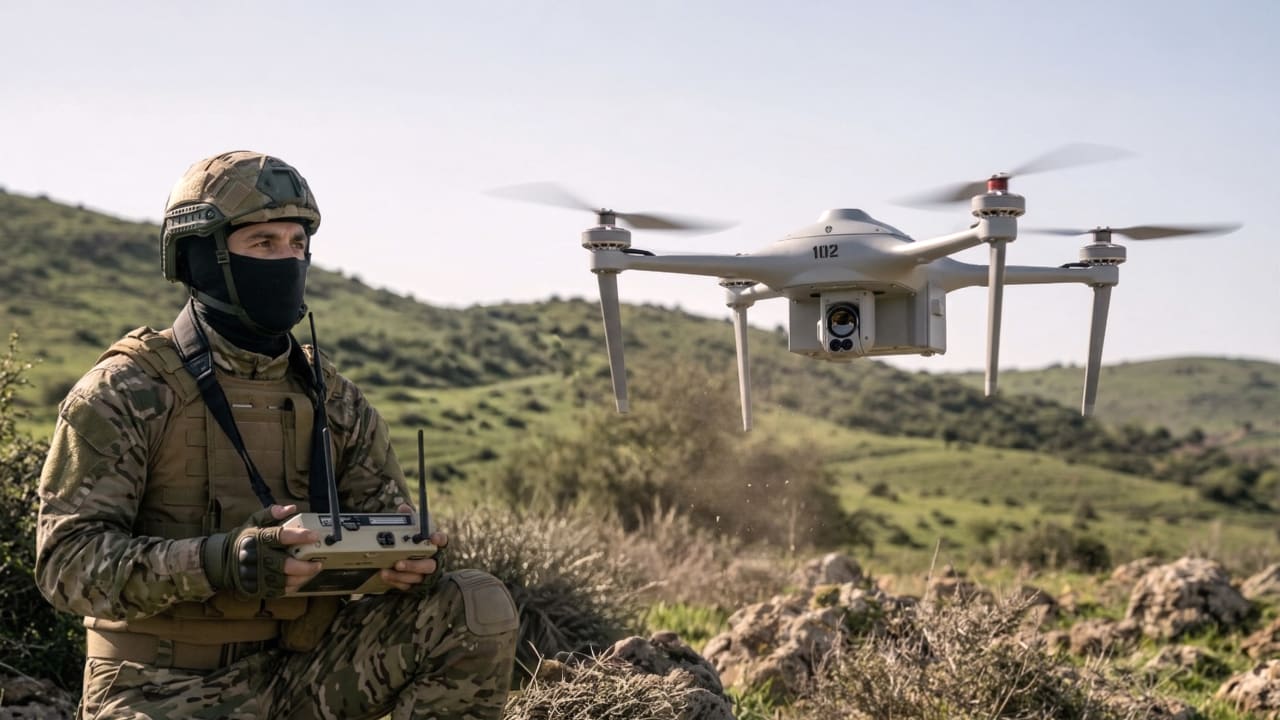
ByLT.-COL. (RES.) OFIR AVRAMAUGUST 17, 2026 05:39The rapid growth of the military drone market has created a dangerous illusion: that more unmanned platforms automatically mean more operational power.Armed forces can now choose from hundreds of systems, each with different payloads, controllers, batteries, communications links, and software environments. On paper, this diversity looks like progress. In practice, it often creates fragmentation.Every additional platform introduces another supply chain, another training requirement, another maintenance process, and another cybersecurity risk. During short demonstrations, this variety may appear innovative. During prolonged operations, especially under electronic warfare and logistical pressure, it can become a burden.The future of military drone procurement should therefore not be based on continuously adding new platforms. It should focus on a smaller number of complete, reliable, and connected systems that can operate at scale.Such a system must deliver five essential advantages.AEROSENTINEL G3 Drone, an 11-kg. Israeli-made nearly silent drone that can travel up to 15 km. with multiple payload options. (credit: AeroSentinel)Operational independence begins with the supply chainA country cannot claim full operational independence if its drones depend on a potential strategic competitor for batteries, critical components, software updates, spare parts, or technical support.This is not only an economic concern. It is a military one.If a crisis disrupts access to components, if software support is withdrawn, or if production cannot continue during wartime, the platform may become unavailable precisely when it is needed most. A low purchase price means little if the system cannot be sustained under real operational conditions.Procurement authorities should therefore examine where a drone is designed, where its critical components are produced, who controls its software, and whether the manufacturer can guarantee continuity during conflict.Supply-chain security must be treated as part of operational readiness.A drone is an intelligence systemA military drone does not merely collect images. It processes and transmits sensitive data: coordinates, video, telemetry, flight routes, unit locations, and patterns of activity.A compromised system may therefore expose not only the target being observed, but also the force operating it.Cybersecurity must be built into the platform from the beginning. Secure communications, encrypted data, controlled software updates, transparent architecture, and the ability to operate without dependence on an external commercial cloud should be basic requirements.Protecting drone data is part of protecting the force.Connectivity creates the force multiplierThe greatest future value of a military drone will not come only from how well it flies. It will come from how well it connects.A drone that sends information only to its own operator remains an isolated flying sensor. A drone that securely shares information with command-and-control systems, intelligence networks, defensive systems, and strike capabilities becomes part of a wider operational ecosystem.That is the difference between another platform and a force multiplier that can help you to gain tactical dominance.Future systems should be designed to connect with other sensors, support decision-making, and pass relevant information rapidly to the right operational element. They should be modular enough to carry different payloads and flexible enough to integrate with future capabilities.A drone should not create another technological island. It should strengthen the entire force.The real performance metric is mission availabilityManufacturers often compete over looks, range, or camera resolution. These figures matter, but they do not always reflect operational value.The more important question is how long the system can provide long endurance and reliable intelligence where it is needed.A drone may advertise impressive flight time, but after transit, battery changes, maintenance, and communications interruptions, the effective observation window may be much shorter. Likewise, an advanced payload is of limited value if the aircraft cannot remain over the mission area long enough to influence decisions.Military evaluations should therefore focus on mission availability: continuous coverage, payload performance, acoustic signature, deployment speed, weather resistance, operator workload, and the logistical effort needed to sustain the system.The question should not be only, “How fast can the drone fly?”It should be, “How long can the system reliably support the mission?”A system that fails under disruption is not ready for warModern battlefields are increasingly shaped by electronic warfare. Communications can be jammed, GNSS signals can be degraded, and false positioning data can be introduced.A military drone should not be judged only in a clean demonstration environment. It must be tested under realistic disruption.Resilience must exist across the entire system: the aircraft, the navigation architecture, the communications link, the controller, and the software. A platform that performs well only when the spectrum is clean is not a combat-ready capability.Resistance to communications and GNSS disruption is no longer a special feature. It is a basic condition for relevance.An Israeli vision for the next generationIsrael has the operational experience, technological infrastructure, and defense ecosystem required to lead this transition.The goal should not be to create another Israeli drone. It should be to build a complete Israeli unmanned system.That system should operate continuously across different mission profiles: tactically with forces in the field, persistently from automated boxes, and as part of wider intelligence, defense, and strike networks.It should be sovereign, secure, modular, resilient, and scalable. It should allow new capabilities to be added without replacing the entire platform. Most importantly, it should be designed from the outset as part of the operational force, not as an aircraft that must later be connected to it.The next generation of military advantage will not belong to the country that owns the greatest number of drone models.It will belong to the country that builds one complete, reliable, and connected unmanned system and can deploy it at scale.The author is a former IDF lieutenant- colonel who commanded an intelligence, surveillance, and reconnaissance unit during the war and currently serves as chief marketing officer of Aero Sentinel, an Israeli tactical unmanned-systems company. The views expressed are his own.Follow us on Google
Quality over quantity: Unified systems are future of drones - opinion
Full Article
Original Source
Read the full article at Jpost →KhanList aggregates and links to publicly available news content. We do not host full articles from third-party sources. Always verify important information with original sources.