
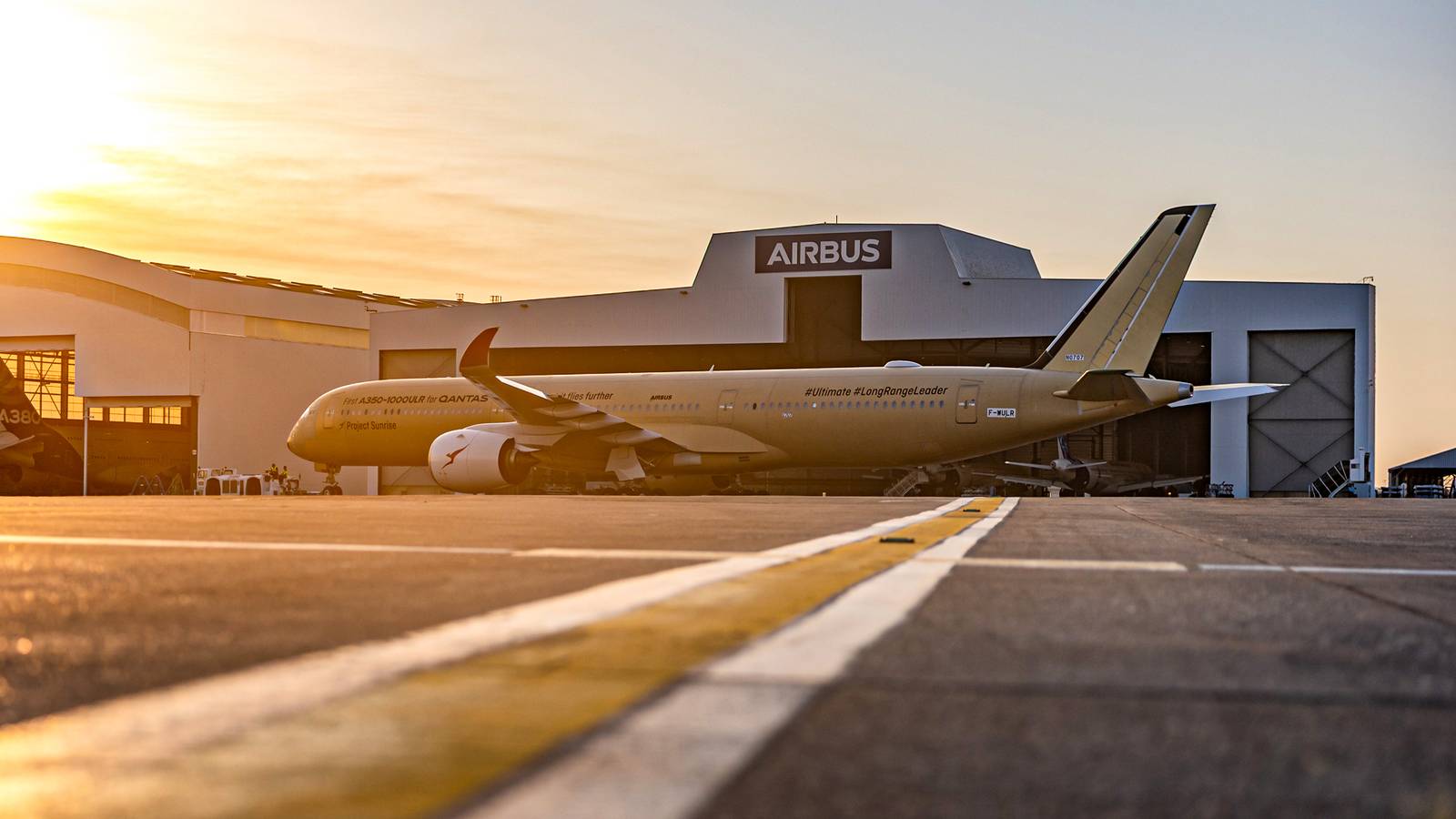
Published Nov 7, 2026, 1:00 AM EST Brandon's passion for aviation started at a young age. He became involved in the flight simulator and VATSIM communities, which sparked his interest in aviation and eventually led him to earn his private pilot license. Outside of work, he continues to build flight hours, explore new airports, and stay involved in the aviation community. Qantas will train more than 360 pilots and 1,200 cabin crew to operate 12 aircraft. The figure comes from the airline's own announcement, which states both groups will be trained by the time the twelfth Airbus A350-1000ULR arrives. That works out to 30 pilots and 100 cabin crew per airframe, roughly double what a conventional long-haul aircraft requires, on a fleet carrying 238 passengers per flight. The length of the flights explains the ratio. Each aircraft carries an additional 5,283-gallon (20,000-liter) rear center fuel tank, enabling more than 9,942 miles (16,000 km) and up to 22 hours nonstop; a sector that long requires more pilots on board and longer rest periods afterward than any conventional rotation. Training is already underway on Australia's first A350 simulator in Sydney and with British Airways in the UK, drawn initially from Qantas A330 pilots, 40 of whom are converting to the A350 while continuing to fly their existing aircraft. The first A350-1000ULR arrives in April 2027, with Sydney to London launching that October and Sydney to New York from mid-2028. 30 Pilots Per Aircraft Credit: Qantas Qantas will train more than 360 pilots and 1,200 cabin crew to operate 12 aircraft. The figure comes from the airline's announcement, which says both groups will be trained by the time the twelfth A350-1000ULR arrives. Divided across the fleet, that is 30 pilots and 100 cabin crew for every airframe, on aircraft configured with 238 seats each. The ratio is unusual enough that it drew attention when Qantas published it. Across the full Project Sunrise fleet, the airline is committing to a flight and cabin crew workforce of more than 1,560 people for twelve aircraft, a number driven by the operating profile rather than the fleet size. The scale also reflects what Qantas is building toward, not what it needs on day one. Project Sunrise is the airline's first attempt at operating ultra-long-range flights as a core part of the network rather than a record-setting exception, and the 1,560 figure covers the full twelve-aircraft fleet across London, New York and whatever routes follow. Qantas has said the program forms part of a broader fleet renewal that shifts the carrier from a predominantly Boeing-operated long-haul fleet to a largely Airbus-based structure, which means the training effort extends beyond Project Sunrise itself and into how the airline's entire long-haul operation will be crewed over the next decade. Why A 22-Hour Flight Needs More Crew Than A Normal One Credit: Qantas The A350-1000ULR has an additional 20,000-liter rear center fuel tank that lets it fly more than 16,000 km and up to 22 hours nonstop. Qantas describes the aircraft as purpose-built for that mission, and the crew numbers follow from it rather than from the size of the fleet. Qantas has framed the operation around the science of ultra-long-haul travel. Group CEO Vanessa Hudson described the aircraft as representing a fundamentally different way to fly, citing the lighting, the meals and a world-first Wellbeing Zone designed to help passengers manage flights of this length. The cabin holds 238 seats across four classes, comprising 6 first, 52 business, 40 premium economy and 140 economy. Regulatory arrangements for flights of this duration are also distinct from standard long-haul operations. Qantas has worked with the Civil Aviation Safety Authority on fatigue management for ultra-long-range flying, an area where normal duty limits do not straightforwardly apply to sectors exceeding 20 hours. The specifics of how crew complements and duty periods are set for Project Sunrise have not been published in detail, but the scale of the workforce Qantas has committed to training is the clearest public indication of what operating a 22-hour sector requires compared with a conventional long-haul rotation. The airline has also not disclosed how crews will be based or how rostering will distribute flying across the 360 pilots, both of which shape how many people a daily London rotation actually consumes. What is clear from the published figure is that Qantas expects to need substantially more crew per aircraft than its existing long-haul fleet requires, and that the gap grows with every additional ultra-long-haul route the program adds. Where The Training Is Actually Happening Credit: Light Orancio | Shutterstock Qantas pilots began training on Australia's first A350 simulator, installed in Sydney, ahead of the aircraft's arrival. The airline has also sent pilots to train with British Airways in the United Kingdom, which operates the A350-1000 and can provide experience that does not yet exist in Australia. Running both tracks lets Qantas build A350 competency before it has an aircraft of its own. The initial cohort comes from inside the existing fleet. Qantas's current A330 pilots make up the first intake for Project Sunrise, with 40 already in the process of training for the A350 alongside their existing A330 flying. Timing adds pressure to it all. With first delivery in April 2027 and Sydney to London launching that October, Qantas has roughly six months between receiving its first aircraft and operating a revenue service on the longest route in its network. Reporting on the program suggests the first A350-1000ULR will likely fly to New Zealand for training and crew familiarization before entering scheduled ultra-long-haul service, which gives crews time on the actual aircraft on short sectors before they take it to London. Everything before that point happens in a simulator in Sydney or on another airline's aircraft in the United Kingdom. What Project Sunrise Is And How Long It Has Taken Credit: Airbus Project Sunrise takes its name from the Double Sunrise endurance flights Qantas operated during the Second World War, a reference the airline has made explicitly in describing the program. The modern version aims to connect Australia's east coast nonstop to London and New York, routes no airline has operated without a stop. The timeline has been long and repeatedly extended. Qantas announced in December 2019 that its preferred aircraft for the project was the Airbus A350-1000, which would receive an additional fuel tank and a slightly increased maximum takeoff weight to deliver the required performance. The firm 12-aircraft order was confirmed in May 2022. In February 2024, Qantas announced a delay of roughly six months, which Airbus attributed to the need to redesign the extra fuel tank, moving delivery to mid-2026. Qantas's August 2025 full-year result expected deliveries from October 2026. Airbus's June 2026 program update set the first delivery for April 2027. The aircraft has since demonstrated the capability the program requires. The first A350-1000ULR made its maiden flight on June 2, 2026, flying for 3 hours and 43 minutes over France. In July 2026, Airbus conducted two nonstop test flights between Toulouse and Melbourne using that aircraft, which were reported as setting a distance record for a commercial airliner. Qantas unveiled the aircraft at Toulouse on June 17, 2026, with the second airframe moving through an eight-week testing and certification program. Those test flights matter beyond the publicity, because they validated the modified fuel system and the extended-range systems that distinguish the ULR from a standard A350-1000 across a real mission profile rather than in a laboratory. The certification campaign covering those changes is what stands between the current flight testing and a delivered aircraft, and it is the piece of the program Qantas does not control. The Timeline The Training Has To Meet Credit: Airbus Qantas will launch daily nonstop Sydney to London service in October 2027, the first Project Sunrise route, operating alongside the existing Perth to London and Sydney via Singapore to London services. Sydney to New York follows from mid-2028, which Qantas Group CEO Vanessa Hudson described as completing a vision the airline set out many years ago. The first aircraft is expected in April 2027, giving roughly six months between delivery and the opening revenue flight. The route network it supports is also still expanding. Qantas confirmed Sydney to New York in September 2026, describing it as the first ever nonstop commercial service between Australia and New York, and Hudson called adding the city a defining moment for Australia and the United States. The airline has indicated further Project Sunrise destinations are possible beyond London and New York, which would push crew requirements even higher. Each additional ultra-long-haul route requires its own rostering coverage rather than drawing on spare capacity from existing ones, because a crew operating a 22-hour sector is unavailable for an extended period afterward. The 360 and 1,200 figures are not a launch requirement. Qantas has said both groups will be trained by the time the twelfth A350-1000ULR arrives, a date the airline has not published and that depends on a delivery schedule that has already shifted several times. The workforce builds alongside the fleet rather than ahead of it, with each additional aircraft requiring another tranche of qualified crew. For the first route, Qantas needs enough crew to operate one daily rotation to London. For the full program across London, New York and whatever follows, it needs all 1,560.
Qantas Is Training 360+ Pilots & 1,200 Cabin Crew For Just 12 Airbus A350-1000ULRs
Full Article
Original Source
Read the full article at Simpleflying →KhanList aggregates and links to publicly available news content. We do not host full articles from third-party sources. Always verify important information with original sources.