
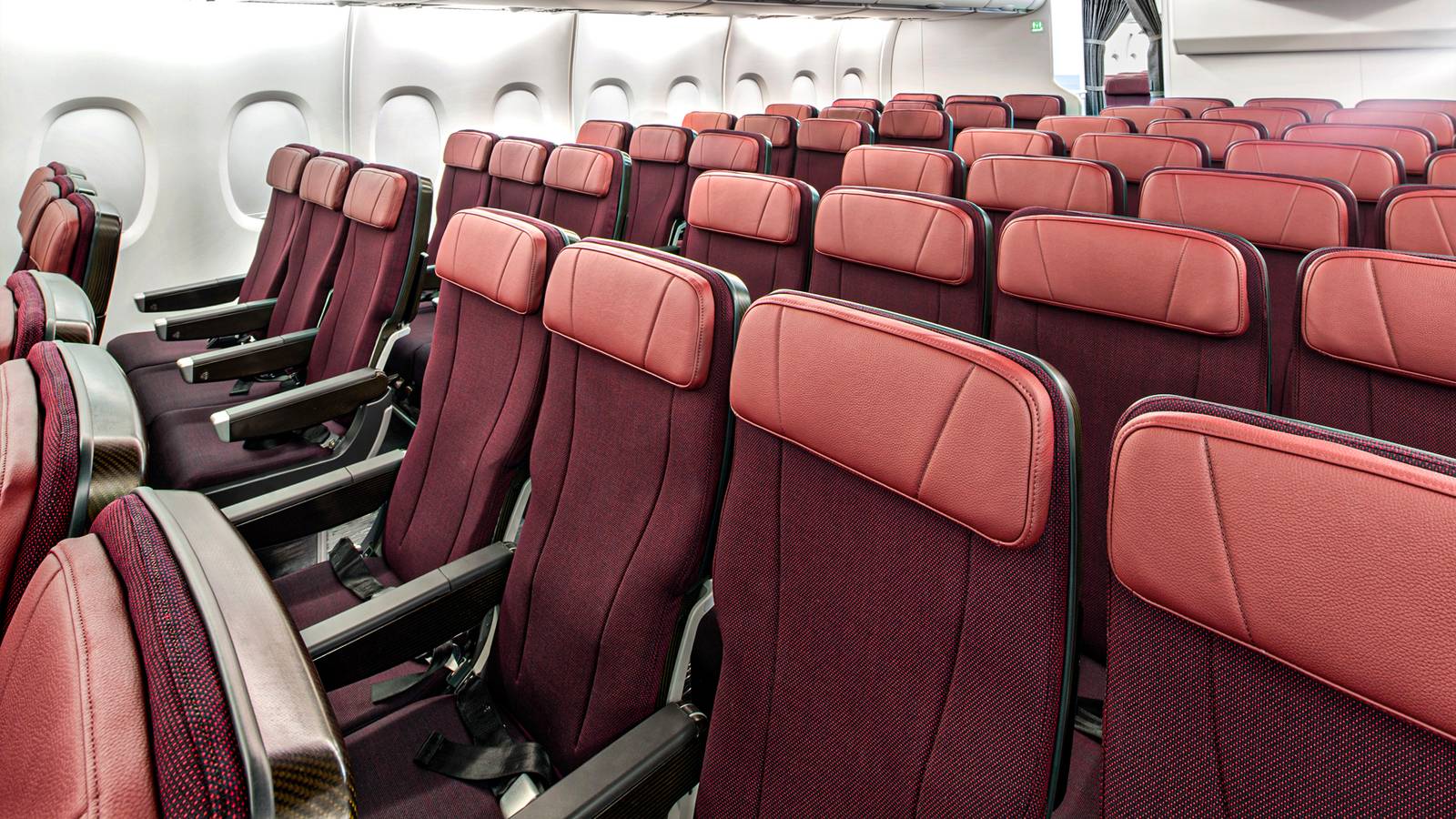
Passengers settling into the economy cabin on one of Qantas' Airbus A380 superjumbos have no idea that sitting just a little way below them is a subterranean capsule hotel where the crew can get some well-needed rest. While hundreds of travelers recline across the main deck, up to 12 off-duty cabin crew members rest in a 12-berth module tucked inside the forward section of the aft cargo hold. The hidden lower-deck compartment is one of the more unique parts of the A380 structure, but is also a part that brings a complex safety and engineering challenge regarding emergency egress on ultra-long-range sectors like Sydney Kingsford Smith Airport (SYD) to Los Angeles International Airport (LAX). The reason for this is that regulatory compliance means a secondary escape route is needed that bypasses the cargo hold entirely, giving birth to a unique seat-map anomaly centered around row 70. Where Is The Best Place On A Double Decker? When looking at the A380 from a structural point of view, the vertical ovoid fuselage cross-section of the A380 can be split into three distinct levels: an upper passenger deck, a main passenger deck, and a lower cargo and utility hold. Single-deck airliners generally have space for crew rest areas carved out above or below the passenger cabin, but because the A380 has two decks full of passengers, the positioning of these spaces had to be thought out carefully. Aircraft designers decided to use the expansive headroom in the forward section of the aft cargo area to install a modular, 12-berth cabin crew rest facility so revenue-generating seating space on the main passenger floor above was not sacrificed, as detailed in Simple Flying analysis. Access to this underground sanctuary is restricted to a steep, narrow staircase hidden behind a locked door situated between rows 65 and 66 in the economy cabin. As noted in insights from Executive Traveller, the interior resembles a compact Japanese capsule hotel, featuring individual padded mattresses, sound-dampening curtains, personal reading lights, AC and USB power outlets, intercom handsets, and emergency oxygen masks. The subterranean bunks are isolated from the main cargo bays by reinforced structural bulkheads and heavy thermal insulation. The air-conditioning system pumps fresh air independently through the module, which helps to maintain a controlled climate that shields resting crew members from the ambient temperatures and noise levels generated by underfloor cargo systems. Keeping Crew Safe In Any Emergency Credit: Qantas Under strict aviation safety regulations established by the European Union Aviation Safety Agency, specifically EASA Special Condition D-04 as analyzed by Global Travel Post, any below-deck or lower-fuselage crew compartment must feature at least two widely separated emergency evacuation routes. The issue is that a single entryway can become blocked by fire, smoke, or structural deformation during an emergency, so a secondary floor exit is legally mandatory on all lower-deck crew rest modules. The requirement means off-duty staff can evacuate directly upward into the main passenger cabin and not have to transit through unpressurized or fire-suppressed cargo holds. The main access stairwell between rows 65 and 66 is considered the default entry and exit point during normal flight operations, while the secondary floor hatch provides an immediate backup path directly into the economy aisle. The idea is to route both escape paths directly into the inhabited passenger deck above so that sleeping crew members can have continuous access to cabin oxygen and fire suppression boundaries. Aviation safety authorities strictly enforce these dual-egress requirements during aircraft certification trials to verify that a full crew shift can clear the module in seconds. Tests require off-duty flight attendants to evacuate the lower compartment under simulated zero-visibility and heavy smoke conditions, all to show that both the primary stairwell and secondary hatch are accessible during difficult cabin angles or structural shifts, as noted in Simple Flying analysis. Meeting these strict regulatory benchmarks is what guarantees that lower-deck crew rest modules achieve the same survival standards as standard main-deck cabin infrastructure. Pilots Have Their Own Dedicated Space? Credit: Qantas The subterranean crew rest module beneath the economy floor serves exclusively cabin crew, so what does that mean for the pilots? Flight crews actually are given access to an entirely different layout. As detailed in the Janes Airbus A380 Technical Analysis, the superjumbo's immense forward upper deck houses a dedicated pilot rest facility located immediately behind the cockpit. Down in the depths of the A380, cabin crew sleep in tightly stacked horizontal pods resembling a railway sleeper carriage, whereas A380 pilots benefit from a more spacious, separate rest room equipped with an armchair, full-length bunk, and isolated climate controls. The reason for this separation is the differing fatigue-management rules and crew complement sizes that exist on ultra-long-haul rotations. It may seem rather counterintuitive to create two separate rest areas; after all, space is an incredibly valuable and scarce commodity on any airliner. Having distinct facilities for pilots and cabin crew actually helps maintain strict operational boundaries during long international sectors. The upper-deck pilot rest area gives flight captains immediate, private access to the flight deck, while the larger lower-deck module gives flight attendants a centralized space to take scheduled breaks without disturbing passengers. The Missing Seat Taking a look at seat maps for the Qantas A380, some may notice a rather peculiar omission in the economy cabin: Seat 70D does not exist. As explored in an analysis from Australian Frequent Flyer, seats 70E, 70F, and 70G are retained in the center block, and the space where 70D should sit is left entirely open as a solid floor panel. To most passengers, this is simply a comfort extra, but its omission does have its own unique purpose. As documented in viral pilot walkthroughs highlighted by the Sydney Morning Herald, this missing seat designation conceals a spring-loaded emergency escape hatch. In the rare event of a lower-deck emergency where the main staircase is blocked, resting crew members can manually release the floor hatch from below, pushing upward into the cabin floor space near row 70 to evacuate directly into the aisle. Of course, keeping an escape hatch visible would be a worrying sight for passengers seated anywhere near it. So, to keep the escape mechanism hidden during regular passenger operations, the hatch panel sits flush with the cabin floor and is covered by standard airline carpeting. Built-in quick-release latches allow off-duty flight attendants to pop the panel open from below without needing any tools or assistance from passengers above. Bringing Freshness To The Fleet During Qantas's comprehensive multi-million-dollar A380 cabin overhaul, the airline reorganized its interior layout, concentrating all 341 economy seats entirely on the lower deck, as outlined in the Qantas Economy Seat Guide from Australian Frequent Flyer. The upper deck was reconfigured to house 70 business suites, 60 premium economy seats, and 14 first class suites sit upfront in the lower deck. After the reactivation of 10 A380 aircraft back into service, Qantas needed to make sure that the passenger experience onboard matched the expectations of travelers, especially as the A380 was seen as the perfect way to deal with surging passenger demand. Despite these extensive passenger-facing upgrades, the subterranean crew rest modules and their associated escape hatches remained untouched. The decision to leave these areas as they were was not because they did not need refreshing; instead, the structural firewalls, primary electrical looms, and lower-deck cargo framing are prohibitively expensive and technically complex to relocate during a mid-life cabin refresh. As a result, the original 12-berth module stayed in its place. Retaining the original lower-deck design allowed Qantas to save millions of dollars in recertification costs during the fleet refurbishment program and focus that spending on fleet improvements that would make a more noticeable positive change in revenue generation. Engineering teams worked meticulously around the existing floor hatches and stairwells, installing updated seat tracks, refreshed bulkheads, and modern carpet tiles, all while leaving the underlying safety infrastructure beneath row 70 completely intact. A World Away From Prying Eyes The hidden world beneath the floorboards of the Qantas A380 illustrates the complex engineering compromises needed to operate ultra-long-range commercial flights. What appears on a consumer seat map as a simple missing seat number is actually far more. In reality, what lies below is a sophisticated intersection of regulatory compliance, structural safety, and space optimization. Global aviation standards continue to evolve toward higher-density twin-jets, where these rest areas will only become even more important as airlines push flights beyond 20 hours in duration. These modern aircraft have inevitably caused the demise of the A380 in the modern airline market, but the sheer scale of the A380's three-level fuselage allows it to maintain dedicated crew rest facilities that smaller widebodies struggle to accommodate without payload penalties. Passengers may never notice the blank space at row 70, and may continue to be blissfully unaware of the sleeping crew members beneath their seats. Even so, the rest areas on the A380 are one of the most fascinating safety innovations in modern commercial aviation.
Qantas' Airbus A380 Hides 12 Crew Bunks Under Economy, And Seat 70D Is Their 2nd Way Out
Full Article
Original Source
Read the full article at Simpleflying →KhanList aggregates and links to publicly available news content. We do not host full articles from third-party sources. Always verify important information with original sources.