
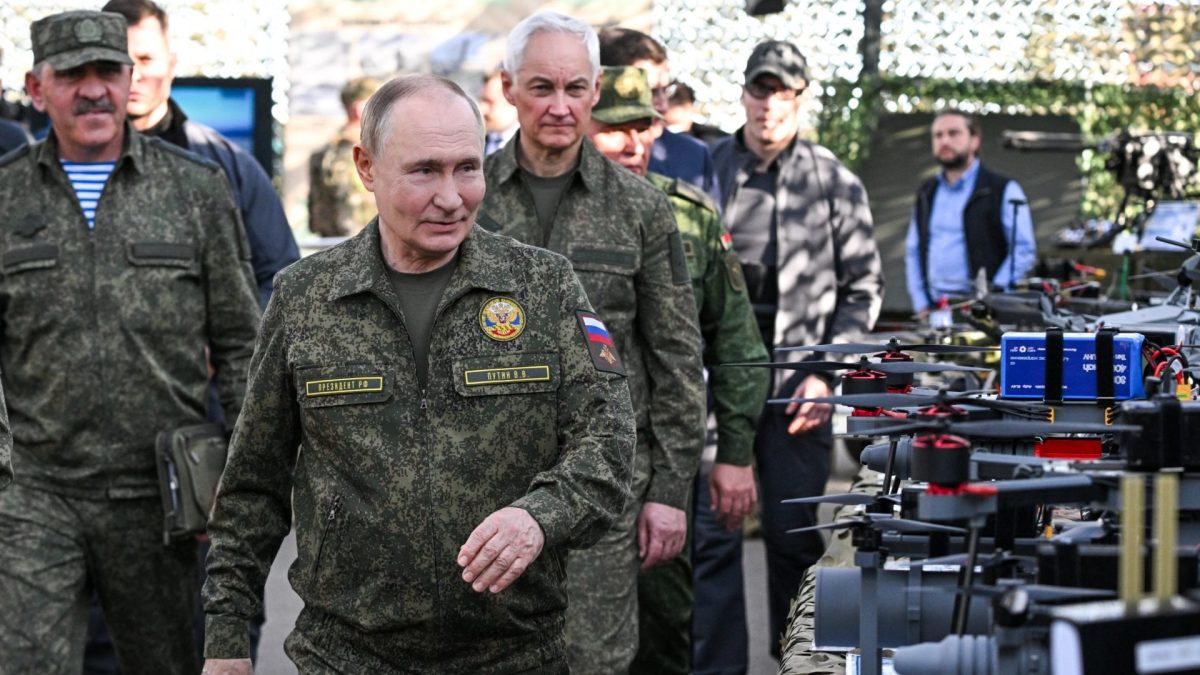
“Would you like to buy our grenades?” The offer was made to me by two Russian soldiers as we stood by the side of a road on a cold winter’s day during Vladimir Putin’s first war, which he waged against his own citizens in Chechnya two decades ago. The soldiers were starving and stood just a couple of miles away from the front line, with the sound of artillery piercing the air. They were so desperate for cash to buy food that they were willing to sell their weapons to a passing BBC foreign correspondent. The Russian military, large in number, was unable to deliver the supplies that its soldiers needed. During Putin’s latest war, this time against Ukraine, similar stories abound of soldiers forced to purchase their own flak jackets, helmets and other equipment because the Russian army has the same supply issues it did 26 years ago. Russia has one of the biggest militaries in the world. Putin has just announced yet another expansion, adding more than 15,000 troops to the over 1.5 million that it has already. But his decree cannot magic up the soldiers overnight – and they will need to be trained and given weapons and ammunition. It’s not the rising troop figures which should worry us in Britain and the rest of Europe, it’s what they symbolise. Russia is settling in for the long haul. If you aren’t persuaded of that, let me give you a really frightening number: the Russian military budget is going up by 27 per cent next year. Think of that the next time you hear the British government is trying to find another few hundred million pounds to bolster its defence spending.It’s a stark reminder to the UK and to our European partners that time is not on our side – we are still sleepwalking rather than being fully awake to the danger posed by Russia. What is clear is that the Kremlin is not rebuilding its pre-war military, it is institutionalising a much larger one. More critically, its factories have adapted – Nato has warned that Russia is producing weapons faster than expected. Col-Gen Andrei Mordvichev, commander of the Russia military’s ground forces, during the Victory Day parade in Moscow this year. Russia is learning, adapting and producing better weapons as the war on Ukraine drags on (Photo: Getty) Corruption continues to eat into the Russian military, just as it did when those soldiers wanted to sell me their grenades. Money leaks out of military procurement by the millions. But a corrupt army is still a dangerous one. Russia is learning, adapting and producing better weapons. Its missile and drone campaign demonstrates a strong industrial capacity and its wartime economy is in full flood. Its submarines remain a serious threat to the underwater cables that are the lifeblood of our own peacetime economy. Meanwhile, years of fighting in Ukraine have taught its commanders and industry lessons that we are having to learn second hand. Now Russia is stepping up its hybrid conflict against Britain and our allies. So what should we do? Firstly, we should not miss the opportunity as we did through most of the 1930s, when Hitler’s Germany was rearming and he took our reluctance to confront him as a sign of weakness. We should also not try to match Putin soldier for soldier. The West should concentrate on the capabilities that Russia finds hardest to overcome: dense air and missile defences, vast ammunition reserves, cheap drones and counter-drone systems, along with electronic warfare and the logistics to move heavy forces rapidly across Europe. Nato has called for more air defences and thousands more armoured vehicles. The EU’s Readiness 2030 programme is pushing joint procurement, as well as an Eastern Flank Watch along the EU’s borders with Russia and a European Drone Defence Initiative and an Air Shield. A Patriot missile battery at Rzeszow-Jasionka airport in Poland. Nato has called for the ramping up of air defences against threats from Russia (Photo: Evan Vucci/AP) But plans are not the same as delivery. Germany and Poland are in the vanguard of responding to the threat. The Germans are aiming to double their defence spending by 2029 and Poland’s military budget is already on the road to being close to 5 per cent of GDP. But more typical are the majority of EU member states which, like Britain, should be doing far more. The possibility remains that for all the grand plans, reality will prove a disappointment, leaving us struggling. Above all, we need to keep Ukraine in the fight. The country’s resistance over the last few years has given us the time we need to respond. We should not waste it when the cost in Ukrainian lives is so high. Every Russian loss means less time and weaponry available to regenerate for a future confrontation with Nato. Putin’s latest decree to beef up his military is not about a new Russian army appearing overnight, it is a warning label on a much larger project. If we want peace, we need to move more swiftly to prepare for war – not because we are heading for a war but because deterrence is the best way to stop one. Putin exploits weakness and respects strength. The British government should read his latest decree thoroughly – and use the time it still has wisely.
Putin is rearming, mobilising and making new weapons. How the UK should respond
Full Article
Original Source
Read the full article at Inews →KhanList aggregates and links to publicly available news content. We do not host full articles from third-party sources. Always verify important information with original sources.