
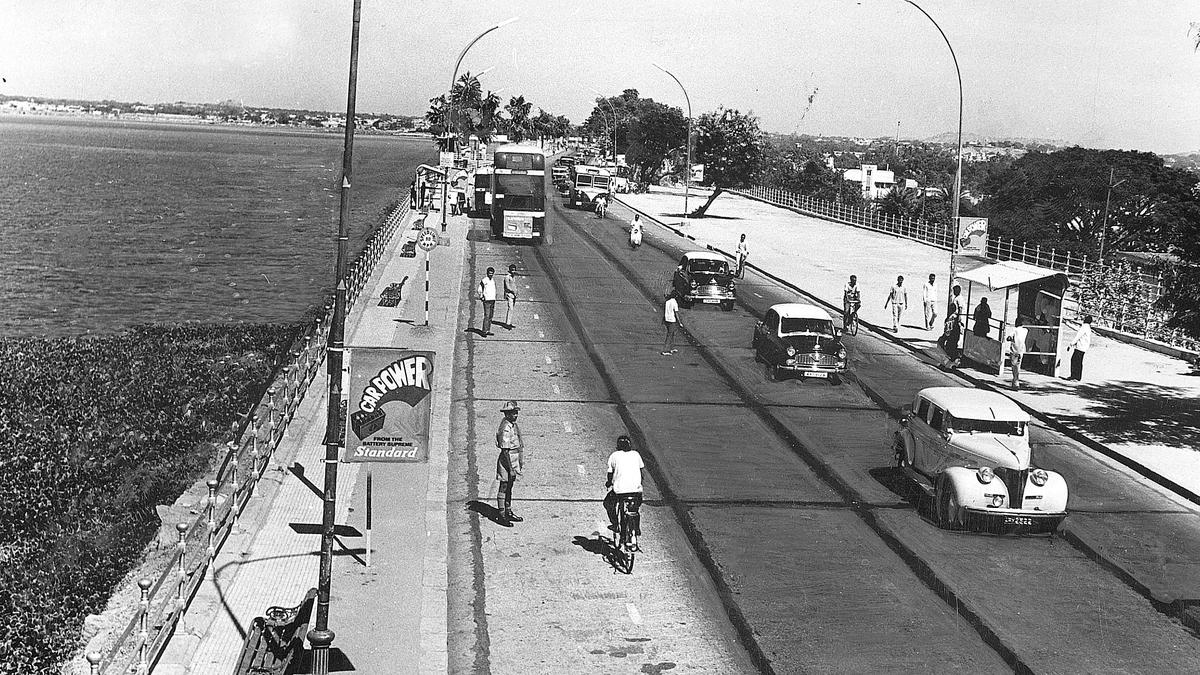
Archive photo Tank Bund, which connected the twin cities of Hyderabad and Secunderabad | Photo Credit: THE HINDU ARCHIVES Hyderabad’s Purana Shahar is no exception. Beyond its old-world charm, it preserves something increasingly rare in modern urban life — the warmth of human bonds and the intimacy of one-to-one interactions.Hyderabad’s history can almost be read in stone. The city possesses an extraordinary cultural heritage, with 166 listed heritage buildings and precincts, 22 protected monuments and nine spectacular rock formations.Rapid urbanisation, however, continues to threaten this legacy. Yet many of these historic structures remain remarkably resilient, continuing to draw tourists and history enthusiasts.What makes Hyderabad’s architecture particularly fascinating is its diversity. Qutb Shahi, Mughal, Rajput, Indo-European, Osmania, vernacular, wooden and Palladian influences can all be found across the city. Remarkably, these varied architectural traditions coexist in harmony, reflecting Hyderabad’s distinctive character as a melting pot of cultures and traditions.The city bears the unmistakable imprint of two great ruling dynasties — the Qutb Shahis, who ruled for nearly 170 years, and the Asaf Jahis, whose rule lasted about 224 years. Like several medieval cities, Hyderabad grew from a fortified settlement.Golconda served as an important centre under the Kakatiyas, Bahmanis and Qutb Shahis. In 1687, Mughal emperor Aurangzeb conquered Golconda after defeating Abul Hasan Tana Shah, the last Qutb Shahi ruler. In 1724, Asaf Jah, the Mughal Subedar of the Deccan, established the Asaf Jahi dynasty, which continued until 1948.The region witnessed its share of wars, political intrigues and struggles for power. Yet history left behind more than stories of conquest; it created a remarkable cultural landscape that continues to shape the city.As the saying goes, nothing endures but change. Hyderabad, too, is changing rapidly.The Information Technology boom has accelerated the pace of life, making the city bigger, faster and more frenetic.It now wears a chic, upscale look. Yet, thankfully, its traditional warmth has not disappeared. Few experiences capture the city’s easy-going spirit better than ordering a one-by-two chai and lingering over it with crisp Osmania biscuits. Culture, costume and cuisine further enrich Hyderabad’s identity.The erstwhile rulers were renowned for their love of royal repast, and the Old City remains a paradise for food lovers. Biryani, shikampur kebab, haleem and numerous other delicacies reveal a delicious fusion of Mughlai, Turkish and Arab influences. Step into the Old City and you embark on a voyage of flavours.Hyderabad today is vibrant, bustling and constantly evolving. Yet, amid the hustle and bustle of the teeming metropolis, the dust of its royal past refuses to settle. To spend time here is to glimpse, and perhaps briefly relive, an age gone by. Beneath its modern exterior, the soul of the old city survives — in its monuments, markets, food, language and, above all, its people. Perhaps that is why visitors rarely leave Hyderabad as mere tourists. More often than not, they leave as unabashed admirers. Published - September 04, 2026 05:30 am IST
Purana Shahar: where the past endures through architecture, cuisine and people who call it home
Full Article
Original Source
Read the full article at Thehindu →KhanList aggregates and links to publicly available news content. We do not host full articles from third-party sources. Always verify important information with original sources.