
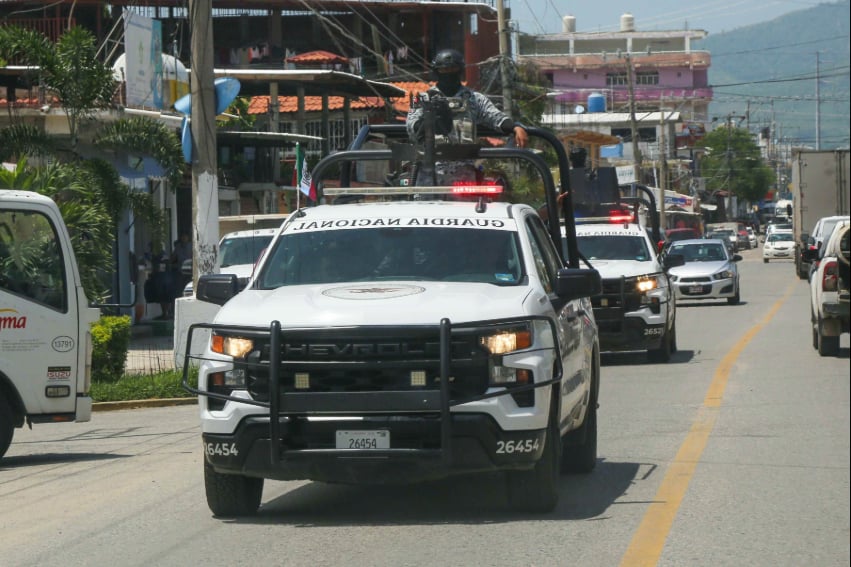
Security Minister Omar García Harfuch said the perception of insecurity in Mexico has fallen to its lowest levels since the national statistics agency INEGI began collecting the data in September 2013 — and yet, 58.1% of people aged 18 and older still consider it unsafe to live in their city. “The survey also shows important advances in what people observe and hear in their communities,” García Harfuch said in a social media post, adding that those surveyed reported fewer robberies and fewer instances of gunfire. The quarterly security survey is carried out by INEGI in approximately 28,000 homes across 91 cities spanning all 32 states. Individuals aged 18 years and older who permanently reside in private housing units within designated urban areas are asked about the principal problems affecting their neighborhood. García Harfuch said the results showed that, compared to September 2025, residents in 28 of the 91 cities felt that there were significant improvements. The survey reflects the public’s perception of security and does not, in itself, constitute a measurement of crimes committed in the country. Instead, the survey measures how safe or unsafe citizens feel in their cities generally as well as in specific public spaces, such as at ATMs, on public transit or in the streets. In general terms, the survey found that 68.7% of the population reported feeling unsafe at ATMs located on public roads, 61.8% felt unsafe on the street, 61.1% felt uneasy on public transport and 55.3% felt unsafe on the highway. Irapuato, Guanajuato, holds the ignominious claim to being the least safe city in Mexico, as 90.5% of its adult population consider it unsafe. Residents of Chilpancingo, Guerrero, followed with 86.9%, and Mazatlán, Sinaloa, was next with 85.8%. At the other end of the spectrum, San Pedro Garza García (an affluent suburb of Monterrey, Nuevo León), registered the lowest percentage, with 5.8%, while the borough of Benito Juárez in Mexico City reported reduced levels at 13.8%. With regard to comparative statistics, cities that saw a significant increase in the perception of public insecurity between June and September 2026 were Hermosillo (the capital of Sonora), which rose from 43.2% to 53.2%; Lázaro Cárdenas (a major port city in Michoacán), from 33.0% to 42.3%; and Ciudad Victoria (the capital of Tamaulipas), from 47.5% to 56.5%. De acuerdo con la Encuesta Nacional de Seguridad Pública Urbana #ENSU, en septiembre 2026, 58.1% de las personas de 18 años y más, residentes en 91 áreas urbanas de interés, consideró que era inseguro vivir en su ciudad: 🚺 64.2% 🚹 50.6% Las ciudades con mayor percepción de inseguridad pública fueron: ▪️ 90.5% Irapuato ▪️ 86.9% Chilpancingo de los Bravo ▪️ 85.8% Mazatlán Con menor percepción de inseguridad pública fueron: ▪️ 5.8% San Pedro Garza García ▪️ 13.8% Benito Juárez ▪️ 14.3% San Nicolás de los Garza y Piedras Negras, cada uno 📄 Consulta el comunicado de prensa: https://t.co/56AiAQzHdW 📊 Explora el reporte de resultados: https://t.co/VMRSfBZiLs — INEGI INFORMA (@INEGI_INFORMA) October 23, 2026 In contrast, the urban areas with the most statistically significant reduction compared to the previous quarter were San Francisco de Campeche (the capital of Campeche), which fell from 65.9% to 49.6%; Tlalnepantla de Baz (México state), from 73.1% to 59.3%; and Ciudad Obregón (Sonora), from 82.4% to 69.8%. Beyond crime, 83.1% of those surveyed considered potholes in streets and avenues to be a significant issue, while 61.2% cited failures and leaks in the drinking water supply, and 57% complained about clogged storm sewers. With reports from El Universal, VanguardiaMX and Reporte Indigo
Public perception of insecurity hits its lowest level in 13 years
Full Article
Original Source
Read the full article at Mexiconewsdaily →KhanList aggregates and links to publicly available news content. We do not host full articles from third-party sources. Always verify important information with original sources.