
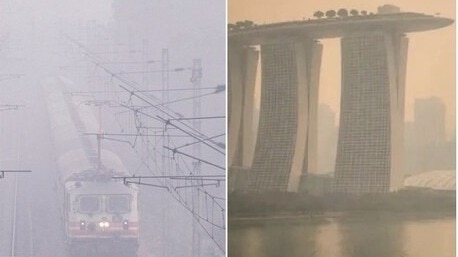
Imagine checking the air quality on two apps and getting two different numbers for the same city at the same moment. Neither app is broken. They are probably speaking two slightly different “dialects” of air quality. That is the PSI vs AQI story, and it came into focus this month. Smoke from Indonesian wildfires drifted across South-East Asia, and Singapore’s air turned hazy.SO, WHAT ARE THEY?The Air Quality Index (AQI) is a simple score that tells you how polluted the air is and what that could mean for your health. It covers pollutants such as PM2.5, PM10, ozone and nitrogen dioxide.The Pollutant Standards Index (PSI) does a similar job. Dr Samir Garde, Director of the Department of Pulmonology and Lung Transplant at Gleneagles Hospital, Parel, explains that PSI “communicates air quality and associated health risks, using that region’s specific calculation method.”PSI is in fact the older name. According to the Commission on Pollution, the United States began publishing a national index in the 1970s under the name Pollutant Standards Index. It was later renamed the AQI. Singapore adopted an index of the same design and kept the PSI name, so PSI there is now the official headline number. Both work the same way. They convert measured pollution into one colour-coded score, and the final number comes from whichever pollutant is worst on the day.WHY DO THE NUMBERS DIFFER?Take the haze episode. On 10 October, Singapore’s National Environment Agency (NEA) reported a 24-hour PSI of 127-177, which is “unhealthy”. At the same time, IQAir’s platform showed a US AQI of 197, also “unhealthy” but at the high end of that band. Dr Garde says this happens because countries “may use different pollutants, calculation methods, averaging periods, and rating scales.”IQAir points to two main causes.Timing. Singapore’s PSI is updated every hour, but each reading is an average of the previous 24 hours. A PSI of 127 at 6 am therefore doesn’t tell you what the air was like at 6 am. IQAir reports hourly, in near real time, so a sudden spike shows up quickly.Strictness. The US AQI is among the world’s more stringent indexes. When PM2.5 sits between 13 and 55 micrograms per cubic metre, Singapore’s PSI calls the air “moderate”. The US AQI treats roughly half of that range, 35.5 to 55.4 g/m, as “unhealthy for sensitive groups”, a warning aimed at children, older adults and people with heart or lung disease.Neither index is “wrong”. Each is built on its own country’s standards, and move those standards and every score shifts. Think of it as measuring a room in feet versus metres.WHAT DOES IT MEAN FOR YOUR HEALTH?Higher readings, on either scale, mean more risk. “Higher PSI or AQI readings tend to indicate greater air pollution and a higher risk of breathing difficulties, irritation, sore throat, coughing and wheezing,” says Dr Garde.The risk is not equal for everyone. “Children, older adults and people with asthma, lung disease or heart conditions are more vulnerable when pollution levels are high,” he adds.CAN A GOOD READING FOOD YOU?Yes. Dr Garde warns that a good score “may not fully reflect exposure to every pollutant or local pollution hotspot.” Short spikes, indoor pollution and pollutants a particular index doesn’t track can all slip through.This is where the 24-hour averaging matters. A smoky evening can be softened by a cleaner morning in the average. His advice is to check “individual pollutant levels, hourly trends, and local advisories.”SO WHICH SHOULD YOU TRUST?Dr Garde’s answer is simple: follow “the official air quality index issued by their local environmental authority and its health advisories.” In Singapore that is the PSI. In India it is the national AQI.If you are comparing cities in different countries, the Commission on Pollution suggests looking at the underlying pollutant concentrations, such as PM2.5 in g/m. Those are the common currency. Index numbers, it says, are “national dialects.”WHAT SHOULD YOU DO ON A BAD AIR DAY?Use the reading together with local health advisories to decide whether to exercise outdoors or limit time outside. Dr Garde says that when air quality reaches unhealthy levels, “children, older adults, and people with heart or lung conditions should reduce outdoor activity, wear an N95 mask, and stay safe at home.”It is important to:Check which index a number belongs to before comparing it with another.Look at hourly readings if you can, not just the headline score.If you are in a sensitive group, act on the cautious side.Treat a “good” reading as a guide, not a guarantee.- Ends
PSI vs AQI: Why does the same air receive different pollution scores
Full Article
Original Source
Read the full article at Indiatoday →KhanList aggregates and links to publicly available news content. We do not host full articles from third-party sources. Always verify important information with original sources.