
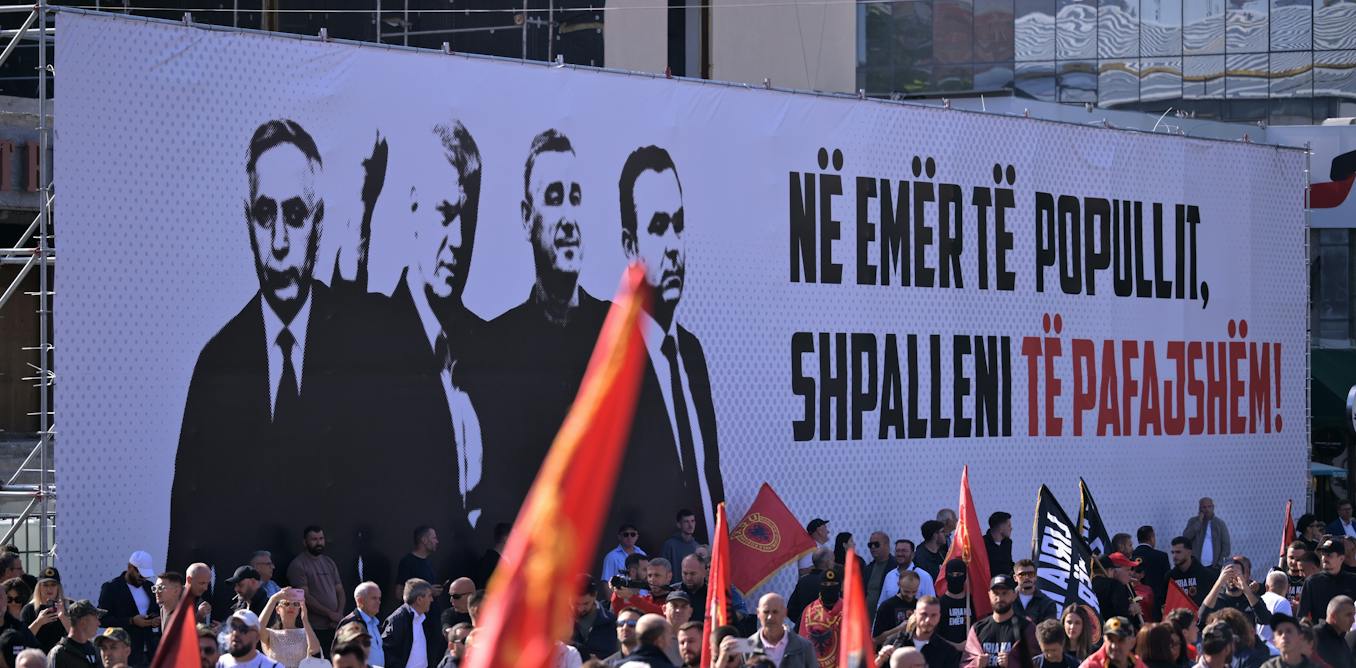
More than 27 years after the end of the Kosovo war, former prime minister and president Hashim Thaçi and three other leaders of the Kosovo Liberation Army (KLA) have been found guilty of war crimes and sentenced to up to 25 years in prison. Thaçi and his fellow defendants faced charges including arbitrary detention, cruel treatment, torture and murder committed during Kosovo’s struggle for independence. The guilty verdict was reached after a three-year trial in the Kosovo Specialist Chambers in the Hague. The special court was set up in 2015 to try crimes committed during the 1998-99 war, in which about 13,500 people were killed or went missing and roughly 1.5 million people were displaced. So why did it take so long to convict Thaçi and his fellow defendants? Global power politics is often touted as the explanation for delays or even for states’ failure to act on an international arrest warrant. Benjamin Netanyahu appeared at the UN general assembly in September, despite being subject to an International Criminal Court (ICC) arrest warrant for alleged war crimes in Gaza. Similarly, Vladimir Putin met the US president, Donald Trump, for a summit in Alaska in August 2025. He is the subject of an ICC arrest warrant for the aggression against Ukraine. Both leaders are seemingly safe from international accountability while they enjoy the support of the US. Yet, the case of the western Balkans illustrates that international prosecutions against heads of states are also affected by national politics within the host states. War crimes in the Western Balkans The Balkan wars of the 1990s shocked the international community. Reports of the deliberate targeting of civilians, strategic use of ethnic cleansing, torture and sexual violence prompted an international outcry. In 1993, the UN Security Council set up the International Criminal Tribunal for the former Yugoslavia (ICTY) to prosecute those held to be responsible. From 1989, the majority Albanian population of the former Serbian province of Kosovo was subjected to discrimination by the Serbian government under Slobodan Milošević and terror by the Serbian army. In the face of mounting repression and violence by the Serbian authorities, the KLA formed in 1995 to fight back. Diplomatic attempts to solve the question failed and in March 1999, a massive and violent campaign of ethnic cleansing by Serbian forces triggered Nato intervention. In June 1999, Serbian forces agreed to withdraw from Kosovo, which was placed under international administration by the UN, to be enforced by Nato troops. An interim administration was set up by the UN, which Thaçi joined. His party won the biggest vote share in the first elections in 2007 and he became Kosovo’s first prime minister the following year. In 2016, he became the country’s president but stepped down in November 2020 following his indictment for war crimes. Fight for justice In the intervening years, Serbian war crimes were prosecuted by the ICTY – and many of those involved in atrocities, most notably Milošević, found guilty and jailed. But the path toward justice for most victims of KLA crimes took much longer. This only began in earnest when new evidence was presented by the Council of Europe in 2011 and a special EU-backed war crimes court, the Kosovo Specialist Chambers and Specialist Prosecutor’s Office (KSC), was established. Hashim Thaçi was sentenced to 25 years for his part in war crimes committed by the Kosovo Liberation Army in the late 1990s. EPA/Koen van Weel In early 2020 the KSC started indicting former KLA leaders. This included Thaçi and his fellow leaders. They were charged with acts of imprisonment against 385 individuals, 303 counts of torture, and 96 cases of murder of perceived “opponents” to the KLA. On September 16 2026, the KSC trial panel sentenced the four to lengthy prison sentences, including 25 years for Thaçi. The power of national politics Why was this guilty verdict so long in coming? A big reason is the influence of national politics. A country’s ruling elites have the power to undermine prosecutions against themselves and their people. Governments can illegally withhold evidence, refuse to surrender suspects, or block access to territory for investigations. Serbia shielded its former president, Slobodan Milošević, from arrest, letting him live openly in Belgrade from 1999 to 2001 despite an arrest warrant from the ICTY. The Republika Srpska refused to arrest and handover generals Radovan Karadžić and Ratko Mladić, who were wanted for the Srebrenica genocide, delaying their arrests for 13 and 16 years, respectively. Such tactics significantly impede speedy trials. In the instances of Milošević, Mladić and Karadžić, it took a change of national government for ruling elites to cooperate and trials to proceed. In both Serbia and Kosovo, political narratives centred on ethnic and nationalist identities, galvanised popular support for members of ruling elites who face prosecutions. In such an atmosphere, witnesses find it hard, and often unsafe, to come forward and testify. Witness intimidation, including suspicious deaths, marred ICTY and KSC trials. Thaçi faces a separate trial on witness intimidation later this year. One of the cornerstones of international criminal law is the need to separate individual criminal accountability from collective responsibility. But this can be hard to sell in societies made up of groups that have experienced victimisation on grounds of their collective identity. In recent days, Albanian supporters of Thaçi have protested that the prosecution and sentencing were unjust, biased and denigrated the KLA’s struggle to liberate Kosovo. Reassurances by the presiding judge that “the trial was not about the legitimacy of the Kosovo Liberation Army and its goal of an independent Kosovo” have not been enough to quell anger against the court’s decision. The long road to justice is not only shaped by global power politics but also national politics. If wanted suspects, including Netanyahu or Putin, are to be held to account for international crimes, ruling elites need to change and societal narratives must stop protecting those elites by whitewashing their crimes. This takes time, persistence – and the acceptance that not everyone will consider, when the court reaches a verdict, that justice has been served.
Prosecution of Kosovan leader Hashim Thaçi illustrates the challenges of bringing war criminals to justice
Full Article
Original Source
Read the full article at Theconversation →KhanList aggregates and links to publicly available news content. We do not host full articles from third-party sources. Always verify important information with original sources.