
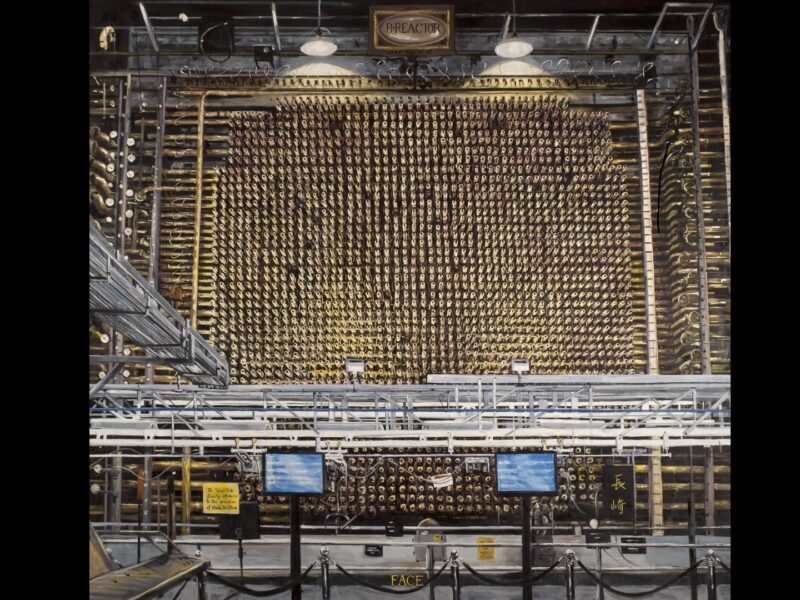
BENTON COUNTY, Wash. (CN) — A few years back, artist Michael Brophy decided to visit one of the United States’ most unusual landmarks.He’d snagged a spot on a tour of Manhattan Project National Historical Park’s Hanford Site, which regularly books out months in advance.In this remote corner of Eastern Washington, a sprawling network of nine nuclear reactors, plutonium processing plants and support facilities lay the foundation for the United States’ nuclear weapon arsenal.While not as well-known as Los Alamos, Hanford played a key role in the early Atomic Age. Plutonium produced here filled the bomb dropped on Nagasaki, killing an estimated 70,000 people.These days, Hanford has the rare distinction of being both a national monument and a Superfund site.Production fully shut down in 1971, and since the 1980s workers have been remediating what’s now the nation’s largest environmental cleanup site. In 2015, it became part of the Manhattan Project National Historic Park as Hanford Reach National Monument.Despite its hazards, Hanford Reach is naturally beautiful. Located in the rain shadow of the Cascade Mountains, this part of the Pacific Northwest is defined by windswept plains and towering mountains.About half the size of Rhode Island, Hanford Reach stretches for around 50 miles along the Columbia River. Ironically, this place’s polluted history has kept it free of agriculture and other growth.A sign welcomes visitors to the protected natural area surrounding Hanford Reach National Monument. (Lily Roby/Courthouse News)On his visit in 2017, Brophy took in the sights the way artists do.Tumbleweeds tangled in fence posts. The grass was baked gold by the sun and dry weather. To the west, Rattlesnake Mountain rose red and treeless over the dusty plains.Guides led the group past defunct reactors, now cocooned in concrete.They visited B Reactor, where plutonium was first produced on an industrial scale in 1944. Women of childbearing age and children under 12 were handed dosimeters to measure radiation exposure.Brophy was struck by the structure. Its dizzying array of gridded process tubes resemble something like a circuit board.“It was like being in a submarine,” he said. “It really had a sealed-off and empty quality: pristine but deadly.”The surreal scene made such an impression on Brophy that it took him years to start painting and years more to finish. He ultimately produced nine works, including one of the B Reactor, drawing on materials like sketches he made during his visit.The sky was bright that day, so cloudless that the light was almost white. But when Brophy created the scene later, he instead painted angry, curling storm clouds, capturing not how the place literally looked, but how it felt to him."First" depicts the B Reactor's exterior. Companies associated with its construction and operation, such as DuPont and General Electric, are featured as stamps and small logos across the image. (Michael Brophy via Courthouse News)For thousands of years, the land around Hanford was home to the Wanapum. Centered around nearby Priest Rapids, the Indigenous group lived and fished along some of the Columbia River’s richest salmon grounds. The tribe’s name means “river people.”In 1943, the whole area was eminent domained by the U.S. Army. The Wanapum and around 2,000 settlers in the area were given around three weeks to evacuate.“It was relatively easy to evict people,” said Robert Franklin, a historian with the Hanford History Project at Washington State University Tri-Cities in nearby Richland, Washington. And since the Wanapum never signed a treaty with the federal government, there was no treaty to break.World War II stretched into the Cold War, and the plutonium for weapons kept coming.Production turned nearby Richland into a military boomtown, making it for a time the fourth-largest city in Washington.Virtually everyone worked for General Electric or the Atomic Energy Commission. Crime was nearly nonexistent, and the influx of young workers gave it the highest birth rate per capita in the country. It was a strange, atomic-powered, militarized vision of utopia. Historian Kate Brown called it a “plutopia” in her book of the same name, comparing it to Mayak, a similar site in the Soviet Union.The B Reactor, pictured here, is the only remaining reactor on the site that hasn't been cocooned in concrete. A cocooned reactor can be seen in the background. (Lily Roby/Courthouse News)Working in such a sensitive industry, a whole lingo sprung up to avoid speaking with too much detail. Uranium was “metal.” A reactor was “a pile.” Plutonium was “product.”While conducting oral histories, Franklin says he still meets workers who catch themselves mid-sentence, stopping themselves from sharing a detail that’s already declassified. He says it’s no accident people don’t know much about it. “I’ve talked to folks who teach history of physics classes about the Manhattan Project and they’re like, ‘Oh, Hanford: Isn’t that just some factories?’”Hints of Richland’s atomic-age history linger everywhere. Opened in 1949, the historic Uptown Shopping Center looks like something out of “The Jetsons,” with retro fonts and designs. To this day, the high school mascot is still a mushroom cloud.About 30 miles up the Columbia River is Hanford.Jon Schwantes, a professor at Pennsylvania State University who previously worked at the Pacific Northwest National Laboratory, has canoed the Columbia River past the old reactors. Being in the river, he explained, is the closest citizens can get to the site without being on an official tour.Like other visitors, Schwantes was struck by how much nature has reclaimed the old nuclear site. “It’s amazing,” he said. “It’s like a nature preserve.”"Fall" was painted in part to commemorate people removed in 1943 to make way for the Hanford Site, including the Wanapum. (Michael Brophy via Courthouse News)Schwantes sees the 40-plus years of cleanup here as a governmental failure. “We go to the moon faster than that,” he said. Franklin, on the other hand, sees the slow pace as a reflection of how difficult this work is. He noted that more people are now employed in the cleanup than worked in plutonium production in Hanford at the height of the Cold War.“It really does a disservice to the complexity of the Manhattan Project to think that you could clean up something so massive so easily,” he said. “It takes another Manhattan Project just to clean up the Manhattan Project.”Plutonium production left behind enormous amounts of waste in Hanford, making it arguably the most polluted place in North America. There was contaminated soil, spent fuel, corrosive acids used to dissolve irradiated uranium, millions of gallons of radioactive sludge and even dirty gloves and other protective gear used by workers.Workers had discharged hundreds of billions of gallons of liquid waste into the soil. The assumption was that someone in the future would deal with it, said Tom Sicilia, a hydrogeologist at the Oregon Department of Energy and a member of the Hanford Advisory Board.Fast-forward to today, and Hanford has spent decades not as a military boomtown but as an environmental hazard zone.While fears of a full-scale nuclear war with the Soviet Union never materialized, the U.S. did manage to poison its own lands here.The Columbia River slowly snakes around the edges of Hanford, creating a natural border that separates the site from the outside world. Visitors can kayak the river to get a closer look. (Lily Roby/Courthouse News)Buried roughly 7 feet underground, 177 storage tanks hold a combined 56 million gallons of nuclear waste.About a third of them are known or suspected to be corroded and leaking. Silica says one of the main risks is an earthquake, which could cause further leaks or trigger what he calls “an uncontrollable nuclear fire.”Some of the waste is being trucked out, including to the Waste Isolation Pilot Plant in Carlsbad, New Mexico. There, officials have mined out a salt bed that is geologically stable enough to prevent leaks.At Hanford, they’re also using a process called “vitrification,” which can turn radioactive materials into a safer glass-like state. In recent years, crews have made strides in the cleanup process, removing contaminated soil and filling a spent fuel basin with concrete.Brophy reflected on his 2017 trip for years before he finally began painting in 2021. He settled on nine identical 78-by-84-inch canvases — one for each reactor.One painting shows the B Reactor. Another depicts Hanford High School. The building is windowless and empty; an ominous mushroom cloud erupts in the horizon. No human figures appear anywhere in the series. Brophy wanted to capture how absent people felt here, first because of the eviction of the Wanapum, then because of the hazards.The painting "Pay" depicts the former Hanford High School, long-abandoned and now windowless. A mushroom cloud rises in the background. (Michael Brophy via Courthouse News)A trip to the Vatican’s Hall of Maps helped bring the project together. There, Brophy was struck by 16th-century maps of Italy’s regions, which use frescoed text to tell the story of millennia of civilization.Brophy adopted the idea, using text to highlight the history of Hanford and U.S. nuclear weapons. His paintings feature the old logo for DuPont and list the dates of nuclear events like the bombing of Nagasaki. For his painting of the B Reactor’s interior, he asked a Japanese woman to write “Nagasaki” in Japanese Kanji script. The series, “Reach,” is named after Hanford Reach National Monument but has other connotations, too. There’s the reach of the mighty Columbia River that flows by this place, as well as the historical reach of weapons materials that will take thousands of years to fully degrade.Subscribe to our free newslettersOur weekly newsletter Closing Arguments offers the latest about ongoing trials, major litigation and rulings in courthouses around the U.S. and the world, while the monthly Under the Lights dishes the legal dirt from Hollywood, sports, Big Tech and the arts.Additional Reads
‘Pristine but deadly’: Visiting the most contaminated place in America
Full Article
Original Source
Read the full article at Courthousenews →KhanList aggregates and links to publicly available news content. We do not host full articles from third-party sources. Always verify important information with original sources.