
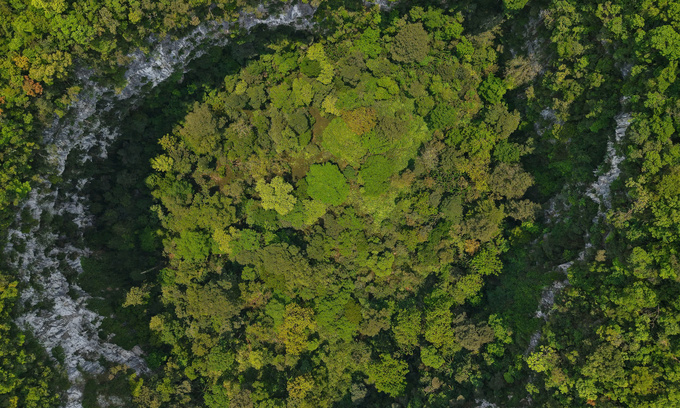
A newly revealed sinkhole in Phong Nha-Ke Bang National Park in central Vietnam's Quang Tri Province covers more than 2 hectares and is home to a primeval forest and wildlife. From July 23 to 29, 2025, a 24-member team including experts from the U.S. National Speleological Society (NSS), exploration company Jungle Boss and the park's management board surveyed the sinkhole in the Cha Noi-Khe Gat area. The explorers and the management board made their findings public on Oct. 22, 2026, after completing preliminary work. The sinkhole has yet to be named. The walls of the sinkhole widen from top to bottom, forming what is described as an upside-down bowl. Its oval mouth is about 190 m long and 140 m wide. Inside, it stretches about 250 m at its longest point and 200 m across, and is 120 m deep. Sinkholes usually form when water wears away limestone over a long period, hollowing out spaces underground until the cave roof can no longer hold itself up and collapses. The rock walls around the sinkhole are sheer. The park has recorded five large sinkholes, including Kong Collapse, discovered in 1997. Experts assessed the new sinkhole as shallower than Kong. The park's management board said documenting the sinkhole adds to field records of the area's limestone terrain and calls for more in-depth research into its geology, landforms and how the terrain has changed over time. A lush primeval forest with many ancient trees grows at the bottom of the sinkhole. The sinkhole covers about 2.18 hectares in compartment 8 of forest sub-zone 603, within the park's strictly protected area. To reach the bottom, team members rigged ropes and safety gear and rappelled down near-vertical rock walls, a descent of about 120 m. The terrain inside the sinkhole is rugged, with rock walls, rubble and forest vegetation. Some spots show signs of landslides, and debris piled up at the foot of the walls made it hard to reach and inspect the area below. Millions of shells lie heaped against the rock walls inside the sinkhole, a sign that an ecosystem that has long been rich is still thriving at the bottom of the chasm. The team recorded a crack in the rock wall about 5 m high and 12-15 m deep. Forest vegetation grows in many places inside the sinkhole, between areas of rubble and the base of the walls. The experts saw signs that monkeys live there and heard a troop calling from the walls. Specialist surveys are needed to fully assess the species present, the level of biodiversity and the site's ecological features. A crack at the base of the sinkhole wall has no air flowing through it. The whole foot of the walls and the watercourses have been buried under debris from landslides, leaving no direct passage exposed. Kevin Ditamore, a veteran member of the NSS, rappels into the sinkhole to survey it. In his assessment, water here drains through hundreds of tiny holes and cracks rather than at a single point. No opening of significant size, and no air current rising from the bottom of the sinkhole, has been found so far. Nguyen Van Uy, deputy director of Jungle Boss and an NSS member with 20 years of cave exploration, rappels into the sinkhole. Uy said it is one of the largest sinkholes he has recorded in Phong Nha-Ke Bang. The sinkhole in Cha Noi lies about 20 km from Da Deo Pass, on the Ho Chi Minh Road where Phong Nha Commune borders Kim Phu Commune. Pham Hong Thai, director of Phong Nha-Ke Bang National Park, called it an entirely new discovery and evidence of Phong Nha's karst system, which dates back 400 million years. The park's management board will next work with specialist units and cave experts on further research to clarify the sinkhole's natural features, determine its exact dimensions, landforms and geological structure, and assess its cracks, signs of landslides and the possibility of underground voids. "Surveying the vegetation and wildlife will add to the scientific data for the management, research and conservation of the natural heritage values of Phong Nha-Ke Bang National Park," Thai said.
Primeval forest grows at bottom of 120-meter-deep sinkhole in central Vietnam
Full Article
Original Source
Read the full article at E →KhanList aggregates and links to publicly available news content. We do not host full articles from third-party sources. Always verify important information with original sources.