
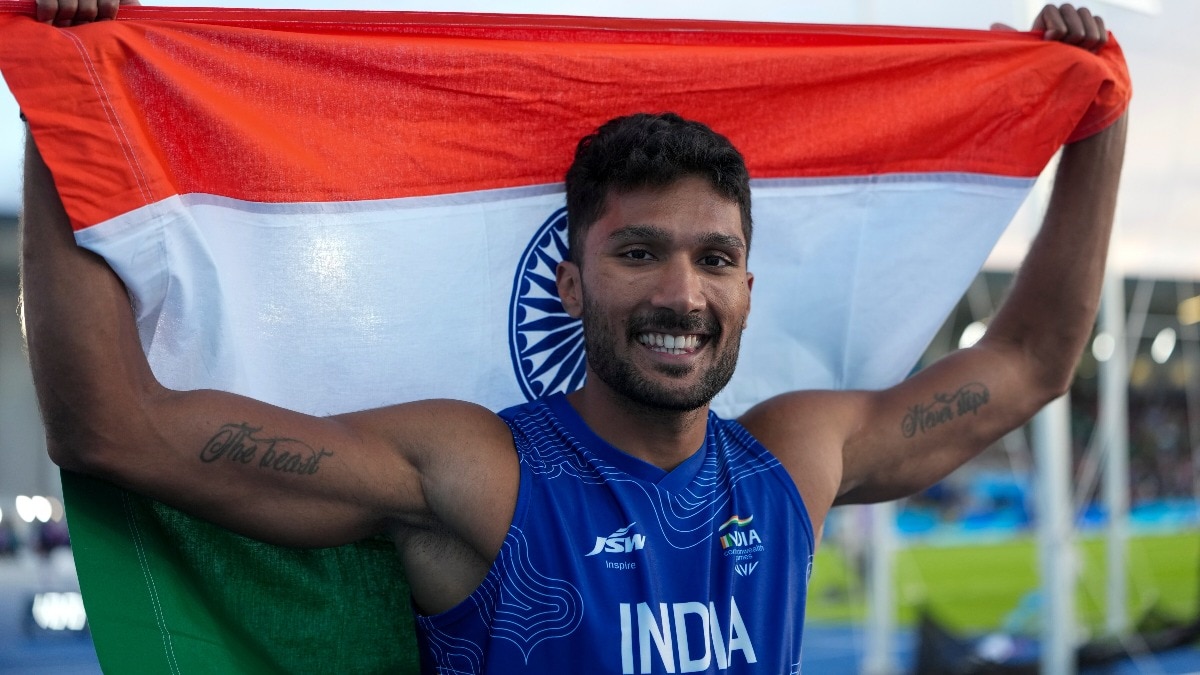
In India's record-breaking 107-medal tally at the 2022 Asian Games (held in 2023), 29 came from athletics. Led by Neeraj Chopra, Indian athletes put together a remarkable campaign in Hangzhou, winning six gold medals, 14 silver and nine bronze, the biggest medal haul by any Indian sport at the Games.Hangzhou was a complicated competition for the Indian athletics contingent. The athletes had to deal with the opposition, but there were also moments when they had to fight their own circumstances. Chopra, who rarely loses his cool during competition, found himself arguing with officials after one of his throws was chalked off following an equipment issue. Jyothi Yarraji had to gather herself after being disqualified from the 100m hurdles final before being reinstated, and eventually came away with a silver medal. Neeraj Chopra argues with official in Asian Games 2022. (Reuters Photo) Three years on, India have another sizeable athletics contingent in Aichi-Nagoya, but this time the most obvious name in the group is missing.The Athletics Federation of India initially named 77 athletes before trimming the squad to 74 after its final assessment. Among those left out was defending women's javelin champion Annu Rani, while sprinter Nithya Gandhe and long jumper Shahnavaz Khan were also removed from the final contingent. The selection process had been deliberately demanding, with the AFI setting stringent qualification standards for athletes hoping to make the Asian Games team. The result is a squad that contains established Asian Games champions, Commonwealth Games medallists, national record holders and a group of younger athletes who have spent the season pushing themselves closer to the continental level.For all the depth in the squad, however, one absence changes the way the entire campaign will be viewed.INDIA'S ATHLETICS TEAM WITHOUT NEERAJ CHOPRA India will head into the athletics programme without the athlete who has become its most reliable source of a major championship medal.Neeraj Chopra, the reigning Asian Games champion and India's defending men's javelin champion, withdrew from the Asian Games after suffering an ankle ligament injury. The injury brought an early end to his season and leaves India without the athlete who won gold in Hangzhou and has subsequently become one of the biggest names in world athletics.There is no straightforward replacement for Chopra. What India does have is a javelin pair capable of making the event competitive.Rohit Yadav enters the Games with an 87.68m season best, while Yashvir Singh has reached 85.41m. Those marks put both Indians into the medal conversation, although the competition at the top end of the event is formidable. Sri Lanka's Rumesh Pathirage has been the biggest throwers in the world this season, producing three 90m+ throws this year. He is the Diamond League and the Ultimate Championship winner and starts as the favourite in this event. Rohit Yadav is the next big thing in Indian javelin. (PTI Photo) For Rohit, who has spent years trying to establish himself behind Chopra in the Indian javelin hierarchy, the Asian Games offer an opportunity to show that Indian javelin can remain relevant even when its biggest name is absent. Yashvir, meanwhile, has also moved into territory where a medal is a realistic ambition rather than a distant possibility.The gold that Chopra won in Hangzhou will be difficult to replace, particularly with Pathirage throwing at a level that has taken the Asian standard beyond 90 metres. A medal for either Indian would nevertheless give the country an important return from an event that has become one of its strongest athletics disciplines.WHO ARE THE BIG FACES?The absence of Chopra leaves Indian athletics without the one athlete whose name is recognised far beyond the sport, but it does not leave the team short of established performers.Tajinderpal Singh Toor will arrive as one of India's clearest gold medal hopes. The shot putter has won the last two Asian Games titles and is chasing a third successive gold in Nagoya, while his 21.03m season best is the best mark in Asia in 2026. He will also have the unusual distinction of leading India into the Games as one of its flag-bearers at the opening ceremony alongside Manu Bhaker.Gulveer Singh has developed into another central figure in Indian athletics. He is entered in the 1500m, 5000m and 10,000m, although it is the longer distances where his medal prospects are strongest. His 27:24.18 season best in the 10,000m has placed him firmly among the leading runners in Asia, and he arrives in Japan after winning two medals at the Commonwealth Games.Murali Sreeshankar is another name around whom India's field-event hopes will revolve. The long jumper returned to competition strongly after injury, winning silver at the Commonwealth Games, and his 8.38m season best is the leading mark in Asia this year according to the Indian team entry list. Murali Sreeshankar will compete for the gold medal spot. (PTI Photo) Sarvesh Kushare has similarly given India another strong field-event prospect. He cleared 2.31m this season, bettering Tejaswin Shankar's previous national record, and followed that performance with a Commonwealth Games silver.Then there is Tejaswin Shankar, whose story is different from almost everyone else in the team. The national record holder in the decathlon has moved beyond being known only for the high jump and will take on one of athletics' most demanding events in Nagoya. His season best of 8057 points puts him firmly into medal contention, although the decathlon is the sort of event where two days of consistency matter far more than one standout performance. Can TJ upgrade his Asian Games silver in gold this time? (Reuters Photo) Avinash Sable and Parul Chaudhary bring another layer of experience to the distance events. Sable is the defending Asian Games champion in the men's 3000m steeplechase, while Parul is entered in the women's 1500m, 3000m steeplechase and 5000m. Both will be asked to carry expectations in multiple events.And then there is Ancy Sojan, who has perhaps had the most striking breakthrough of the year among the Indian women. In June, she jumped 6.88m to break Anju Bobby George's 22-year-old national record, turning one of the longest-standing records in Indian athletics into a piece of history. She enters Nagoya with the best mark in Asia this season. Ancy Sojan is the best long jumper from Asia this season. (Reuters Photo) WHERE CAN INDIA'S MEDALS COME FROM?If Hangzhou is the benchmark, the encouraging part for India is that its medal possibilities are spread across the programme rather than resting on one or two events.The field events provide some of the clearest opportunities. Sreeshankar and Ancy Sojan lead the long jump challenge, Kushare and Pooja Singh carry the high jump hopes, Toor and Karanveer Singh give India a strong presence in the shot put, and Rohit Yadav and Yashvir Singh provide two genuine javelin possibilities.Praveen Chithravel, the third-best triple jumper in Asia on the current standings, is another medal contender, while Asha Ilango gives India a second strong women's triple jump option. Chithravel has a season best of 17.08m, while Asha has reached 13.89m.The distance races could produce another cluster of medals. Gulveer's programme alone gives India three opportunities, although the 10,000m remains his clearest gold-medal prospect. Sable's steeplechase title defence will be closely watched, while Parul and Ankita give India two serious contenders in the women's steeplechase.The relay teams add another layer of possibility. The men's 4x400m quartet clocked 3:00.32 at the World Athletics Relays in Botswana in May, finishing ahead of Japan in their heat, although Qatar and Belgium were faster in that race. Japan ran 3:00.79, which gives India a clear indication of the narrow margins involved at the top of the event. India's men's 4x400m team could spring a surprise. (PTI Photo) Vishal TK is particularly important to that challenge. He has moved into the 400m full-time and owns a 44.98 season best, the fourth-best mark in Asia on the current Indian team listing. Rajesh Ramesh, who has a 45.26 season best, and the other members of the relay pool give India enough depth to make the event genuinely interesting.The women's 4x400m team faces a tougher challenge, but the depth provided by Ansa Babu, Kiran Pahal, Prachi, Vithya Ramraj, Rashdeep Kaur, Neeru Pathak, Poovamma R and Saloni Nagar gives India a competitive relay unit.Beyond those events are the wildcards, the athletes who may not enter Nagoya as favourites but could change the medal count with one exceptional performance. Jyothi Yarraji's return from injury makes the women's 100m hurdles particularly interesting, while the marathon pairing of Sawan Barwal and Kartik Karkera gives India two athletes entering the Asian Games marathon with encouraging recent performances.WHO ARE INDIA'S MAIN MEDAL CONTENDERS?One way to understand India's athletics campaign is to look at the athletes carrying the strongest medal hopes, and those who could push themselves into the conversation with a big performance.TRACKGulveer Singh is India's strongest gold prospect in the 10,000m. His 27:24.18 season best is a significant marker of how far he has moved as a distance runner, and his ability to return later in the programme for the 5000m gives him a chance to leave Nagoya with more than one medal. The 5000m is a more open proposition and a silver medal is a realistic target given the quality of the field.Avinash Sable's case is slightly different. He is the defending Asian Games champion in the 3000m steeplechase and has returned to competition after recovering from an ACL injury. He made his intentions known in Delhi in his first race on return. If he is good for a sub-8:20 run, he cannot be left out of the gold-medal conversation. Avinash Sable returns from injury. Will he be in medal contention? (PIT Photo) Parul Chaudhary is another athlete with multiple medal routes. She is the defending Asian Games champion in the 5000m and will also contest the 3000m steeplechase, where she and Ankita give India two medal possibilities. Her 1500m entry adds another event, although the longer races are where her strongest prospects lie.The men's 4x400m relay is harder to categorise because relay medals depend on the performance of four athletes on one evening rather than one individual's season best. India's 3:00.32 in Botswana, however, was good enough to finish ahead of Japan in the qualifying heat, and the team has the raw speed to challenge for the medals. Qatar, Japan and India are likely to be separated by very small margins if all three produce their best races.Jyothi Yarraji belongs in the silver and bronze conversation rather than being presented as a certainty. Her 12.85 season best puts her in range of the podium, and the bigger question is whether she can reproduce her best form after returning from injury. She has already shown at Hangzhou that she can recover from a major setback during a competition and still win a medal.FIELDTajinderpal Singh Toor has perhaps the clearest gold-medal narrative of the entire team. He is the two-time defending champion, owns Asia's best throw of the season at 21.03m and has a chance to become the first Indian athlete to win the men's shot put at three consecutive Asian Games.Sreeshankar is another athlete with a strong case for gold. His 8.38m is the leading Asian mark this year, and his return to major competition has already produced a Commonwealth Games silver. The long jump, however, is an event where a single foul or a missed opportunity can completely change the standings, so his season best is a marker of potential rather than a guarantee of the result.Ancy Sojan enters with an even more intriguing story. Her 6.88m national record was the first Indian women's long jump mark beyond Anju Bobby George's 6.83m in more than two decades, and she followed it by winning the Indian Athletics Series Final with 6.76m. She has been one of the most consistent Indian jumpers this season and will be one of the athletes most closely watched when the women's long jump begins.Kushare's 2.31m makes him another leading gold contender. He has already broken the national record and won Commonwealth Games silver, and the Asian Games give him the opportunity to convert a breakthrough season into a continental title.Pooja Singh, the 2007-born high jumper, enters with a 1.93m season best, while Praveen Chithravel's 17.08m puts him in the medal conversation in the men's triple jump. Asha Ilango, with a 13.89m season best, is another athlete capable of adding to India's field-event tally.The javelin remains the biggest question mark among India's major field events. Rohit's 87.68m is good enough to make him a serious medal contender, and Yashvir's 85.41m means India has two throwers capable of reaching a significant distance. But Pathirage's 92.62m means the gold medal is likely to require something close to the very best that either Indian can produce.Tejaswin Shankar is perhaps the most difficult medal prospect to predict. His 8057 points place him among the leading decathletes in the field, but the event is decided over two days and ten disciplines, making it far less forgiving than an individual jump or throw. If he can put together a clean competition, he has a realistic chance of finishing on the podium.WHO ARE THE NEW NAMES?One of the more interesting aspects of this Indian team is that some of the athletes who could eventually become familiar names are entering Nagoya without the same expectations carried by the established stars.Animesh Kujur is one of them. He has consistently operated around the 10.20-second mark in the 100m and around 20.40 seconds in the 200m, although his current standing in Asia means a medal would require another step forward. His participation in the mixed 4x100m relay gives him another opportunity to make an impact.Gurindervir Singh has already run 10.09 seconds, which puts him among Asia's better sprinters, but his form has fluctuated since that national record. If he can return to anything close to his best, the 100m becomes considerably more interesting from an Indian perspective. Animesh Kujur (in pic) and Gurindervir Singh are participating in the Asian Games for the first time. (PTI Photo) Vishal's emergence has been even more significant for the 400m. His 44.98 season best has moved him into the Asian top four, and his individual event will also feed directly into India's 4x400m relay ambitions. Rajesh Ramesh, Manu T S, Dharamveer Chaudhary, Jay Kumar and Mohammed Ashfaq complete a relay group that gives India considerable depth.The marathon is another place where India can produce a surprise. Sawan Barwal has a 2:11:58 season best, while Kartik Karkera has moved to 2:13:10 territory this year. Neither enters as a conventional medal favourite, but both have the sort of recent form that makes them dangerous outsiders in a race where weather, pacing and the final few kilometres can reshape the standings.Karkera's story is particularly unusual. He is an orthopaedic surgeon who moved towards running full-time, and the Asian Games marathon will give him a chance to test himself against the continent's best after making a substantial improvement in his personal best.Karthik Unnikrishnan provides another compelling wildcard in the triple jump. At 33, he is making his Asian Games debut and has a season best of 16.80m, which places him eighth in Asia on the current list. He believes he has a 17m jump in him, and if he finds it in Nagoya, he can change the shape of the medal battle.Shaili Singh, Asha Ilango, Karanveer Singh, J Aadarsh Ram, Ankita, Vithya Ramraj and several others fall into a similar category. They have performances that put them close enough to the medal positions to make their events worth following, but their stories are different from those of athletes such as Toor or Sreeshankar, who arrive with a much stronger case for gold.That distinction matters because a 74-athlete athletics team is never really 74 medal contenders. Some are going to Nagoya carrying the weight of defending titles, some are there because they have established themselves among the best in Asia, and others are taking their first significant step towards becoming regular names on this stage.CAN INDIA MATCH 2022 MEDAL TALLY?The 29 medals from Hangzhou provide a difficult benchmark, particularly because India's most dependable source of individual gold from that campaign will not be available this time.Yet the composition of the 2026 team also makes a direct comparison with Hangzhou slightly misleading. India have a different group of athletes operating at a higher level in some events, while other events have become more uncertain because of injuries, changes in personnel or the arrival of stronger opposition.The clearest examples are spread across the programme.Toor can become a three-time Asian Games champion. Sreeshankar and Ancy Sojan enter with the best long jump marks in Asia this year. Kushare has cleared 2.31m. Gulveer has established himself as one of India's leading distance runners and has three events on his schedule. Sable is back to defend his steeplechase title. Tejaswin is taking on the decathlon. Rohit and Yashvir have both thrown beyond 85m in a javelin event where India no longer has Chopra to fall back on.There are also athletes who could push the final tally in less predictable ways. Chithravel is a medal contender in the triple jump, while Karthik Unnikrishnan is betting on a 17m performance. Jyothi Yarraji has returned from injury with enough form to make the hurdles interesting. The men's 4x400m team has already gone under 3:01 this season, while the women's relay squad has enough depth to make its final competitive.That is ultimately what will define India's athletics campaign in Nagoya.It is not a team that can be measured simply by asking who will replace Neeraj Chopra. There is no single athlete capable of doing that, and the more relevant question is whether the depth of the group can make up for the loss of one of its strongest medal contenders.Hangzhou produced 29 athletics medals because India found contributors across the track and field programme, with six gold medals and a remarkable 14 silver medals. A similar haul in Nagoya will require the established champions to deliver, the leading contenders to convert their current form into podium finishes and several of the outsiders to produce performances beyond what their season standings suggest.The 74 athletes therefore arrive in Japan with very different jobs to do. Some are chasing gold, some are trying to extend India's run of medals in events where it has traditionally been strong, and some are looking for the performance that can change how they are viewed when the next major championship comes around.And with Chopra watching from home rather than throwing in Nagoya, that broader group will have to carry the Indian athletics story themselves.74 INDIAN ATHLETES TO WATCH IN ASIAN GAMES 2026TRACK AND ROAD1. Animesh Kujur: 100m, 200m, 4x100m Mixed Relay. Ranked 27th in Asia in the 100m, but has consistently operated around the 10.20-second mark this season, making him one of India's more interesting emerging sprinters.2. Gurindervir Singh: 100m, 4x100m Mixed Relay. Ranked seventh in Asia and the former national record holder at 10.09 seconds, although he has struggled for consistency since producing that breakthrough run.3. Rajesh Ramesh: 400m, 4x400m Men's Relay. His 45.26-second season best places him seventh in Asia and gives India another important component for the men's relay.4. Vishal T K: 400m, 4x400m Men's Relay. His 44.98-second season best is the fourth-fastest time in Asia this year and makes him a genuine individual medal contender as well as a key relay runner.5. Manu TS: 4x400m Mixed Relay, 4x400m Men's Relay.6. Jay Kumar: 4x400m Mixed Relay, 4x400m Men's Relay.7. Mohammed Ashfaq: 4x400m Men's Relay.8. Dharmveer Singh: 4x400m Men's Relay. Part of the Indian quartet that ran 3:00.32 at the World Athletics Relays, putting India firmly into the Asian medal conversation alongside Qatar and Japan.9. Pranav Gurav: 4x100m Mixed Relay. Part of India's mixed relay group, although changes to the final combination have made the medal picture less straightforward than it appeared earlier.10. Yashas Palaksha: 400m Hurdles.11. Santhosh Thamilarasan: 400m Hurdles.12. Mohammed Afsal: 800m.13. Krishna Kumar: 800m.14. Gulveer Singh: 1500m, 5000m, 10,000m. One of India's biggest medal hopes and arguably its busiest individual athlete in Nagoya. His strongest gold opportunity comes in the 10,000m, while the 5000m offers another realistic medal route.15. Yoonus Shah: 1500m.16. Avinash Sable: 3000m Steeplechase, 5000m. The defending Asian Games champion in the steeplechase, Sable returns after his injury lay-off and will be one of India's most closely watched athletes.17. Kartik Karkera: Marathon. The former orthopaedic surgeon has moved into full-time running and improved to 2:13:10 this season, giving India an outside medal possibility in the marathon.18. Sawan Barwal: Marathon. His 2:11:58 season best makes him one of India's leading marathoners and gives him a realistic outside chance of challenging for the podium.19. Jyothi Yarraji: 100m Hurdles. A silver medallist in Hangzhou, Yarraji returns from injury and is around the medal conversation if she can reproduce her best form.20. Nandhini Kongan: 100m Hurdles.21. Unnathi Bollanda: 200m, 4x100m Mixed Relay.22. Harita Bhadra: 200m, 4x100m Mixed Relay. Bhadra's inclusion in the final squad became particularly notable after Nithya Gandhe was dropped; she ran 11.22 seconds in the Delhi trials but will contest the 200m and mixed relay in Nagoya.23. Tamanna Dhankeri: 4x100m Mixed Relay, 4x100m Women's Relay.24. Srabani Nanda: 4x100m Women's Relay. One of the more experienced members of India's women's sprint relay group.25. Sneha Gowda Sathyanarayana: 4x100m Mixed Relay, 4x100m Women's Relay.26. Abinaya Rajarajan: 4x100m Women's Relay.27. Sudeshna Shivankar Hanmant Shanuvalli: 4x100m Women's Relay.28. Prachi Choudhary: 400m, 4x400m Women's Relay.29. Kiran Pahal: 400m, 4x400m Women's Relay.30. Ansa Babu: 4x400m Mixed Relay, 4x400m Women's Relay. India's women's 4x400m team is fourth in Asia with a 3:17.06 season best, leaving it within striking distance of Japan, China and Kazakhstan.31. Rashdeep Kaur: 4x400m Mixed Relay, 4x400m Women's Relay.32. Neeru Pathak: 4x400m Women's Relay.33. Poovamma R Machettira: 4x400m Women's Relay.34. Kumari Saloni Nagar: 4x400m Women's Relay.35. Anu Raghavan: 400m Hurdles.36. Vithya Ramraj: 400m Hurdles, 4x400m Women's Relay. Ranked seventh in Asia in the hurdles and also an important part of India's women's relay group. Her recovery from the heavy fall she suffered in Delhi will be worth monitoring.37. Gowthami Jayaraman: 800m.38. Pooja Olla: 800m, 1500m. Ranked seventh in Asia in the 800m and one of India's better medal possibilities in the middle-distance events.39. Parul Chaudhary: 1500m, 3000m Steeplechase, 5000m. The defending Asian Games champion in the 5000m, Parul also has a medal opportunity in the steeplechase, where she and Ankita give India two strong contenders.40. Seema Kumari: 5000m, 10,000m.41. Ankita: 3000m Steeplechase. Fourth in Asia in the event and another genuine medal contender behind Parul.42. Priyanka Goswami: Marathon Race Walk.43. Manju Rani: Marathon Race Walk.FIELD EVENTS44. Sarvesh Kushare: High Jump. One of India's leading gold medal hopes after clearing 2.31m this season, a mark that broke the national record.45. J Aadarsh Ram: High Jump. Fifth in Asia and another Indian capable of challenging for a place on the podium.46. Sreeshankar Murali: Long Jump. His 8.38m season best makes him one of India's strongest gold medal prospects, although China's Yuan Chenlong is expected to provide significant competition.47. Praveen Chithravel: Triple Jump. Third in Asia and a genuine medal contender with a 17.08m season best.48. Karthik Unnikrishnan: Triple Jump. Ranked eighth in Asia, but the 33-year-old Asian Games debutant believes he can produce a 17m jump and move himself into the medal battle.49. Tajinderpal Singh Toor: Shot Put. The two-time defending champion is chasing a third straight Asian Games gold and enters with the best throw in Asia this season.50. Karanveer Singh: Shot Put. Gives India a second strong medal possibility in an event where Toor carries the main gold hopes.51. Praveen Kumar: Hammer Throw.52. Damneet Singh: Hammer Throw.53. Yash Vir Singh: Javelin Throw. His 85.41m season best puts him firmly in the conversation for a medal, although the javelin field is led by Sri Lanka's Rumesh Pathirage.54. Rohit Yadav: Javelin Throw. A major medal contender after throwing 87.68m this season. He will be one of the Indian athletes carrying the biggest expectations in the absence of Neeraj Chopra.55. Kuldeep Kumar: Pole Vault.56. Dev Meena: Pole Vault.57. Pooja Singh: High Jump. A 1.93m season best puts her among the leading Asian contenders and makes her one of India's strongest women's field-event medal hopes.58. Supriya Basavaraju: High Jump.59. Ancy Sojan: Long Jump. One of India's clearest gold medal prospects after breaking Anju Bobby George's 22-year-old national record with a 6.88m jump. She enters Nagoya with the leading mark in Asia this season.60. Shaili Singh: Long Jump. An established young Indian long jumper who remains a medal contender and gives India the possibility of having two athletes in the women's long jump battle.61. Niharika Vashisht: Triple Jump. Ranked 12th in Asia.62. Asha Ilango: Triple Jump. Fifth in Asia and a realistic medal contender with a 13.89m season best.63. Manpreet Kaur: Shot Put.64. Krishna Jayasankar Menon: Shot Put.65. Seema Kaliramna: Discus Throw. Fifth in Asia and one of India's outside medal possibilities in the women's discus.66. Sanya Yadav: Discus Throw.67. Anushka Yadav: Hammer Throw. Ranked 13th in Asia.68. Tanya Chaudhary: Hammer Throw. Ranked ninth in Asia.69. Sindhushree Ganesh: Pole Vault. Sixth in Asia.70. Baranica Elangovan: Pole Vault. Eighth in Asia.COMBINED EVENTS71. N Thowfeeq: Decathlon.72. Tejaswin Shankar: Decathlon. One of India's most recognisable athletes and a genuine medal contender in the decathlon. His 8057-point season best puts him in the mix, although he faces strong competition from China and Japan.73. Anamika Aneesh Kozhinjaparambil: Heptathlon.74. Pooja Sharma: Heptathlon.- EndsPublished On: Sep 24, 2026 06:59 IST
Preview: No Neeraj Chopra, but here's what Indian athletics offers in Asian Games
Full Article
Original Source
Read the full article at Indiatoday →KhanList aggregates and links to publicly available news content. We do not host full articles from third-party sources. Always verify important information with original sources.