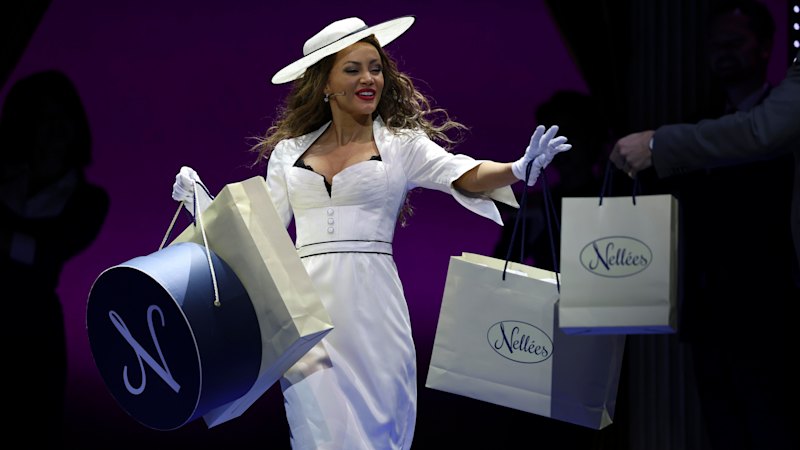
Updated July 19, 2026 — 12:29pm,first published July 17, 2026 — 1:29pmMUSICAL THEATREPretty Woman: The Musical ★★★Regent Theatre, until September 13Pretty Woman was always going to be hot property as far as movie-to-musical adaptations are concerned. Its gender and class politics might be icky – perhaps inevitable when you rework Cinderella into a yuppie fantasy that hinges on the so-called “hooker with a heart of gold” trope – but the 1990 film with Julia Roberts and Richard Gere remains one of the most bankable Hollywood rom-coms of all time.In Pretty Woman: The Musical, almost all the looks and scenes from the film are resurrected.Eddie JimThe cha-ching is only fitting. Although the story does make weak gestures towards pretending otherwise, money is the real love language of Pretty Woman. Its cultural influence relies at least as much on celebrating conspicuous consumption – the Rodeo Drive shopping scenes, the fabulous frocks and fast cars, and the opulent banquets with too many forks – as it does on the romantic chemistry of the leads.For fans of the movie, this musical adaptation has its finger pressed firmly on the nostalgia button in a way that should put bums on seats. Almost all the iconic looks and scenes are resurrected, and short of bringing Roy Orbison back to life, you couldn’t ask for better music.Songs from Canadian songwriting duo Bryan Adams and Jim Vallance range from a base of ’80s-style soft rock ballads, with strong melodies and a romantic charge.While the score isn’t always doing enough dramatic work, it does unleash vocal pyrotechnics, and occasionally a rock concert vibe that compensates for some of the looser stage business.Samantha Jade as Vivian Ward.Eddie JimChemistry is integral to making the fairytale fly, and Samantha Jade and Ben Hall are both charismatic and well-matched vocally. They create intimacy, and even a few tasteful erotic scenes that don’t look silly, even if they’re a bit hamstrung in replicating the dynamic from the film.Jade gives a pocket-rocket performance of the Julia Roberts role; Hall cops most of the show’s cringe moments, suddenly bursting into song in the Richard Gere part – an uneven performance, though, to be fair, Jade’s extroverted naif is easier to reconcile with the artifice of musical theatre than an introverted male lead.The supporting cast includes a larger-than-life comic contribution from Michelle Brasier as Vivian’s wisecracking bestie Kit, and a versatile one from Tim Omaji as a homeless man and a classy hotel manager. Douglas Hansell has the unenviable task of playing a nasty corporate lawyer – a character responsible for a troubling late plot point involving attempted sexual assault.It’s a reminder that gender politics have changed since Pretty Woman first appeared, though that isn’t, in the end, the show’s chief stumbling block.That comes from various aspects of the craft not being in service to one another, from the sense of a show that doesn’t wield musical and dramatic art to create something greater than the sum of its parts.Pretty Woman has entertaining sequences, some memorable music, and fans of the movie should enjoy the nostalgia hit. Yet it does feel overstretched as a full-length musical – and could have been trimmed into a play with songs or performed as a staged concert without losing much.Reviewed by Cameron WoodheadTHEATRERabbit & Watson ★★Darebin Arts Speakeasy, Northcote Town Hall, until July 26Chinese folk religion and homophobia in the AFL make uneasy bedfellows in this cross-cultural queer rom-com. Emerging playwright Shane Woon takes Tu’er Shen – the Rabbit God from Chinese legend, known as a gay matchmaker and patron deity of homosexual love – and thrusts him into a world of closeted young footy players.Rabbit & Watson is at its best in epical and comedic modes.Darren GillOriginally a soldier from Fujian who fell in love with a handsome Ming official, Tu’er Shen was, according to legend, caught perving on his beloved and subsequently executed for it. He was transformed into Rabbit (Sean Yuen Halley), the celestial protector of same-sex lovers – although each time his own beloved is reincarnated, Rabbit falls head over heels again and neglects his duties, with chaotic results.This time, the wheel of reincarnation has landed on a talented dreamboat of an AFL player named Watson (Anton Pan-Cassin). Watson has come out to his “stereotypical Asian mum” (played with an exaggerated sense of fun by Dr Cindy Pan), who’s ambitious for him and tremendously spiky about his growing affection for Rabbit.As love blossoms and Watson’s career belatedly takes flight, Rabbit begs the aid of other celestials – the Monkey God (Jesse Vasiliadis) famed from Chinese classic Journey to the West, and Guanyin, Goddess of Mercy.But Watson isn’t the only one struggling against homophobia in the AFL, and Rabbit’s distraction falls hard on others (Charlie Morris, Gabriel Partington) involved in the game.Rabbit & Watson’s sense of camp serves it well.Darren GillWill this centuries-old romance finally get a happy ending?Rabbit & Watson is at its best in epical and comedic modes and opens with elaborate pageantry. A spectacular lion dance sees two Chinese lions with laser-green eyes roaring to life, leaping and cavorting around the stage, accompanied by riotous percussion.The show’s sense of camp also serves it well – notably in Pan’s mischievous performance, and amusing touches brought to the courtship between the romantic leads.I suppose I would have liked to see more heated rivalry (or chemistry, or something) between them. It’s a same-sex love as chaste as the moon, and the Boy Love cultural influence should perhaps have made it a little raunchier. All that yearning deserves a payoff.Yet it’s the AFL stuff that produces the most dispiriting theatre. Both racism and homophobia remain serious issues in professional sport. That isn’t an excuse to oversimplify, or to beat audiences over the head with them, and the acting is so wooden, the characterisation so thin, and the dialogue so pedestrian in many of these scenes, that the show risks trivialising, or imprecisely diagnosing, the problems it seeks to highlight.It’s all rather dull and coarsely observed compared to the mythical love story, interferes with the colourful sense of picaresque, and distends the show to around two hours without interval.The good news is that there’s enough promising material here for a charming queer epic. But I fear only a substantial rewrite could cut out the dead dialogue, refocus the dynamics on the rom-com fantasy, and clarify and distil exposition (including through nonverbal aspects of theatrical storytelling) to avoid substantial longueurs.Reviewed by Cameron WoodheadDANCEThe Nutcracker Act II and other works ★★★Bunjil Place, until July 18Who would have thought the Australian Ballet would emerge as a key supporter of Melbourne’s independent dance scene? Well, it has – just look at its touring program, which in recent years has provided a valuable platform for the creation of new contemporary dance works.Hannah Sergi in The Nutcracker Act II by Paul Knobloch.Kate LongleyLast year, the company took on a new work by Lucy Guerin: the wonderful Ground Control. And this year we get not one but two premieres – by Sandra Parker and Stephanie Lake – and both are very strong.But the program is not all contemporary. It begins with company members Hugo Dumapit and Larissa Kiyoto-Ward in the glittering, exacerbated classicism of the Tchaikovsky Pas de Deux. Kiyoto-Ward is crisp and sure-footed, while Dumapit has an impressive leap.Then we fall into the austere, highly prescriptive world of Parker’s We Dance. This is a work for four dancers built from short but suggestive phrases, chiselled poses and densely organised sequences all performed with extreme largo.With its repetitions and exhausting variations, the work recalls Samuel Beckett’s late choreographies, while the hostile soundscape intensifies the sense of interminable crisis. Some may wonder if the title is ironic, but for me, this is bleakness of the most thrilling kind.Chrysalis by Stephanie Lake.Kate LongleyStephanie Lake’s Chrysalis deploys a large Australian Ballet School ensemble in a very different mode. Kinetic, comic and pop, it sends dancers in striking red costumes scurrying insect-like across the stage. The duets and trios are a little rough but the larger massed effects are great.After the interval, we enter the Kingdom of Sweets for the second act of Paul Knobloch’s version of The Nutcracker. Sara Andrlon and Jeremy Hargreaves bring a mature assurance to the Sugar Plum Fairy and her Prince, with Hannah Sergi as the Floral Fairy and Yaru Xu as Clara.There is a bit of whiplash in the transition from the dim monasticism of We Dance to The Nutcracker’s candyfloss skies and giddy smiles, though the creepy fun of Chrysalis, squeezed between them, provides a kind of bridge.The tour continues through Albury, Ballarat, Horsham and beyond.Reviewed by Andrew FuhrmannThe Booklist is a weekly newsletter for book lovers from Jason Steger. Get it delivered every Friday.More:Melbourne live reviewsArtsFor subscribersSee & DoWhat’s onPerforming artsReviewReviewVictoriaFrom our partners
Pretty Woman the movie is beloved. Does it work as a musical?
Full Article
📰 Original Source
Read full article at Smh →KhanList aggregates and links to publicly available news content. We do not host full articles from third-party sources. Always verify important information with original sources.