
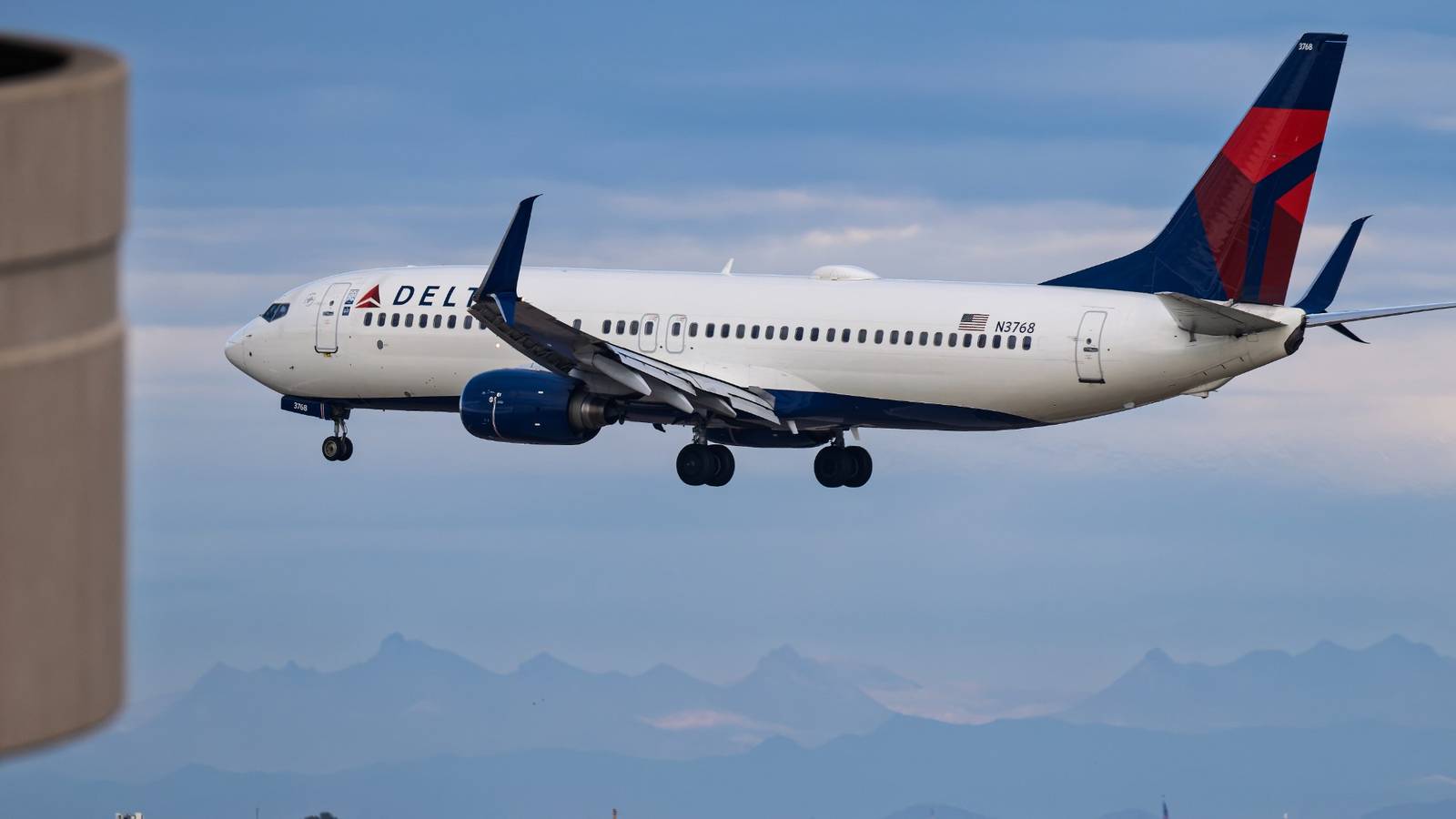
Published Sep 8, 2026, 3:46 AM EDT Luke Diaz is a freelance military writer with experience with active duty experience in the US Navy as well as defense and industrial engineering. He is a former Naval Flight Officer who performed tactical air control on the carrier-based E-2 Hawkeye. Delta Air Lines flight 2311 departed on Sunday from Los Angeles International Airport (LAX) bound for Salt Lake City Airport (SLC), but just before touchdown, the Boeing 737-900ER was forced to rapidly descend. Passengers were required to use emergency oxygen as the plane dove down to a safe altitude during what is believed to be a cabin depressurization event. In the audio shared by Flight Drama via X, the pilots did not explicitly state the nature of the emergency to Air Traffic Control. However, a user on Reddit claiming to be one of the passengers said it was a pressurization system failure, describing the experience as "pretty traumatic." Hiccups In The Air Conditioning Force An Emergency Landing Credit: Flightradar24 Delta flight 2311 was nearing the terminal area at Harry Reid International (LAS) in Las Vegas just before commencing rapid descent after the depressurization. The timing of the emergency was fortunate, as the pilots were able to make a very quick diversion. No Mayday call is heard in the recorded audio, but the priority handling makes it clear that an emergency was declared by the crew to make the swift landing possible. The source of the malfunction that caused the depressurization has not been publicly revealed, but the aircraft was back in service within hours, continuing on to SLC that same night. According to Flightradar24, DL2311 had departed from LAX at 5:06 PM, and the jet arrived in SLC at 12:24 AM. In general, a rapid depressurization that can be quickly fixed within a couple of hours is typically caused by software or a minor valve malfunction. Still, the passenger aboard DL2311 described the initial rapid descent as a chaotic and extremely stressful event. The flyer who posted on Reddit after the flight described it in these terms: "The pressurization system failed, my ears immediately started hurting, the oxygen masks dropped, and we did a rapid descent into Las Vegas. The scariest part wasn’t even the descent — it was not knowing what was going on. Flight attendants were trying to make announcements with their masks on and it was almost impossible to hear them..." Delta's Second Depressurization Mishap In One Year Credit: Wangkun Jia | Shutterstock Some observers online have drawn parallels to the slow depressurization that occurred on Delta flight 760 in January of this year. The strangest point of comparison between the events on each plane is the lack of similarity between the two malfunctions. On Sunday, the Boeing 737 rapidly lost cabin pressure, whereas on January 5, the Airbus A319 was forced to divert because of a slow pressure leak. Technically, the pilots flying the A319 were forced to respond to a sudden depressurization and rapidly descend from 36,000 feet (10,972.8 meters) to below 10,000 feet (3,048 meters), but they were aware of the gradual pressure loss beforehand. During Sunday's emergency landing, the aircrew had to immediately react, which is also why DL2311 deployed emergency oxygen masks but DAL760 did not. Another notable difference beyond the surface level between the two seemingly similar incidents is the fact that DAL760 was actually able to use backup systems to repressurize before diverting to JFK International Airport (JFK) as a precaution. Scant details are available from the DL2311 situation. However, based on the short time between the declaration of emergency and actual touchdown at LAS, it's unlikely that the backup systems were available or the air crew decided it was an unnecessary risk to attempt to continue on. Airframe Agnostic Emergency: Airbus Versus Boeing Cabin Pressure Loss Credit: Walter Cicchetti | Shutterstock The two aircraft involved in each of Delta's pressure loss incidents this year are drastically different in terms of their specification and airframe age, as well as operational history. Starting with Sunday's jetliner, Delta acquired the 737-900ER from Lion Air of Indonesia in 2023. Tail number N934DZ is almost 15 years old according to Flightradar24. One point of overlap is that it is powered by two CFM International CFM56-7B27 turbofan engines, while the A319-114 flown by DAL760 is also equipped with CFM56-5B4 powerplants. However, tail number N328NB is over 25 years old and was acquired from Northwest Airlines in 2009, according to Planespotters. So while the Airbus has never been exposed to the harsher weather of Southeast Asia, the Boeing jet is still a decade younger. Yet each of these planes suffered very similar malfunctions that led to an emergency scenario, which is very rare in commercial flying.
"Pretty Traumatic": Delta Boeing 737 Drops To 9,000 Feet As Oxygen Masks Deploy
Full Article
Original Source
Read the full article at Simpleflying →KhanList aggregates and links to publicly available news content. We do not host full articles from third-party sources. Always verify important information with original sources.