
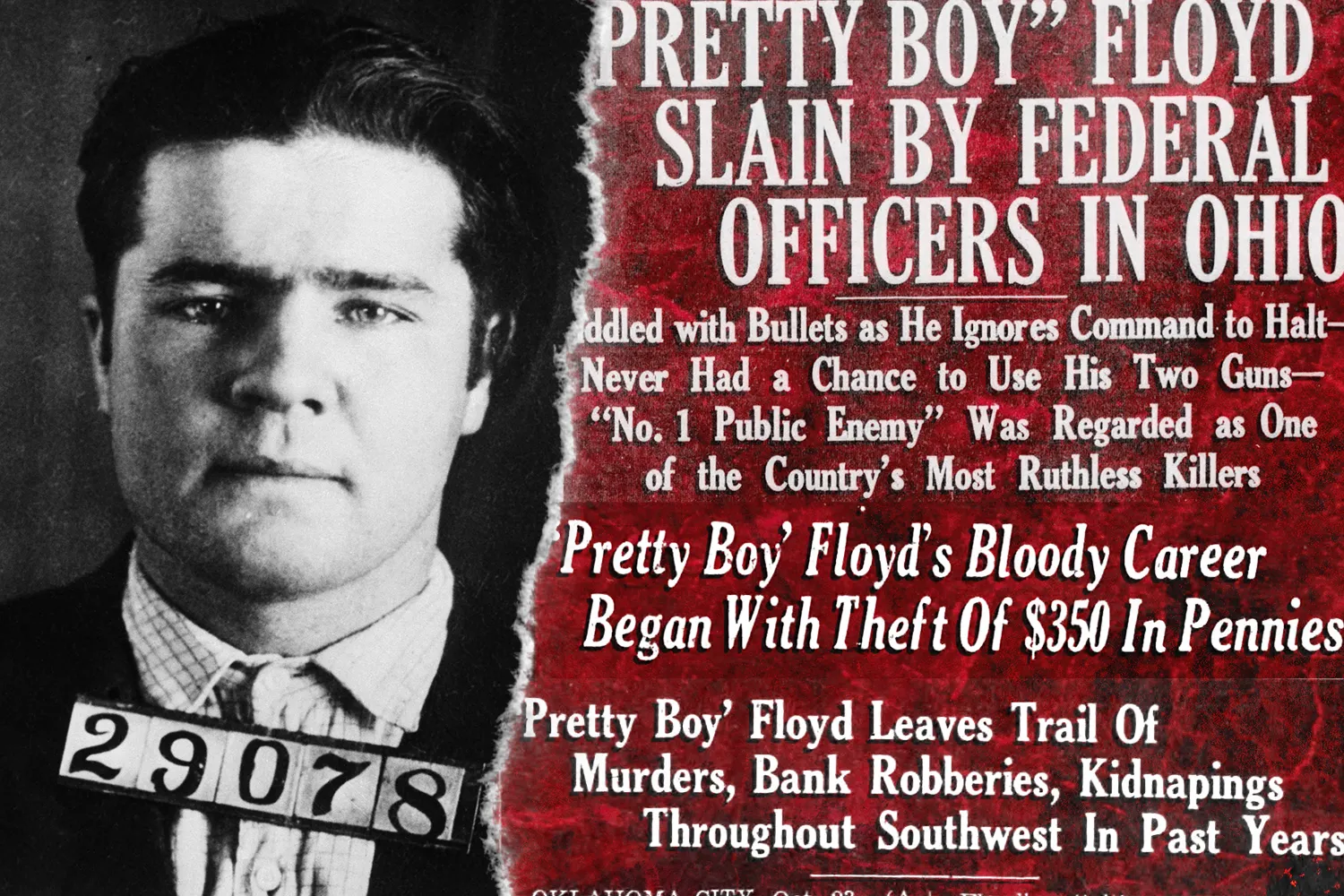
Some Americans lauded the 30-year-old bank robber as a Robin Hood-esque folk hero. Others castigated him as a violent criminal whose misdeeds were emblematic of the troubled era October 22, 2026 7:45 a.m. Charles Arthur "Pretty Boy" Floyd was a Depression-era outlaw who earned the title of the nation's "public enemy No. 1." Illustration by Meilan Solly / Images via Bettmann / Getty Images and Newspapers.com It was October 22, 1934. The late afternoon sun baked the Ohio cornfield in a wash of orange and red—an earthly premonition of the bloodshed soon to come. A volley of gunshots cut through the usual autumn quiet as a man in a mud-stained blue suit dashed through the tree line, a group of officers on his tail. Suddenly, he fell. As the officers approached the man, he looked up at them in shock. “I’m done for,” he said. “You’ve hit me twice.” And then—silence. Thirty-year-old Charles Arthur “Pretty Boy” Floyd, America’s public enemy No. 1, was dead at the hands of the Federal Bureau of Investigation. Floyd's 1928 prison record Public domain via Wikimedia Commons Nearly a century later, Floyd still captivates the American psyche. One of the most high-profile criminals of the Great Depression—often making headlines alongside the infamous Bonnie Parker and Clyde Barrow, John Dillinger, and George “Machine Gun” Kelly—Floyd is emblematic of his time. A poor American farmer-turned-bootlegger who embraced a life of crime, Floyd danced on the line of lawlessness until he crossed the point of no return. But he also earned a reputation as a champion of the poor, stealing from the banks that many of his fellow rural farmers viewed as the real thieves. Ultimately, Floyd’s legacy is neither as robber nor Robin Hood, but rather as a complex character whose story reflects a series of upheavals in law enforcement, media and the United States economy. Floyd was born into a farming family in Georgia in 1904, the fourth of eight children. When he was still young, his family moved to rural Oklahoma. They settled along the southern edge of the Cookson Hills, a rugged and poorly maintained stretch of land that would soon develop a reputation for housing outlaws. Floyd grew up on meager farm fare—but his other sources of sustenance were stories of the legendary Belle Starr and Jesse James, violent criminals who fancied themselves heroes of the common man. “These old desperadoes, shrouded in cobwebs and fantasy, made potent dreams” for an aspiring outlaw, biographer Michael Wallis writes in Pretty Boy: The Life and Times of Charles Arthur Floyd. An 1886 photo of the outlaw Belle Starr Public domain via Wikimedia Commons At the time, Oklahoma was undergoing major changes. White families like the Floyds flocked to what was previously tribal-controlled land, often encroaching on either sovereign Indigenous states or communities of formerly enslaved African Americans and their descendants. These new white settlers had little more to their names than those they displaced. In 1919, the state’s per capita income peaked at 83 percent of the national average before falling to 67 percent in 1921. Populist sentiment bubbled against this backdrop of economic hardship. Many of the state’s tenant farmers joined unions and sided with the growing Socialist Party of Oklahoma, culminating in the U.S.’s only attempted socialist revolution, in 1917. The political and economic climate also made the region particularly conducive to banditry: In addition to hosting Starr and James, the Sooner State also produced the Dalton Gang and the Marlow Brothers. “There was so much public backlash against the government, the banks, any institution that represents money,” Ally Mills, the artifacts and programs manager at Alcatraz East Crime Museum in Tennessee, tells Smithsonian magazine. Plenty of Oklahomans at the time toed the legal line—whether out of necessity or in a show of institutional opposition—by bootlegging liquor or engaging in petty theft as their neighbors turned a blind eye. Did you know? Oklahoma alcohol laws Oklahoma’s bootlegging culture predated national Prohibition, which banned the manufacture, transport and sale of alcoholic beverages across the U.S. between 1920 and 1933. Oklahoma entered the Union as a dry state in 1907 and didn’t legalize the sale of liquor until 1959. Floyd grew up in this world, where some deviation of the law was a common practice. As a teenager, he earned the nickname “Choc,” a playful nod to his drink of choice: a 120-proof barley-and-tobacco brew known as Choctaw beer. Floyd’s first scrape with the law came at age 18, when he and a few friends stole $350 in pennies from a local post office. Although investigators tried to pin the theft on Floyd, his father provided a false alibi that enabled the young man to escape punishment. It wasn’t until three years later that Floyd’s career in crime truly began. In 1924, Floyd met and married 17-year-old Ruby Hardgraves. The couple settled down with their newborn son, Charles Dempsey Floyd, in a small cabin near Floyd’s family. But cotton farming, small-scale bootlegging and the quiet life of a family man didn’t prove captivating enough for Floyd, who left for St. Louis in 1925. That September, Floyd and two associates robbed couriers for the Kroger grocery company at gunpoint, taking nearly $12,000 (around $230,000 today) before fleeing the Missouri city. The crew drove back to Sallisaw, Oklahoma, where the local sheriff, tipped off by the fact that they were driving a brand-new Studebaker automobile, arrested them for the crime. Sentenced to five years in prison, Floyd served three and a half years before being granted parole. This stint marked his only time behind bars. “He gets out of prison and just jumps right back into crime,” Mills says. As Floyd told journalist Vivian Brown in 1932, he “was just a green country kid that got caught on a job that I didn’t know much about, but I guess that was the job that puts its mark on me, and I could never shake it off.” He added, “Yes, I tried.” Upon his release in 1929, Floyd set out for Kansas City, Missouri, where he found a thriving criminal underworld. There, he built a network of co-conspirators, robbing more than 30 banks across Missouri, Ohio, Kentucky and Oklahoma. Floyd and his Kansas City girlfriend, Beulah Baird Archive Photos via Getty Images In the late 1920s and early ’30s, law enforcement in the U.S. was decentralized and uncoordinated, Mills says. Federal agents operated separately from state officials. “Even towns would not work with each other,” she adds. Although Floyd was frequently a suspect in local robberies, police simply couldn’t amass enough evidence to detain him for more than a few days. Floyd likely didn’t commit every crime attributed to him, Mills says. Crime ran rampant in the region at the time, and desperate characters abounded. Still, the media, law enforcement and everyday people were quick to pin just about any act of wrongdoing on the big names of the day—and Floyd was indeed making a name for himself. He was dubbed “Pretty Boy” by his Kansas City girlfriend, Beulah Baird, and the sobriquet stuck, much to his chagrin, Wallis tells Smithsonian. The nickname soon made headlines in publications across the country. At the same time, Floyd developed a reputation as the so-called Robin Hood of the Cookson Hills. Neighbors whispered of their encounters with Floyd, recounting how they’d provided him with shelter and a hot meal, only to find a stack of money left underneath his plate. During bank robberies, he would rip up the mortgages to local farms—or so the legend goes. “Most of the people in those days, they were on my father’s side,” Floyd’s son, Charles (better known as Jack), told documentarian Terry Kay Rockefeller in the early 1990s. “They felt he was striking back for the little person. … I don’t think it bothered them at all. I think they [were] kind of proud that he did it.” Interview with Charles Dempsey Floyd for "The Great Depression" Just as Floyd was credited with crimes that he likely didn’t commit, Mills cautions against taking these folklore accounts at face value. “This is how the American public, the ordinary people, the people of rural Oklahoma, viewed him, not the concrete truth,” she says. By 1930, Floyd’s outsize reputation in Kansas City and Oklahoma had driven him north, to Ohio. The decision proved disastrous: He and four associates botched their first big job, a bank robbery, barely escaping with less than $2,000 to split among them. Local police soon found the gang’s hideout, and a deadly shootout ensued. Floyd wasn’t charged with the killing of local patrolman Harland Manes, but one of his associates was convicted of the crime and sentenced to death. As for Floyd himself, authorities arrested him in connection with the recent bank robbery, and a court sentenced him to 12 to 15 years. But he wasn’t ready to head back to the slammer. While on the train to the Ohio penitentiary, the outlaw jumped out of the moving locomotive’s open bathroom window. Floyd managed to lay low in the immediate aftermath of his escape, returning to the familiar Kansas City underground. Then, in 1931, he found himself back in national headlines—and in the sights of J. Edgar Hoover, director of the Bureau of Investigation (soon to be rechristened the FBI). A 1932 photo of FBI Director J. Edgar Hoover Public domain via Wikimedia Commons That July, a group of federal Prohibition agents and local Kansas City police officers discovered Floyd in hiding while conducting routine liquor investigations. Floyd escaped the gunfight that followed without injury, but the officers weren’t so lucky. For one of the men, federal agent Curtis Burks, the encounter would prove fatal. Burks wasn’t the first person killed by Floyd. Nor would the agent be the last. (Estimates of the number of deaths attributed to Floyd range from six to as many as a dozen.) But Burks’ murder marked a turning point for the increasingly notorious criminal. Floyd left Kansas City and headed back to his family in the hills of Oklahoma. His wife had remarried while he was in prison, but she agreed to leave her new husband and reunite with Floyd, who continued seeing both her and Baird until his death. Floyd’s story is inextricably linked to Hoover, whom Wallis describes as “probably the most ambitious man in the last century.” A career bureaucrat, he quickly rose through the ranks of the federal government, becoming the bureau’s director in 1924. But Hoover inherited a weakened department that was lacking in manpower and tainted by the scandals of his predecessors. He needed success, and he needed it fast. America had no shortage of lawbreakers in the 1920s. The second wave of the Ku Klux Klan was at its peak, with Prohibition providing an excuse for the white supremacist group to target Catholic immigrants and others accused of breaking the alcohol ban. Prohibition also acted a backdrop for mounting gang violence and organized crime. Hoover was shrewd. The bureau didn’t yet have the workforce needed to properly take down either the KKK or major organized crime syndicates, Mills says. Instead, the director looked to another target: the American outlaw. John Dillinger's 1924 mugshot. Dillinger was the first person to hold the title of America's "public enemy No. 1." Public domain via Wikimedia Commons Operating solo or in small groups, these criminals often relied on a network of goodwill to remain hidden, Wallis says. As the Great Depression hardened more people against American institutions, highlighting these outlaws’ crimes and taking them down turned out to be an easier way of underscoring the bureau’s utility. At the time, “the economic crisis is really public enemy No. 1,” Mills explains. But by going after Floyd and his contemporaries, Hoover “displaces that public enemy No. 1 onto these people.” Floyd’s killing of a federal officer officially put him on Hoover’s radar. But Floyd’s real troubles began a year later, after a June 1933 shootout at Kansas City’s Union Station. The FBI’s official account of the attack claims that Floyd and associates Vernon Miller and Adam Richetti hatched a plan to free their friend Frank Nash as he arrived at the station en route to the state penitentiary. When law enforcement officers moved Nash into a car, the three men fired their guns, killing four officers, including an agent with the bureau, as well as Nash. Scholars, however, are divided on whether Floyd and Richetti took part in the bloodshed. While several bystanders placed Floyd at the scene, Mills says that those accounts came from rival gang members, calling their veracity into question. Although the authorities’ star witness suggested that Floyd had sustained a bullet wound to his left shoulder, the autopsy performed after his death the following year found no evidence of such an injury. Kansas City residents watch the aftermath of the June 1933 Union Station shootout between law enforcement officials and outlaws. Public domain via Wikimedia Commons In his book, Wallis collects several counter-testimonies from individuals present at the shootout. The accounts implicate another set of outlaws, but as Wallis says to Smithsonian, “Hoover discounted all of them because [the witnesses] were Black.” Floyd vehemently denied any involvement in the killings. But the media, capitalizing on public demand for outlaw stories, was quick to publicize the FBI’s version of events. Front pages across the nation carried Floyd’s name. Back on the lam, Floyd would live for another 16 months, but after Kansas City, his “death warrant was signed,” Wallis writes. In June 1934, Hoover named Dillinger, a prolific Midwestern bank robber and one of Floyd’s contemporaries, the nation’s first public enemy No. 1. The designation directed all law enforcement (and subsequent media coverage) to find and stop a single man. But Hoover had not forgotten Floyd and the Kansas City massacre. When Dillinger was shot and killed by federal officials just a month later, Floyd inherited his title—and the officers on his tail. It was October, and fall was settling in. Floyd had spent the better part of the past year hiding out in Buffalo, and he was ready to go home. The FBI was closing in. Floyd and Richetti set out for Oklahoma in a two-door Ford sedan, accompanied by Baird and Richetti’s girlfriend, who had joined the fugitives in hiding. Along the roads of rural Ohio, the plan quickly derailed. Amid heavy fog, Floyd lost control of the car, sending it sliding into a telephone pole. A wanted poster for Floyd Public domain via Wikimedia Commons Floyd and Richetti stayed by the car while their companions sought help. The two men fell asleep. A local man walked past them on his way home and, finding the situation odd, reported it to local sheriff John Fultz. Fultz immediately investigated—and was met by gunfire. Richetti and Floyd escaped into the forest, but federal backup was close at hand. Officers quickly apprehended Richetti; Floyd hijacked a car and slipped away. FBI agents led by Melvin Purvis, famous for his role in taking down Dillinger, tracked the outlaw to a nearby farm. Floyd ran into the pasture, with federal and local officers on his heels. According to an FBI statement, Floyd refused to stop running, prompting the agents to fatally shoot him. Decades later, in 1979, local police captain Chester Smith, who’d been present at the scene, contested this account in an interview with Time magazine. In his telling, he’d fired the first shots at Floyd, wounding—but not killing—the criminal. Purvis reportedly approached Floyd and exchanged a few words with him before ordering a fellow officer to shoot the incapacitated man. Smith, who came out with his alternative account amid a national reckoning with the FBI, claimed that the bureau had orchestrated a cover-up “because they didn’t want it to get out that he’d been killed that way.” The FBI refuted Smith’s version of events. “They could have taken Floyd alive, and they didn’t,” Wallis says. “They literally executed him in that cornfield.” Floyd's death mask Public domain via Wikimedia Commons Floyd’s death caused a media frenzy. News reports indicate that between 20,000 and 40,000 people attended his funeral, making it the largest in Oklahoma history. Mills says that the bureau encouraged the publicization of Floyd’s death, hoping that his fate would serve as an example of the consequences of lawlessness. Instead, the coverage struck a chord with people across the country—primarily those who saw themselves in the Oklahoman outlaw and his hardscrabble beginnings. “If you’re a lower-class individual trying to make a dime in a rural tenant farm area, you’re probably not going to side with the government,” Mills says. “You’re going to side with the antihero. You’re going to side with the person fighting against them.” In the near-century since Floyd’s final moments in that Ohio cornfield, his life has become the stuff of legend, immortalized by John Steinbeck in his novel The Grapes of Wrath and Woody Guthrie in the folk song “Pretty Boy Floyd.” But such tales often aggrandize both his misdeeds and his acts of charity. Floyd’s lasting imprint on American culture has little to do with the crimes he committed, Mills says, but rather how his life represents the Great Plains in the 1930s, a region on the cusp of change. “It’s this idea that one person can make a difference,” Mills says. “Did he go about it the wrong way? Absolutely. But he left a legacy that an idealized hero can emerge out of an era marked by so many horrible events.” Pretty Boy Floyd You Might Also Like Get the latest History stories in your inbox. More about: Alcohol Crime Death FBI Great Depression Kansas Law Media Missouri Murder Newspapers Oklahoma Prohibition
'Pretty Boy' Floyd, One of the Most Notorious Outlaws of the Great Depression, Was Shot and Killed in an FBI Raid 92 Years Ago
Full Article
Original Source
Read the full article at Smithsonianmag →KhanList aggregates and links to publicly available news content. We do not host full articles from third-party sources. Always verify important information with original sources.