
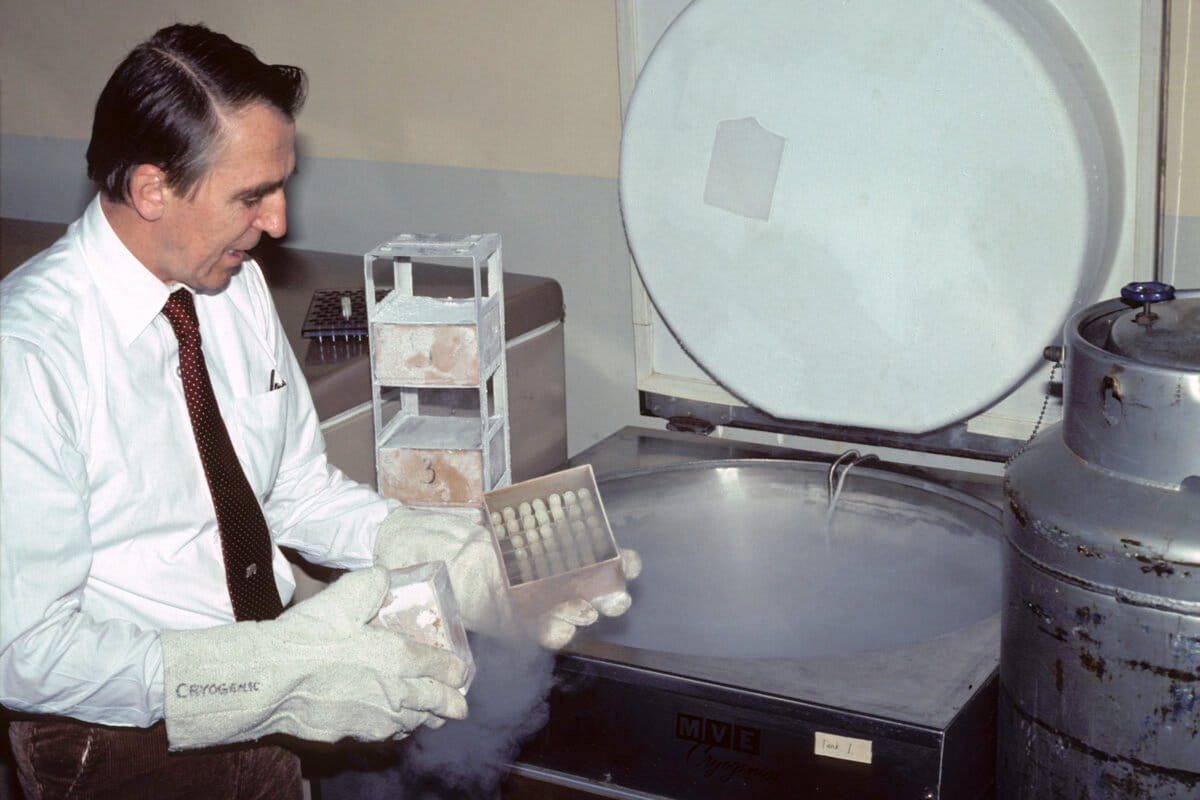
Biodiversity banking is the collection and preservation of genetic samples of plants and animals.At the San Diego Zoo Wildlife Alliance, the biodiversity bank includes a plant gene bank, a tissue and DNA bank, along with their popular Frozen Zoo where genetic samples are cryopreserved in liquid nitrogen.Preserving genetic samples is crucial for species recovery in the future as well to preserve genetic diversity and for research purposes, Katie Heineman, conservation program leader for biodiversity banking, tells Mongabay.The alliance is now helping build capacity for sample collection by collaborating with governments and partner organizations in Kenya, Vietnam, Peru, and Hawai‘i. Kurt, a Przewalski’s horse, was born at San Diego Zoo in the U.S. in August 2020. Less than three years later, Ollie followed. Out in the wild, their species had gone extinct in the 1960s. Both individuals, born of a surrogate mother — a domestic horse — were the first Przewalski’s horses (Equus ferus przewalskii) to be successfully cloned from another of their species whose DNA had been preserved at the zoo for 40 years. At the San Diego Zoo Wildlife Alliance’s Frozen Zoo, the largest initiative of its kind in the world, genetic materials from animals and plants are stored — cryopreserved using liquid nitrogen at temperatures as low as -196° Celsius (-320° Fahrenheit) — for posterity. But the Frozen Zoo is only part of the alliance’s broader biodiversity banking initiative, which also includes a native plant gene bank and a tissue and DNA bank. “I think of it as saving DNA for the future,” Katie Heineman, conservation program leader for biodiversity banking at the San Diego Zoo Wildlife Alliance (SDZWA), told Mongabay in a video interview. “It really is an optimistic act to conserve biodiversity for a time where we’ve solved the threats facing nature.” Applications are aplenty. Biodiversity banking can help not just in the recovery of threatened species, but also in preserving genetic diversity. It’s also crucial for scientific research. However, given the pace of habitat degradation and biodiversity loss, Heineman said there’s an urgency to build capacity around the world to ensure more samples are collected and preserved for genetic recovery and research. “This can’t be industrialized without an understanding of biodiversity,” she said. “It is crucial to tailor these methods to the diversity of life around us, and that is key to the innovation that’s needed.” Katie Heineman, pictured above, calls biodiversity banking “an optimistic act to conserve biodiversity for a time where we’ve solved the threats facing nature.” Image courtesy of the San Diego Zoo Wildlife Alliance. Katie Heineman spoke with Mongabay’s Abhishyant Kidangoor about the biodiversity bank at SDZWA, the impact of their work, and the crucial need to build capacity to collect more samples at scale around the world. The following interview has been lightly edited for length and clarity. Mongabay: How did you get into the field of biodiversity banking? What attracted you to this field? Katie Heineman: I am, by training, a tropical forest ecologist. I did my Ph.D. in Panama, working with tropical forest trees. But I became really interested in conservation when I started to learn more and more about the threats that the species I was working with were facing. In the case of Panama, it was a wind energy concession threatening our forest reserve. I am also really interested in data and how we can use data to enhance conservation. So I transitioned after my Ph.D. from working with forestry data sets to collections data sets. Collections are amazing because they have so much data associated with them, especially in the biodiversity context from the animals and plants you collect them from and the things that we learn about them as we process them. Then there are also the outcomes that happen after we do things, especially for plants. Like planting them back out into the environment. I’m really inspired by what biodiversity collections can do for the future. It really is an optimistic act to conserve biodiversity for a time where we’ve solved the threats facing nature. Mongabay: For someone unfamiliar with it, how would you define collections? What does it include? Katie Heineman: What our organization works on is biodiversity banking. I define that as the collection of biological materials for conservation purposes. This can take many forms. Our biodiversity bank at San Diego Zoo includes collections that are very veterinary. They include blood samples and serum that they take from animals, and it almost serves as a blood bank. Then there’s also collections that are definitely more for applied conservation purposes, like our native plant seed bank, where we dry down and store seeds so that we can plant them back out into nature. We also have cryogenic collections that are serving as long-term repositories for things like cells and gametes to really suspend that life in animation until we can develop new conservation technologies. Biodiversity banking is a pretty broad term, but in general, I think of it as saving DNA for the future. Mongabay: Why is it more important now than ever before to do this? Katie Heineman: A big benefit of biodiversity banking is genetic diversity conservation. When species lose genetic diversity, they lose their ability to adapt to nature and be resilient to nature. This includes disease resistance. Having low genetic diversity decreases mating success. And so, by saving this DNA, we can do two things: We can directly increase genetic diversity when technologies exist to reintroduce that genetic diversity into populations. We can take genetic diversity that we’ve saved in a biobank and use it to facilitate the genetic diversity of the living populations. But there’s also so much we can do just by saving DNA to learn about species, to learn about what extinction risks are present in a group of species, what predicts disease susceptibility to things like COVID and other emerging threats. I think those are the two main avenues in which biodiversity banking can support species. You can literally create genetic diversity and put it back into populations, and you can also learn things that can really help save species by mitigating threats. Mongabay: I know SDZWA is working with different aspects of biobanking. Could you walk me through those? Katie Heineman: San Diego Zoo’s conservation programs started with the Frozen Zoo in 1975. The Frozen Zoo is a cryogenic living collection of cell lines and reproductive materials; so that includes sperm, oocytes and embryos from primarily vertebrates. This is the first collection and really the most famous collection that we have. It’s something that’s been developed over the years by the curator of the Frozen Zoo, Marlys Houck, and was started by the founder of the conservation science department, Kurt Benirschke. He was a medical doctor who was really interested in chromosomes, but he just saw incredible potential for this living material for applications down the road. He had this mantra that he quotes from another historian that says, “You must collect things for reasons you do not yet know.” So that was the first collection, but it really expanded into other types of biodiversity banking. The other subcollections include our DNA and tissue bank, which is material that’s saved for genomic analysis. There’s our native plant seed bank, which has over 500 species of native plants from primarily San Diego county. We have a pathology archive that archives the diseases that we’ve documented, especially through our veterinary care. And then we also have a clinical repository of blood and serum. They’re all slightly different practices, but in general, they share a lot in terms of data management and in terms of thinking about the infrastructure needed to maintain collections long term. The Frozen Zoo, where genetic material from animals and plants are stored and preserved for posterity, is part of a border biodiversity banking initiative. Image courtesy of the San Diego Zoo Wildlife Alliance. Mongabay: Could you walk me through the four sites where you have initiated pilot projects? What’s happening at these sites? Katie Heineman: The Frozen Zoo is a cryogenic collection of living cells, and so that’s a technology that we really are excited to expand into four of our conservation hubs where San Diego Zoo Wildlife Alliance has conservation programs on the ground. These are Peru, Kenya, Vietnam, and Hawai‘i. This is part of a broader partnership with the IUCN Species Survival Commission. We work closely with the Animal Biobanking for Conservation Specialist Group to provide technical support and, through a philanthropic campaign, financial support to help these programs start biodiversity banks, especially cryogenic banks that are similar to the Frozen Zoo in terms of conserving living biodiversity in cryogenic storage. This is a long-term training partnership that we have, and we’re becoming very invested in mentoring and facilitating knowledge exchange. What’s really important is that these are not San Diego Zoo biobanks. These are biobanks that are owned and operated by in-country partners. Their governments will have governance over these samples and derive the biodiversity benefits from the samples. Mongabay: If you were to describe the impact of this work, what examples would you give? Katie Heineman: Conservation cloning is a very good example of this application in terms of re-injecting genetic diversity into managed populations. Essentially, the way that the Frozen Zoo operates is it collects samples, primarily skin samples, from individuals, and then it can be preserved in perpetuity. In the case of Przewalski’s horses, there was a horse, Kuporovich, who passed away in the late 1980s, and his cell lines were conserved in the Frozen Zoo. Then in the early 2020s, two clones were made from that cell line through a process called somatic cell nuclear transfer, in which the nucleus of the cell line of Kuporovich was implanted and created into an embryo that was then gestated in a domestic horse. Now, there are two clones that we care for here at San Diego Zoo. So that’s one way that we’re really reimagining genetic diversity from the Frozen Zoo. Another way that this resource has been really helpful is facilitating genomic discovery. So the Vertebrate Genome Project and the Earth Biogenome Project are facilitating the sequencing of the genome of all life on Earth. Over 100 reference genomes, especially from vertebrates, have been created from sequences in the Frozen Zoo, and through something called the Zoonomia Project, this has been used in high-profile articles predicting extinction risk in vertebrates, and predicting what is the susceptibility of vertebrates to COVID-19 virus. Those are the ways that it’s been used currently. There’s a lot more potential, especially in terms of advanced reproductive technologies for vertebrates. We’re really excited about the way our collection is expanding to more taxonomic groups. For example, we’ve been able to cryopreserve larvae of sunflower sea stars. That’s an entire organism that can be used to help that species, which has been rapidly declining because of the sunflower sea star wasting disease. Kurt, born of a surrogate mother in August 2020, was the first Przewalski’s horse to be cloned from DNA preserved at the zoo. Image courtesy of the San Diego Zoo Wildlife Alliance. Mongabay: Moving to capacity building for biodiversity banking, how is it faring around the world? What more needs to be done? Katie Heineman: We are part of a global network of biodiversity banking partners. Our biodiversity bank is probably the largest in terms of wild vertebrate cell lines. But we’re excited by the growth of other biobanks, whether it be at Toronto Zoo in Canada and the Leibniz Institute in Bonn. There’s amazing work happening in Singapore as well. I think of this as a two-pronged approach that we need to be taking. We need to be expanding both our networking and knowledge sharing. As you know, in high-resource areas like San Diego, I think it’s really incumbent upon us to facilitate training. We’re really taking that responsibility seriously in terms of providing training programs in the conservation hubs where we work actively. But no organization can do it alone, which is why we’re really invested in this distributed network of biobanks so that we can really divide and conquer the enormous problem of biobanking all 40,000 threatened species in the entire world. New technologies are also really going to help so that we can take samples in minimally invasive ways from things like feces, air or blood. It can really accelerate the pace at which we not only biobank more species, but more individuals per species. Because one individual is not enough in terms of conserving the genetic diversity of a population or a species at large. I’m really excited by the way technology is evolving for us to be able to do more. Mongabay: What are the gaps that continue to exist? Katie Heineman: We’ve made a lot of progress in terms of biobanking vertebrates. But for us to really make a global impact, we need to also be expanding this practice and the resources available to this practice to things like invertebrates, the pollinators that are so important for all of all life on Earth and crop survival too. That’s something that’s very unexplored and something our team is really interested in. Marine life is something that really, in general in scientific study overall but in this field as well, has received very little attention and is worthy of a ton of resources and study. Essentially, it’s not a one-size-fits-all practice. For example, seed banking is appropriate for many seed plants. Cryogenic preservation is appropriate for many vertebrate organisms. So I think the reason that we need a distributed approach is because taxonomically the scientific innovation that’s needed is going to need to come from so many different places that it’s going to really take so many people. I think that there needs to be an accelerant in terms of the research and the attention on this topic. The native plant gene bank is also part of SDZWA’s broader initiative to preserve genetic samples for the future. Image courtesy of San Diego Zoo Wildlife Alliance. Mongabay: Let’s say we talk again in 10 years. What do you hope you’ll be telling me about the state of biodiversity banking around the world? Katie Heineman: I would love to tell you two things. As a conservationist, I’d love to tell you that we’ve taken care of the Earth. And that our natural environments are ready for us to use new technologies to release species from biodiversity banks into nature. So, number one is that the situation around the world with biodiversity threats facing nature improves to the point where technologies can allow the genetic diversity in biobanks to make a really impactful difference in terms of the genetic diversity of the species and their resilience in nature. I would love to see more technologies where the genomic discovery of species allows scientists to make better decisions, and also reproductive methods have improved to the point where we can reanimate many of the cells and other materials from our biodiversity banks to make a difference for conservation. Banner image: Kurt Benirschke, founder of San Diego Zoo’s Frozen Zoo, holding cryopreserved samples in 1979. Image courtesy of the San Diego Zoo Wildlife Alliance. Abhishyant Kidangoor is a staff writer at Mongabay. Find him on 𝕏 @AbhishyantPK. From one deer’s DNA, a road map emerges to save an endangered Philippine species DNA research changes the fate of the most trafficked parrots in Colombia Credits Topics
Preserving wildlife DNA for the future: Interview with the Frozen Zoo’s Katie Heineman
Full Article
Original Source
Read the full article at News →KhanList aggregates and links to publicly available news content. We do not host full articles from third-party sources. Always verify important information with original sources.