
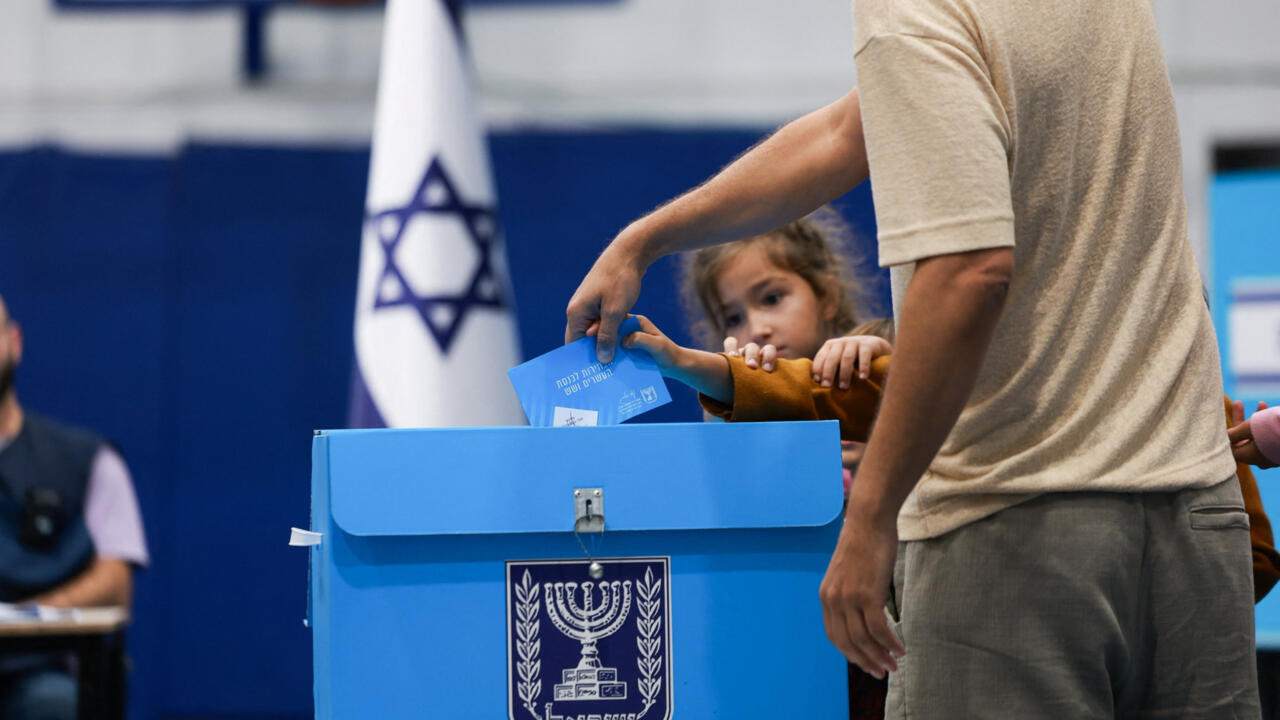
Polls opened in Israel on Tuesday in the country’s first election since the Hamas-led attack of 7 October 2023, with Prime Minister Benjamin Netanyahu facing a close contest after three years of war and deepening political divisions. Issued on: 27/10/2026 - 09:02 3 min Reading time Some 7.3 million people are eligible to vote in an election shaped by questions over security, accountability and the country’s future direction. The last published opinion polls put Netanyahu neck and neck with his main centrist challenger, former military chief Gadi Eisenkot. The vote offers Israelis a chance to deliver their verdict on Netanyahu’s wartime leadership and the growing influence of his far-right coalition partners. But a close result could lead to weeks or months of negotiations before a government emerges. Hundreds of thousands of young Israelis are eligible to cast their first ballots, with surveys showing that they overwhelmingly identify as centre-right or right-wing. Tens of thousands of Israelis are also estimated to have travelled home from abroad to vote. Most polling stations will close at 10pm. Final results could take days, and no single party is expected to approach the 61 seats needed for a majority in the 120-member parliament. Three years on from the 7 October attacks, war has redrawn the map of Palestine Security and accountability Netanyahu, 77, has served as prime minister on and off for more than 19 years. His campaign has emphasised his security credentials and relationship with US President Donald Trump, presenting him as the leader best equipped to protect Israel. Since the October 2023 attack, he has overseen military campaigns that have devastated Gaza, seen Israeli forces occupy southern Lebanon and brought direct strikes against Iran with US support. Israelis have also faced bombardment from Iran, Hamas, Lebanon’s Hezbollah and Yemen’s Houthi rebels. The wars have intensified scrutiny of Netanyahu’s leadership while Israel has become increasingly isolated internationally over its conduct in Gaza, expanding settlement construction and violence in the occupied West Bank. At home, one of the most persistent criticisms concerns his refusal to accept responsibility for the security failures surrounding 7 October, the deadliest day in Israel’s history. Eisenkot, 66, has promised an independent state commission of inquiry into those failures – a step Netanyahu’s government has resisted. The former military chief, a relative newcomer to politics, has offered a more restrained leadership style while seeking to rally voters across an informal opposition bloc stretching from the right to the centre-left. Young Israeli voters lean right, as election puts Netanyahu to the test Coalition arithmetic Eisenkot’s Yashar party leads that loose grouping, but replacing Netanyahu would require agreement among parties with differing political priorities. Eisenkot has ruled out supporting the creation of a Palestinian state and has backed Israeli settlements, while promising action against violent settlers. Netanyahu returned to office in December 2022 at the head of a coalition that brought far-right ultra-nationalists into government. Their influence has grown sharply since then. National Security Minister Itamar Ben Gvir voted on Tuesday in Kiryat Arba, an Israeli settlement in the occupied West Bank. Netanyahu has also faced opposition criticism over his support for ultra-Orthodox parties seeking to preserve military service exemptions for religious Jewish students, despite personnel shortages in the armed forces. Predominantly Arab electoral lists could hold the balance of power. Arab citizens account for about 21 percent of Israel’s population, but neither Netanyahu nor Eisenkot has publicly committed to partnering with those lists. After voting in the northern town of Umm al Fahm, Yousef Jabareen, who heads one of the Arab-majority lists, called for strong participation to help remove Netanyahu’s coalition. With neither camp assured of a majority, coalition bargaining may prove as decisive as Tuesday’s vote. Failure to form a government could send Israelis back to the polls. (with newswires)
Polls open in Israel as Netanyahu faces close contest after three years of war
Full Article
Original Source
Read the full article at Rfi →KhanList aggregates and links to publicly available news content. We do not host full articles from third-party sources. Always verify important information with original sources.