
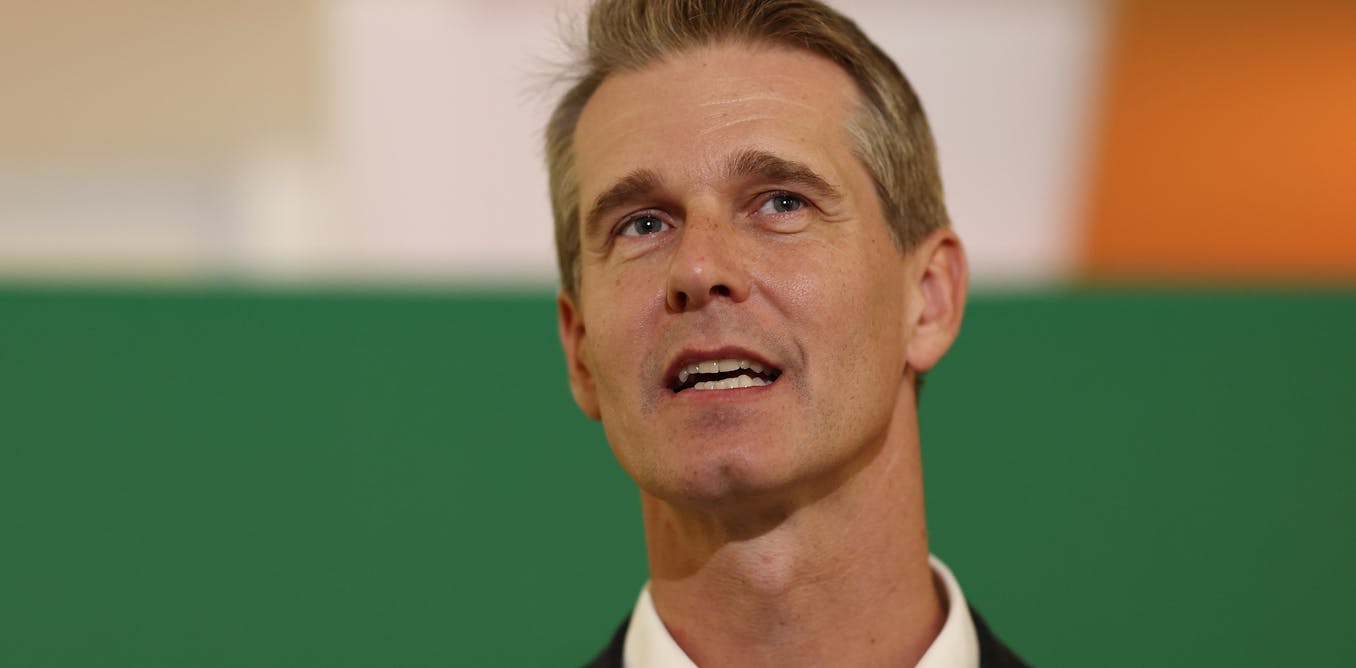
Household and business power prices could rise if artificial intelligence (AI) data centres on Australia’s end up being powered by coal or gas generation, a federal assistant minister has said. Cabinet Secretary and Assistant Minister for Science, Technology and the Digital Economy Andrew Charlton spoke to The Conversation’s politics podcast on Wednesday afternoon – before the details of a national agreement on AI emerged from a National Cabinet meeting between the prime minister and state and territory leaders. During the interview, Charlton defended his government’s push for national agreement that new data centres be powered by new renewable energy projects, backed by gas, warning that the alternative would “push up the price” of power. Look, I’m not agnostic to the outcome for Australians. I want to make sure that Australian households do not face higher power prices because of data centres. And if we are allowing data centres to use power from, for example, coal-fired generation, then they are going to be competing for that existing power from that source with households and businesses. That will push up the price. If we allow data centres to use gas from the East Coast Reservation, for example, then they will be drawing gas that would otherwise be used by households and businesses. So the problem with that proposal is if we allow the data centres to draw on finite sources of energy, they will inevitably put upward pressure on the price of those finite sources. However, if we require the data centres to bring new incremental energy, which is renewable energy, additional to what we already have, then they won’t push up prices for Australian consumers. But Wednesday’s National Cabinet meeting ended with Queensland and the Northern Territory winning agreement that they could power their data centres with coal and gas. Read more: Australia’s backdown on data centres allows them to use energy from coal and gas. Here’s what that means That backdown came after Federal Energy Minister Chris Bowen had previously threatened to override state governments that didn’t use renewables to power their data centres. ‘Very serious’ public concerns Charlton, who is playing a central role in shaping the government’s AI strategy, said he accepted that the public had “real” concerns about data centres. I think the backlash against data centres is very serious. And the reason I think it’s very serious is because I think the concerns that many people have are real. When you look at the United States, the consequences for local communities of the unplanned and unmanaged rollout of data centres has been very severe. I mean, if you think about energy costs in the United States, we’ve seen very significant increases in consumer energy prices. In the largest electricity grid in the United States, the PJM grid, prices went up by more than 60%. Big part of that was due to data centres. There are families in the Unites States who turned on their taps after a cluster of new data centres was put near their homes and they lost water pressure. So I think to the extent that the backlash against data centres is based on real community concerns, we should take it very seriously. That’s really the Australian government’s approach. It’s to make sure that those types of impacts don’t happen in Australia, to make that data centres don’t push up power prices, to make the data centres don’t complicate people’s access to water. And by addressing those very real concerns, thereby increase public confidence and reduce the backlash against them. On AI and productivity When asked if AI would be a “small silver bullet” to increase productivity, Charlton said: I would hope so. Artificial intelligence is effectively a significant technological innovation and technological innovation is one of the primary drivers of productivity growth. Productivity growth […] is that enabling us to produce more output for the same amount of inputs. And artificial intelligence, because it will help us to do a lot of work, should be a significant source of productivity gains. How quickly those gains come is another question. […But] there’s no point getting productivity growth at the expense of employment, because then your total output does not go up. What we need is productivity growth that augments and enhances the human labour to make that human labour more productive, get higher returns from that human labour, and ultimately drive up wages and living standards. That’s the outcome that we want. On managing AI risks Charlton flagged further reform to come on AI safety: We’ve already seen around the world in the last few elections significant attempts at interference. And artificial intelligence will be a tool for the people who want to interfere in elections. There’s no question about that. Now, this is part of the government’s broader artificial intelligence safety agenda. That safety agenda is looking at a whole range of different risks that are posed by artificial intelligence. Risks, for example, to child safety, and that’s why minister Wells is leading the digital duty of care. Risks to privacy and that is why minister Rowland is leading reform in the Privacy Act. Risks in critical infrastructure, being addressed by minister Burke. Risks in the economy, being led by assistant minister Leigh. The government is working hard on all the range of risks that are posed by artificial intelligence. On Australia’s inflation challenge Charlton declared inflation is “a terrible feature of our economy”, while defending his government’s record in bringing it down from recent highs and acknowledging “there’s no question we’ve got more work to do”. [Inflation] increases prices. It hurts the cost of living. It’s very damaging for family budgets. The good news is that inflation has come down a lot in the last four years. Four years ago, inflation was in the sixes, it is now in the threes. That is still too high, as the treasurer has said many times. The government has been […] helping to put downward pressure on inflation by running responsible fiscal policy. This government delivered two budget surpluses last term. That is two more than the Liberals delivered in their entire three terms in Parliament […] So there’s no question we’ve got more work to do in terms of getting inflation down. But this is a government, through fiscal discipline and through work on the productivity side and supply side of the economy, that’s committed to supporting those objectives.
Politics with Michelle Grattan: Andrew Charlton’s warning on data centres’ impact on power bills
Full Article
Original Source
Read the full article at Theconversation →KhanList aggregates and links to publicly available news content. We do not host full articles from third-party sources. Always verify important information with original sources.