
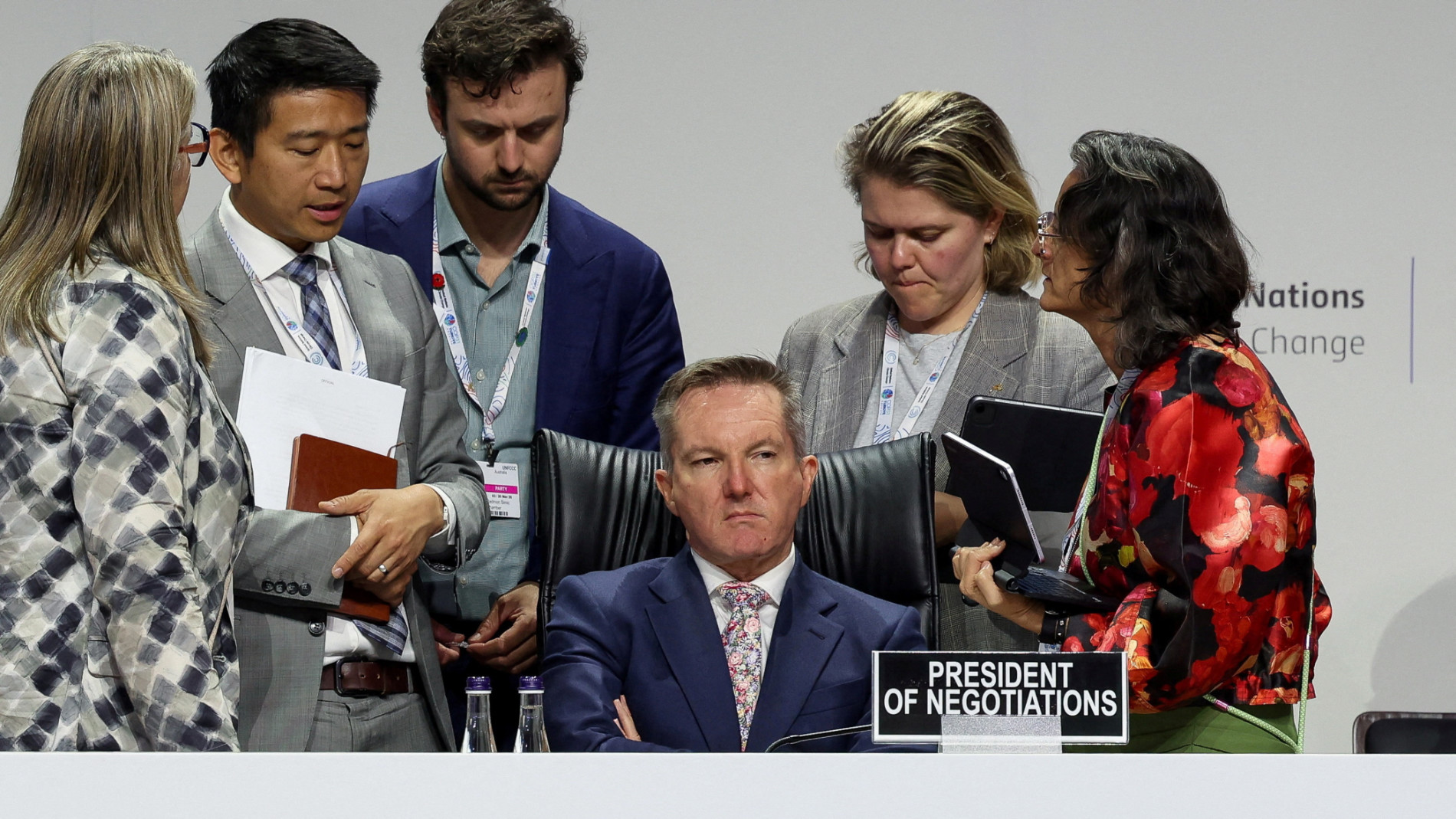
On Sunday, fraught global climate talks in Turkey, the longest ever in the climate conference’s history, ground to a halt, with no deal. The EU, UK and allies rejected the draft text over its failure to mention fossil fuels. At the closing plenary, Ireland’s Climate Minister Darragh O’Brien, on behalf of the EU, rejected the text, saying it “does not respond to the science, and that actually risks deepening the chasm between global commitments and the action required… that does not even mention fossil fuels”. His words were met with applause. But they rang hollow for developing countries, many of whom also rejected the text over its weak language on climate finance. After delivering his intervention, O’Brien and EU Climate Minister Wopke Hoekstra walked out of the plenary to hold a press huddle while developing nations were speaking about the need for climate finance. While the EU, UK and allies cited the omission of fossil fuels from the text as their main reason for rejecting it, climate justice campaigners reported that developed countries and EU officials had spent the duration of the talks blocking measures which would require them to make fresh finance commitments. New MEE newsletter: Jerusalem Dispatch Sign up to get the latest insights and analysis on Israel-Palestine, alongside Turkey Unpacked and other MEE newsletters “The EU used fossil fuels as the main reason for their rejection of the text. But the other issue, or what I would call the most important issue, is climate finance,” Harjeet Singh, strategic adviser to the Fossil Fuel Treaty Initiative and the global convenor of the Fill the Fund campaign, told Middle East Eye. “If you listened to what other countries said, like Panama, Ghana, the Marshall Islands, their reasons were no money for adaptation, no money for loss and damage.” Under the 2015 Paris Agreement, developed countries are required to provide finance to help developing countries cut emissions and adapt to climate impacts. According to the UN’s latest report, published earlier this month, developing countries will need about $300bn annually in adaptation funding by 2035. At Cop26 in 2021, developed countries agreed to at least double adaptation finance by 2025, with 2019 levels, $19bn, as a benchmark. Last year, they agreed to a call to “at least triple” adaptation finance by 2035. But the final text left ambiguities around the baseline year. An earlier draft of this year’s text, released on 16 November, stipulated a target annual figure of at least $120bn, with a baseline of $40bn a year. But the sums were quietly dropped from subsequent drafts. Climate justice campaigners laid the blame for this squarely at the doors of the EU and wealthier countries who they say "came with nothing" and thwarted progress on discussions around climate finance. During this year’s “Contributor Dialogue” at the conference, which aimed to fill the starved fund, a handful of developed countries pledged just $30m, significantly down from last year’s sum of $120m. “So we have a fund that no one wants to fill,” Singh said. Dead in the water Even before the summit had started, Hoekstra set the tone for negotiations by proclaiming climate finance “dead in the water”. “They entered negotiations with that bad faith and blocked every single track which is important for developing countries,” Singh told MEE. According to Climate Action Network, the EU and other developed countries refused to engage on a baseline for tripling adaptation finance. Cop31 draft agreement ‘the worst ever', campaigners warn Read More » “We agreed on the baseline, I was witness to that process in 2019,” Singh said. “So they just want to create new processes and new loops so that we can just continue talking.” Singh also pointed to what he described as the hypocrisy of the EU and wealthy countries’ stance on fossil fuel language in the draft text. "Norway and Ireland, who were arguing for the inclusion of fossil fuel language in the text, are back home expanding fossil fuel production,” he said. The EU’s own “roadmaps” for transitions away from fossil fuels have drawn criticism for restating existing policies that are not aligned with the 1.5 degree temperature goal. Brandon Wu, director of policy and campaigns at Action Aid USA, slammed the EU’s transition plans as a “smokescreen”. “They’re using the rhetoric around fossil fuels to make themselves look like champions," Wu told reporters. For Singh, a Cop veteran who has attended the last 18 conferences, the EU’s actions are tantamount to little more than “political theatre”. “Do your work. We need to move beyond these theatrics and take real action, rather than simply claiming leadership. Be a real leader. Provide the money. Take action at home in line with your fair share of the global effort,” he said. ‘Extremely disrespected’ Campaigners told Middle East Eye that the talks’ meltdown was also due in part to the weak and untransparent facilitation by the joint presidents, Australia and Turkey. “There was no stocktaking plenary where countries could share their opinion, where things could be dragged out in the open. When they said they would publish text, they didn’t do so,” Andreas Sieber, associate director of global policy at 350.org, told MEE. 'Norway and Ireland, who were arguing for the inclusion of fossil fuel language in the text, are back home expanding fossil fuel production' - Harjeet Singh, strategic adviser to the Fossil Fuel Treaty Initiative MEE understands that many developing countries felt they were left in the dark and not consulted while the text was being drafted. Cop presidents usually release printed versions of drafts for parties to review. But this year, only selected groups were shown excerpts, leaving many developing countries feeling “extremely disrespected and extremely badly treated,” one observer said. Hanen Keskes of Greenpeace Mena said that the process of revising the second draft of the Cop text was very unclear. “From what I've heard from parties, they had not been consulted,” Keskes told MEE. “It was very unclear what progress happened between the 19th and 22nd on other agenda items that were quite important. “When the new text came out on Saturday night, it was essentially the same text from the 19th. So clearly no consultation had been done.” The acrimony was summed up in a searing rebuke of the Cop presidency by Ghana’s Environment Minister Zanetor Agyeman-Rawlings, who was “rudely cut off” during her delivery by Murat Kurum, Cop31 president and Turkey's environment minister. “This excellency is an example of the levels of disrespect we have endured and continue to express our objection to. It absolutely does not respect multilateralism,” she said.
'Political theatre': Campaigners hit out at EU hypocrisy as Cop31 ends in chaos
Full Article
Original Source
Read the full article at Middleeasteye →KhanList aggregates and links to publicly available news content. We do not host full articles from third-party sources. Always verify important information with original sources.