
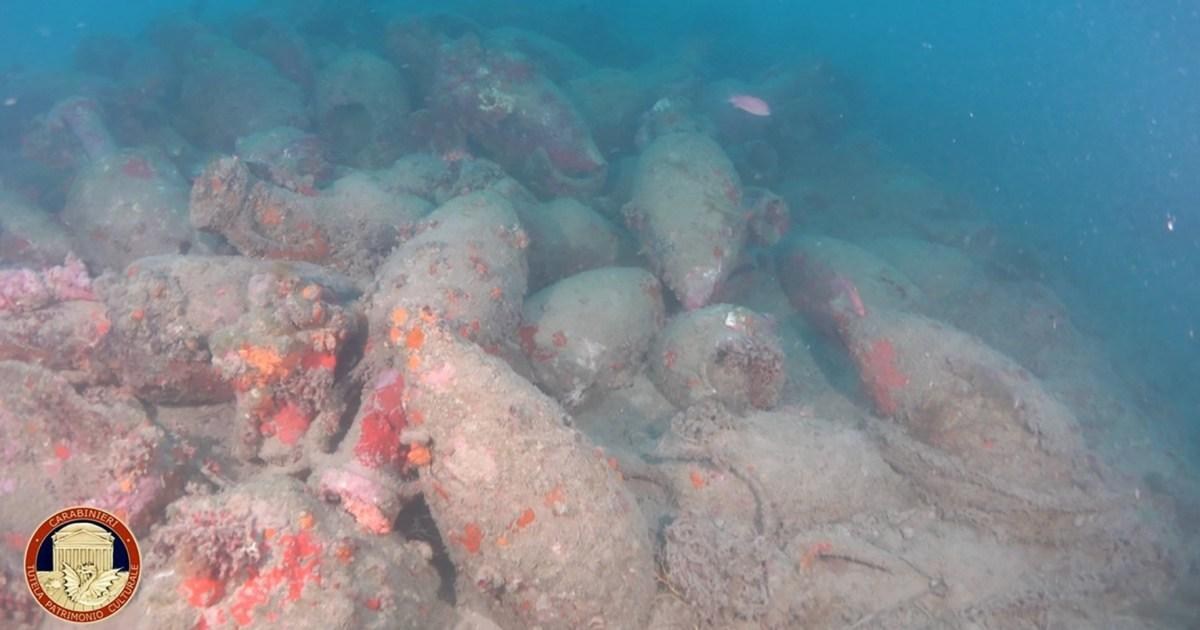
Police on routine dive make incredible 2000-year-old discovery Lizzie McAllister | Deputy News Editor Published October 4, 2026 1:18pm Updated October 4, 2026 1:18pm The items were found on the sea floor (Picture: Handout / Italian Carabinieri press office / AFP via Getty Images) Police officers on a routine diving expedition in Italy made a fascinating discovery dating back 2,000 years. A set of Roman artifacts were found off the coast of Porto Rotondo in Sardinia, an Italian island in the Mediterranean Sea, during an underwater safety operation by police based in nearby Olbia. They then noticed a piece of broken terracotta and later went back on a second dive, when they found a series of largely intact items. ‘Careful dredging action allowed the identification and subsequent recovery of three intact terra cotta artifacts, specifically a transport basin, along with other minor items,’ officials said. Sassari Police Headquarters then announced the find earlier this year. Images show police divers examining the seabed for more artefacts. Sign up for all of the latest stories Start your day informed with Metro's News Updates newsletter or get Breaking News alerts the moment it happens. One picture shows an intact amphora hidden in seagrass. These were used to transport the likes of wine, olive oil and grain. ‘From a preliminary analysis, it is hypothesised that the items may date back to a time frame between the second half of the first century BC and the first century AD, with a potential origin area that can be linked to Lazio, Campania or the Iberian Peninsula,’ officials said. Specialists will now examine the items to learn where they came from and precisely how old they are. Scientists are also hoping to learn whether they come from a larger archaeological site where there could be more artifacts. Earlier this year, Italian authorities said the shipwreck of a Roman merchant ship filled with amphorae had been found in the Ionian Sea during a routine maritime patrol in June 2025. It was dated to the late Imperial era, which spanned roughly 284 AD to 641 AD. Arrow MORE: London has a hidden Roman bath that isn’t actually Roman at all Arrow MORE: Newly discovered Bronze Age weapon may have been placed by a ‘cult’ Arrow MORE: The 5 best European islands to visit in October with flights from £75 News Updates Stay on top of the headlines with daily email updates.
Police on routine dive make incredible 2000-year-old discovery
Full Article
Original Source
Read the full article at Metro →KhanList aggregates and links to publicly available news content. We do not host full articles from third-party sources. Always verify important information with original sources.