
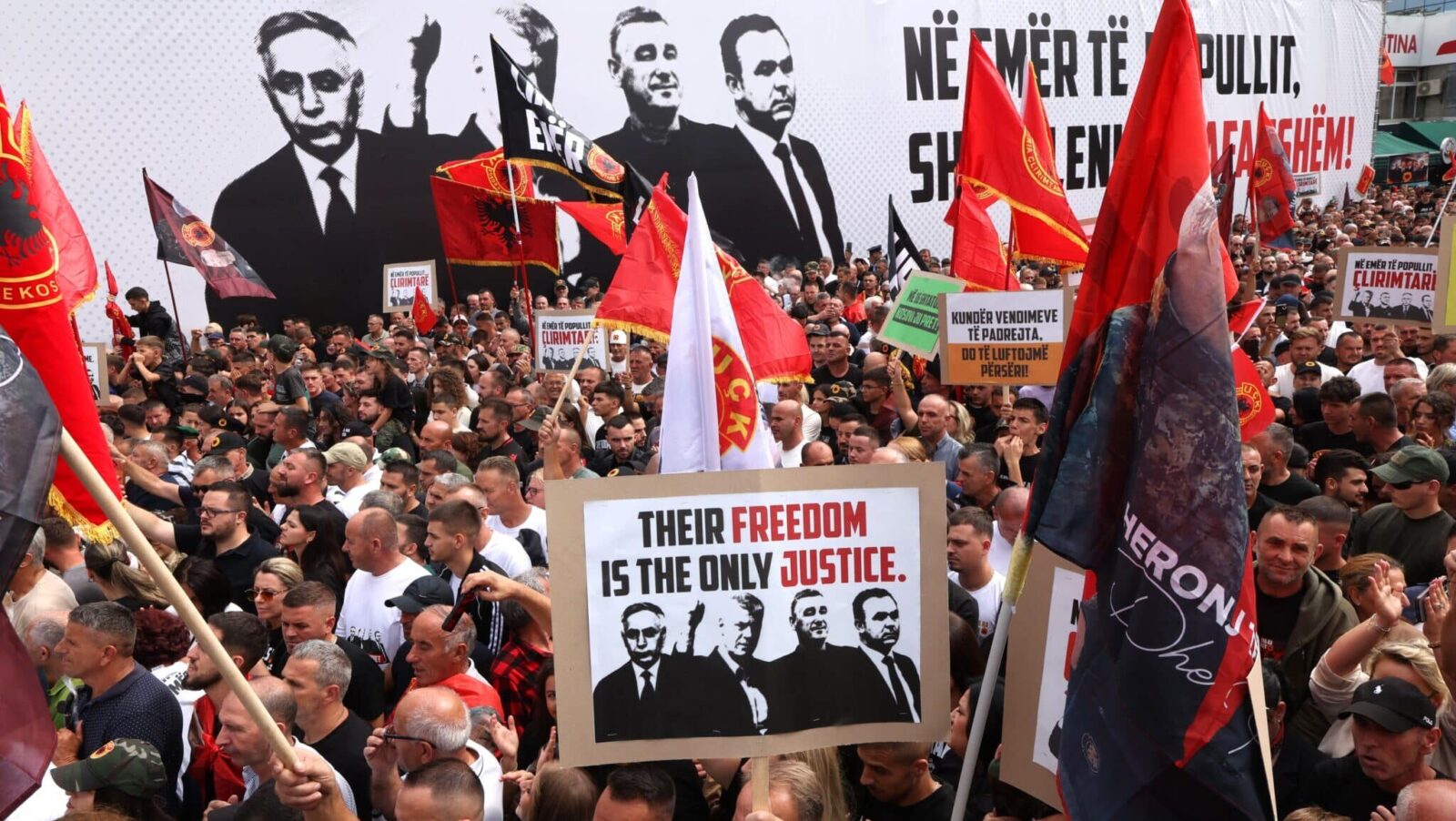
Supporters of Hashim Thaci and his co-defendants rally in Pristina, September 12, 2026. Photo: EPA/Georgi Licovski . Ethnic Albanians and supporters of the Kosovo Liberation Army, KLA, are expected to demonstrate in The Hague on Wednesday as Kosovo’s ex-President Hashim Thaci and three other former guerrilla fighters hear their war crimes verdict. The announcement of demonstrations and of numerous ethnic Albanians travelling to the Kosovo Specialist Chambers in The Hague for the verdict has prompted the court and Dutch police in The Hague to take special security measures. Prior to the verdict, several transitional justice NGOs from Kosovo and Serbia, which are part of the Specialist Chambers’ outreach forum, the Court Information Network, were notified that their scheduled meeting at the court had been cancelled for security reasons. Sofija Todorovic, director of the Belgrade-based Youth Initiative for Human Rights Serbia, told BIRN that NGOs that were part of the Court Information Network had a meeting planned when the verdict was to be announced in The Hague. “But we received information from the court that due to the announced demonstrations and the large number of people coming to The Hague for the verdict, basically the circumstances had changed and they could not guarantee that we will not be recognised by someone and will not face some sort of hostility, so they decided to cancel the meeting,” Todorovic said. Dusan Radakovic, from a North Mitrovica-based civil society organisation, Advocacy Centre for Democratic Culture, ACDC, told BIRN that “the decision to cancel the visit was primarily related to security concerns and the announced large-scale protests, as can also be inferred from the explanation provided in the email informing us about the cancellation. Particular concern was likely related to the protests expected outside the court following the anticipated decision. “As a lawyer, I considered it a valuable opportunity to directly observe the work of such an important institution at a time when it is dealing with a matter of considerable public significance,” Radakovic said. A Dutch police spokesperson in The Hague told BIRN: “We do not announce measures taken and we do not comment on threats in general. We know there will be demonstrations and we will be present in the location.” Angela Griep, the court’s spokesperson, told BIRN that the Kosovo Specialist Chambers was “undertaking all necessary security measures within its authority and responsibilities on 16 September, also taking into account the announced possible protests”. Thaci, together with former Kosovo parliament Speakers Kadri Veseli and Jakup Krasniqi, and former MP Rexhep Selimi, are accused of committing crimes against humanity – including murder, torture and illegal detention – during the Kosovo conflict in the late 1990s. They have been in detention in The Hague since November 2020 and have all pleaded not guilty. Prosecutors at the Kosovo Specialist Chambers have called for a 45-year prison sentence. Defence lawyers have urged acquittal. This is the highest-level case held at the so-called Kosovo Special Court and has been marred by delays and controversy. It has also been accompanied by protests staged by supporters of the defendants in Pristina, Tirana, Skopje, Strasbourg and The Hague. Many ethnic Albanians consider the court biased against the KLA’s war against repression by the Serbian authorities. The trial has been surrounded by accusations of fake news and hate speech, and has even led to witness intimidation charges and convictions. Radakovic told BIRN that, “although I can understand the security considerations that may have led to the cancellation of the visit, I believe that such a decision, particularly the way it was communicated, and if no further explanation is provided, may further increase mistrust among certain groups of citizens and reinforce perceptions of insufficient transparency on the part of the court”. Todorovic told BIRN that the cancellation of the NGOs’ visit was “not in general a good message”. While she understood the importance of security measures, especially for the protection of witnesses, she said this level of security measures for the monitoring of civil society organisations was problematic. “The monitoring visit does not affect the outcome of the verdict whatsoever, it just is part of a dialogue that should be ongoing in general with the people that work on these topics [of transitional justice] and the work of the court reflects the work of dealing with the past that we have on the ground,” she said. She added that the cancellation “decreases the trust in the overall impact of the work of the court. That is the big issue and it fuels this feeling of uncertainty among many people who are waiting to see the output of the work of the court while waiting for the verdict.” Rallies have been announced across Kosovo, with family members and supporters announcing they will be waiting for the verdict at Pristina’s main square starting from Tuesday evening. The US embassy in Pristina issued a demonstration alert for Wednesday, warning that “these demonstrations may cause large crowds, road closures and severe traffic disruptions. It is advised to limit travel to the immediate area of your residence and to avoid travel to your workplace and schools if your route passes through impacted areas, as you may not be able to complete the journey in a timely manner.” On September 12, thousands of supporters of the defendants also marched through Kosovo’s capital, Pristina. Prosecutors accuse the four men of individual and command responsibility for crimes committed against prisoners held at KLA detention facilities in Kosovo and in neighbouring Albania. Those include more than one hundred murders. The charges cover the period during and just after the Kosovo war in 1998 and 1999. The Kosovo Specialist Chambers was created specifically to try former members of the KLA. As prime minister in 2014, Thaci signed the agreement with the European Union to establish the court. It is based in The Hague and staffed by international judges and prosecutors due to doubts about the Kosovo justice system’s ability to try former KLA fighters. Veterans are widely viewed as heroes in Kosovo and the potential for witness intimidation was a serious concern. During the trial, the prosecution argued that the defendants’ senior roles in the KLA meant they were responsible for subordinates who committed crimes. The defence insisted that the KLA did not have a proper army command structure, so the defendants did not have real authority over lower-ranking fighters.
Police in The Hague Brace for Rallies Ahead of Kosovo Trial Verdict
Full Article
Original Source
Read the full article at Balkaninsight →KhanList aggregates and links to publicly available news content. We do not host full articles from third-party sources. Always verify important information with original sources.